By Cassandra Stafford, SLP, ATP (speech-language pathologist and assistive technology professional); NWACS Board Member
reading time: 2 minutes
The views expressed in this post are those of the author and do not necessarily reflect the views and policies of NWACS. No endorsement by NWACS is implied regarding any device, manufacturer, resource, or strategy mentioned.
Let’s dive into a quick overview of a book featuring AAC:
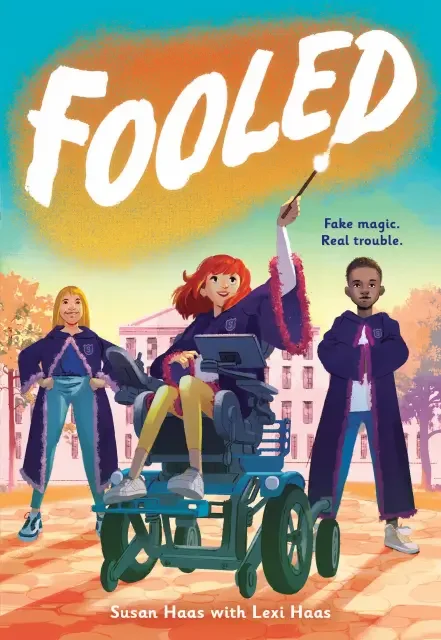
Book Title: Fooled
Authors: Susan Haas and Lexi Haas (a mother and daughter writing team; Lexi has cerebral palsy and uses AAC)
Published in 2025
Age Range: middle-grade fiction
How AAC is Featured: The main character, Lily (“Lil”) has cerebral palsy and is a part-time AAC user. She has had her speech-generating device for less than a year. She is still learning (reluctantly) the benefits of using it to support her communication. Another character has limited spoken language.
Note: I am not an AAC user, nor am I a parent/guardian or caregiver of an AAC user. I am a speech-language pathologist. So I am coming at the book from this perspective. I read this book through my local library using the Libby app.
We meet Lil at the beginning of her 6th-grade year. It’s her first year in middle school. As you would expect, it is full of middle-school drama and intrigue. Lil has been in a self-contained special education classroom since Kindergarten. While it made sense back when she was 5, it is clearly not the correct placement for her now. But change is hard, and Lil does not want to leave her best friend and fellow classmate. Between the limitations of her school placement and the treatment from the school at large (including some adults), Lil and her classmates use joy as a form of resistance. They lean into their love of magic and the wizarding world.
What started out as a group leisure project to cultivate joy for themselves (and also as a dream of protection), turns into something bigger than they ever imagined. Which, of course, adds to the drama in their lives.
This is a fun story with four disabled kids (plus a non-disabled peer) as the protagonists. It touches on themes including ableism, discrimination disguised as “protection”, education for disabled students, inclusion, bullying, and peer support. It illustrates the power of supporting one another. It highlights the magic of
seeing people beneath the surface,
courage and confidence,
connection and community,
hope and joy.
This book is a great jumping off point for discussions on several topics. To facilitate going deeper, the authors’ included discussion questions (and activity suggestions) at the end of the book.
Have you read this book? What did you think of it?

