by Morgan Scherer; NWACS Board Member
reading time: 7 minutes
The views expressed in this post are those of the author and do not necessarily reflect the views and policies of NWACS. No endorsement by NWACS is implied regarding any device, manufacturer, resource, or strategy mentioned.
The NWACS Theme for 2026
In the recent blog post, 2026 NWACS Theme: Joy and Connection, NWACS announced our guiding theme for this year: Joy and Connection in AAC.
Why ‘Joy and Connection in AAC’?
2025 was an incredibly tough year for disabled people. As NWACS was starting the discussion around our educational focus for the coming year, I felt deeply conflicted. I wanted to be excited about the coming New Year, celebrate the wins of the past, and learn from the mistakes. I especially wanted to make optimistic plans and dream big for the future. Yet, it is likely that the same things that were devastating in 2025 will continue throughout 2026. They will likely even increase in intensity and scope. NWACS serves the disability community, so it felt important for our focus for the year to acknowledge the current and upcoming difficulties, and provide some support.
It has been a year of watching rhetoric (attention-getting talk) and policy change target vulnerable groups of people who just want to live their lives. As new policies have been put into place, we have started to see some of the expected and damaging results landing on already disadvantaged and struggling disabled adults, families, and children. These are real impacts that directly decrease our
quality of life,
autonomy,
dignity,
and even lifespan.
I had planned to list out 20 of the most negatively impactful cuts and policy changes. However, the avalanche of terrible news might make you stop reading before we get to the point I am trying to make. That JOY is one of the most powerful tools in our toolbelt to start counteracting this overwhelming flood of negative impacts.
I can’t help but mention Medicaid and research though.
Cuts to Medicaid
Shifting of costs onto states
Cuts to research and nonprofit funding
All contribute to a decline in critical community- and home-based services that make well-being possible for disabled people and families. They also cause deep uncertainty about the future, which contributes to health impacts. If you would like to read more about this and other impacts, here are some good articles to start with:
Project 2025: A Potential Reshaping of Disability Rights In America
Budget Reconciliation Issue Brief: Impact on People with Disabilities
My own immediate family has experienced several harmful impacts from policy decisions in the past year. I am physically disabled, autistic/ADHD/PDA, an AAC user, and have severe chronic illness. My whole family is wildly neurodivergent. My adult son has chronic illness. My wife, who makes most of the money in the family as a nonprofit accounting consultant and Internal Family Systems practitioner, deals with mild Long Covid. And my youngest child is a part-time AAC user. We have experienced:
loss of income due to the broad based loss of nonprofit grants;
additional loss of income as individual clients faced loss of food stamps;
loss of some of our own needed benefits;
spiraling health maintenance costs, often due to tariffs;
unsustainably large increases in our food budget;
and health insurance premiums that are more than doubling to over $2200 per month for 2026.
We are financially in the hole by hundreds of dollars or more, every single month. We approach our circumstances with unflagging creativity in problem-solving, attracting clients, and alternate income streams, but are still not breaking even.
The Importance of JOY
So, how could any of this possibly relate to joy? I don’t feel joy when I write this. Or when I’m at the grocery store paying too much for food for my family. Or when I listen to influential people say that people like me, my child, and people I know and love, are tragedies that should never be born. Instead, I feel stripped of my humanity. I feel disregarded, and my existence reduced to only the monetary cost vs productivity to society.
dehumanization: the act of denying full humanity in others, and the harm and suffering that go with it
Until… I go home to my family, and play sweet, connecting AAC games with my child. Until I ride my electric trike to a disabled friend’s house to support them through a hard time. Until I read about the multitude of ways disabled people are
finding meaning,
developing community,
learning and growing,
and yes, finding joy.
Until my autistic, intensely detail-oriented eyes notice a tiny hairy woodpecker in the nearby trees. In those moments, it becomes apparent how joy is a fundamental antidote to dehumanization, as well as a required ingredient for hope.
Dehumanization creates shame. It causes us to make ourselves smaller. To cover up and snuff out the parts of us that are unacceptable to others. The way I (want to) jump up and down and flap my arms when I’m happy. The way I (need to) use my AAC when I have something emotional to say. They way I (am bursting to) ask “why did you do it that way?”, without judgement and out of real curiosity.
However, joy and shame cannot both live in the same person at the same moment. The best part is that once you give in to the joy of expressing your real self, it creates more joy. Each time I *actually do* jump up and down “inappropriately” when I’m happy, it creates more happiness. It pushes back the dehumanization and shame, making it smaller and less powerful. Each time I use my AAC in public and it goes well. Each time I witness my child unabashedly
asking questions,
lining up their toys,
and communicating with gestures and other AAC instead of mouth words,
I experience deep joy and connection. It centers me, and allows hope to kindle and burn.
Dehumanization, shame, and hopelessness tend to make us more passive and pliant. In contrast, joy, connection, and hope tend to make us more
visible,
powerful,
communicative,
and strong.
With joy we can resist. With joy we can create. With joy we can survive, and even thrive.
Leaning into joy isn’t always easy. From the perspective of shame, leaning into joy feels incredibly vulnerable. And realistically, being who we are in public isn’t always safe. Disabled people are impacted by interpersonal violence at much higher rates than non-disabled people. Some portion of that is because we interact and respond differently, and people at times react with violence. However, shame encourages us to believe that *who we are* is dangerous. That the solution is to cut off access to our authentic ways of being, even in private, even to ourselves.
When we cultivate joy, we learn that we are not the problem. That who we are and how we naturally exist in the world is ok. We learn that we are valuable for who we are, as we are. Joy cultivates internal strength. It carves out a small place for freedom, even when the world seems to not care if we live or die.
I am not saying that every aspect of being disabled is joyful. There are times I am deeply frustrated by my inability to physically move when I am frozen in place by executive dysfunction. When my high pain level makes playing with or caring for my child feel impossible. When I can’t get out of bed for weeks or months, and my spouse shoulders the entire load of the household as well as caring for me. When I miss my child’s milestones, and realize I don’t know anymore what their favorite color is because I haven’t been well enough to spend much time with them. Like many disabled people, my life is complex and often objectively and emotionally difficult.
In those particularly rough times, my tendency is to shut down and retreat. I have learned that leaning into joy is the fundamental thing that keeps me going. Looking out my window at the birds, or even listening to their distant singing when my eyes hurt too much to open, gives me enough joy to be able to be present in the moment. Instead of just getting through it. Saying an enthusiastic “yes!” to my child when they knock on my door and want to interact is deeply worth it. Even if I am in too much pain and too sick to interact for long.
Mission: JOY
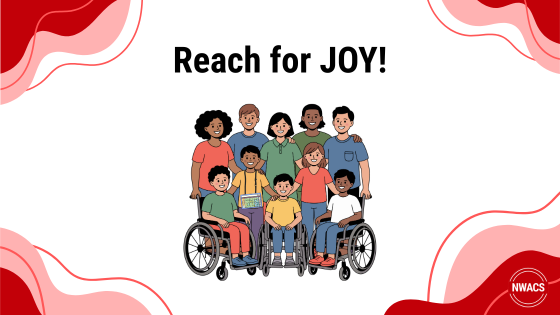
So this is my hope and challenge for all of us, through whatever is thrown our way in the coming year: Reach for joy. Say yes to connection. Lean into the parts of you that are “not allowed”. Joyously support your friends, family, and community members for daring to proudly show up as their unmasked selves. This is how we resist dehumanization. This is how we build strength and support for ourselves and our communities. Reach for JOY!
NWACS will be right there with you. Through our focus for the year, we will be
reaching for joy,
publishing articles about joy, connection, and AAC,
offering educational opportunities about joy, connection, and AAC,
and helping us all build our internal resilience and strength.
And helping us all create lasting change in the coming year.
Let’s get started! Leave a comment and share a time you have leaned into joy, particularly around disability or AAC.
