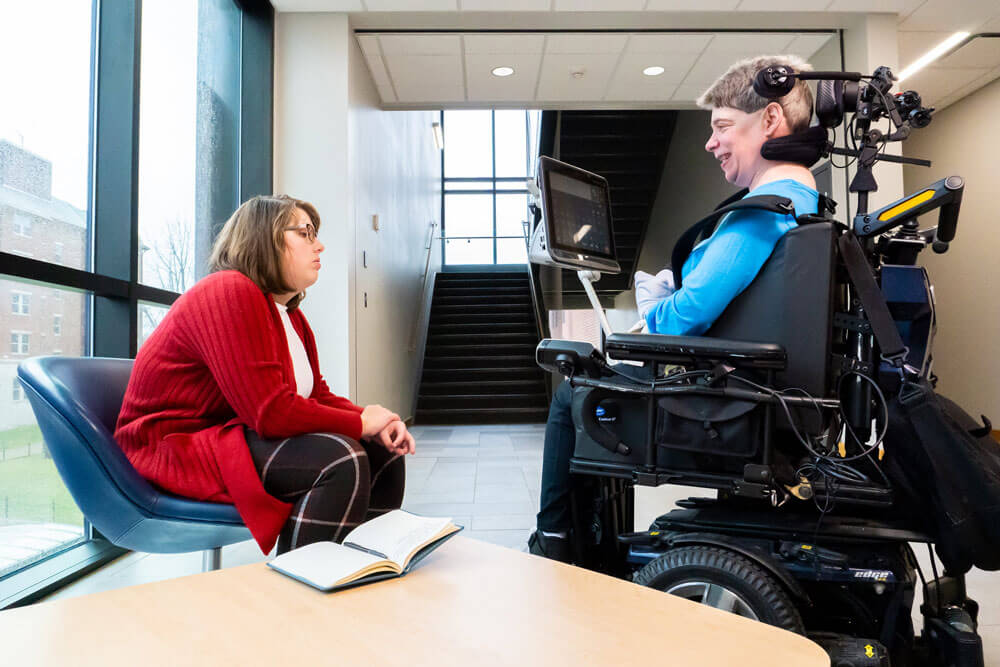
“adult person in blue shirt using wheelchair with AAC device talking with young student in a red sweater near a stairwell on campus” by UK Human Development Institute (public domain) is licensed under CC by 3.0
This is a collection of information and resources related to supporting augmentative and alternative communication (AAC) with adults with developmental disabilities.
This is not an exhaustive list. Do you have a favorite resource or strategy that we missed? Leave a comment to share!
Explore key issues related to this topic. Jump to:
- What are developmental disabilities?
- What does supporting communication look like for adults with intellectual and/or developmental disabilities?
- Key Goals
- What AAC Looks Like
- Helpful Implementation Strategies
Explore relevant resources. Jump to Resources
Jump to Useful Tips
Jump to Selected References
What are developmental disabilities?
Intellectual and/or Developmental Disabilities (IDD) is a term that covers many disabilities, such as (among others):
- ADHD
- Angelman syndrome
- autism
- cerebral palsy
- developmental disability
- Down syndrome
- fetal alcohol syndrome
- intellectual disability
- Prader-Willi syndrome
- Rett syndrome
- Williams syndrome
Developmental disability is a lifelong disability that is evident before the person turns 22. Intellectual disability starts any time before a child turns 18. Often the disability is present at birth. IDD affects the course of the person’s physical and/or mental development. IDD limits the person’s ability to function in three or more of the following areas of major life activity:
- self-care
- receptive and expressive language
- learning
- mobility
- self-direction
- capacity for independent living
- economic self-sufficiency
What does supporting communication look like for adults with intellectual and/or developmental disabilities?
When we think of quality of life, we are thinking about psychosocial competence. One’s ability to maintain a state of well-being. To deal effectively with the demands and challenges of everyday life. Going deeper, it is life skills that enable us to manage everyday demands and challenges.
The World Health Organization (WHO, 1994) identified a core set of skills that promote well-being:
- decision making
- problem solving
- creative thinking
- critical thinking
- effective communication (which includes literacy!)
- interpersonal relationship skills
- self-awareness
- empathy
- coping with emotions
- coping with stress
These are life skills. Skills in each of these areas provide a foundation for psychosocial competence. These life skills enhance the quality of one’s life. These are universally needed and/or desirable to be a full participant in everyday life.
When we look even deeper, we realize that ALL the communicative competencies are needed to develop these life skills:
- linguistic competence – receptive language (including text-based), expressive language (including text-based), vocabulary, grammar, morphology, etc.
- operational competence – skills needed to use the AAC system, including navigation and adjusting volume
- social competence – skills that support making and keeping relationships
- strategic competence – skills to fix communication issues and increase communication effectiveness
- psychosocial competence – motivation, attitude, confidence, resilience, etc.
- emotional competence – being able to identify, respond to, and manage own emotions as well as the emotions of others
All the communicative competencies support well-being and quality of life.
People with IDD reach adulthood with a range of communication skills. Their communication abilities may be emerging. Or they may be able to communicate independently. Some adults with IDD do not have a reliable way of communicating using symbolic language. They may have developed unique, unconventional ways of communicating. Other adults with IDD use symbolic language to communicate anything to anyone in any situation. They may even be able to read and spell.
What does supporting communication look like for this age group? It looks like meeting the person where they are at and helping them build on their strengths. It looks like continuing to support their development of language, literacy, communication, and other life skills. It looks like supporting the goals they have for themselves.
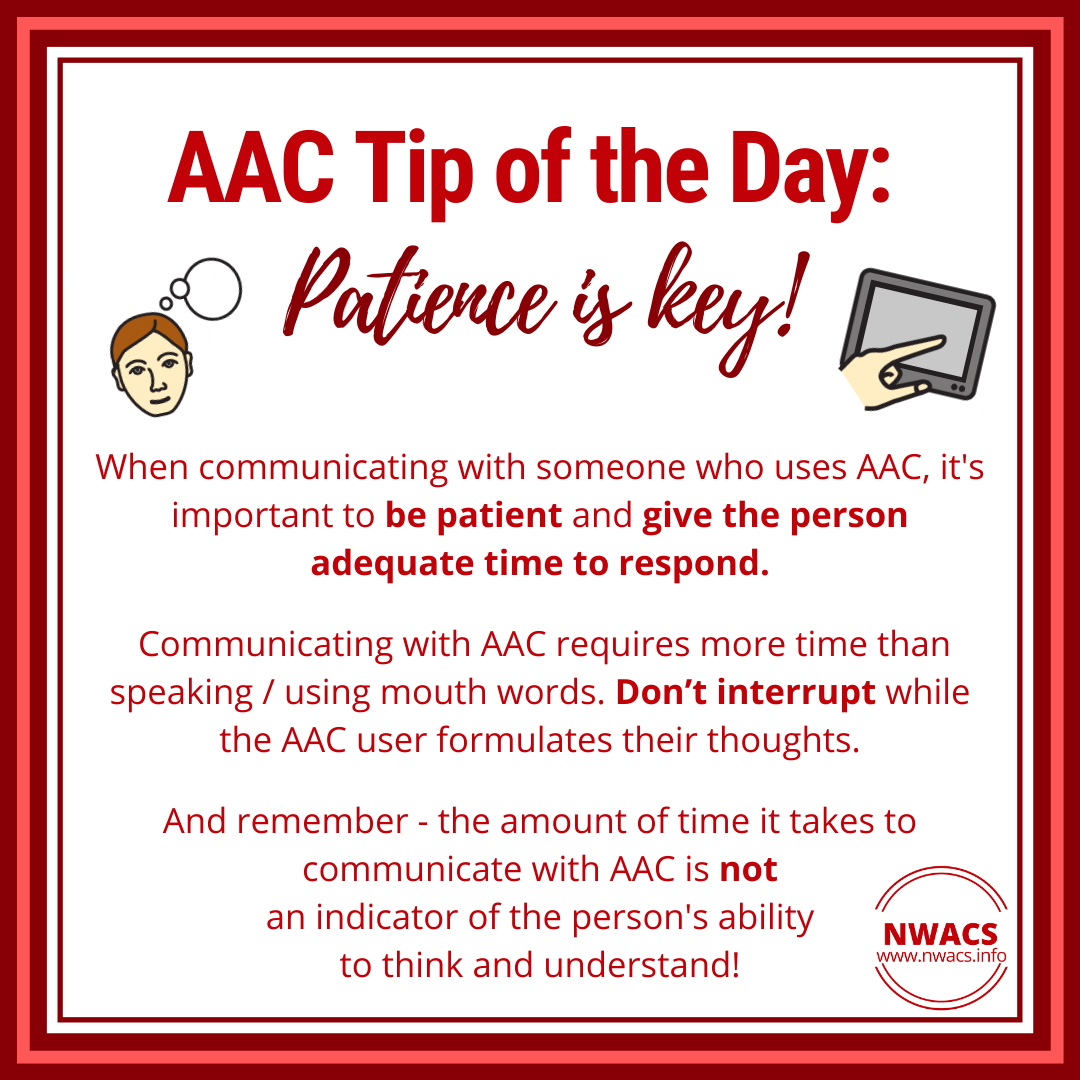
Wait and be patient!
“Most important is: be patient! And not interrupt while they are still using AAC device to say something. Talking with AAC device is always more slow than mouth talking. Even the best AAC user with the best AAC device will still need more time and patience than mouth talkers.
Many times AAC devices do not have exactly the right word a person needs. May need to look for a longer time to try finding a suitable replacement word. For example when C. wanted to talk about a specific kind of place but didn’t have the right word, C. said “death park”. With a little bit of thought the person understood that C. was trying to say Cemetery!
A person’s way of using an AAC device, and how fast or slow a person is, have not much to say about a person’s ability to think and understand.
Really is so important to keep waiting with patience!”
C., AAC User
Read more about providing AAC users opportunities to take turns in conversations and discussions: The Right to Express Preferences and Feelings, Make Comments, and Share Opinions (Right #9)
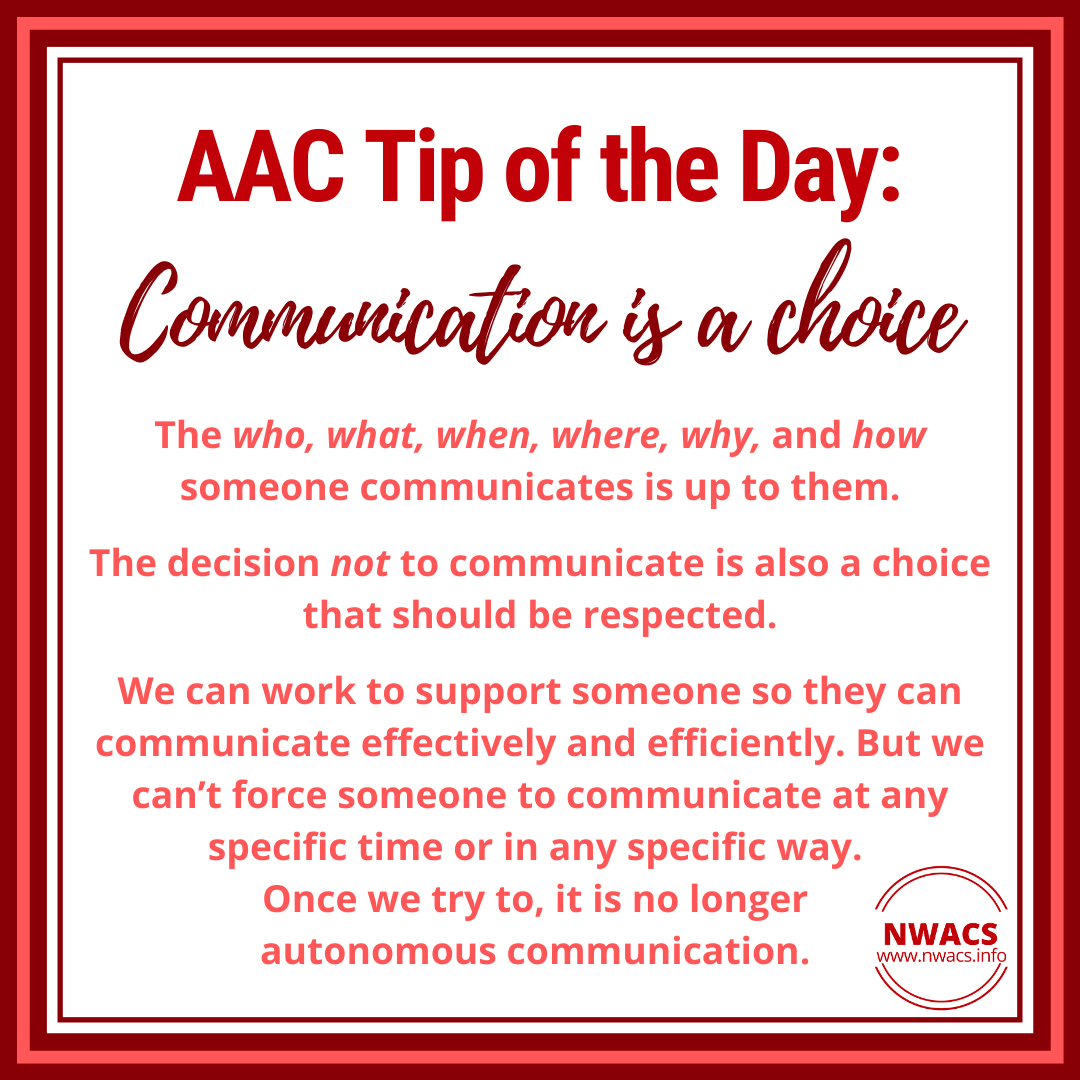
Be a good communication partner.
“I feel the key to good communication is having skilled communication partners.”
Beth Moulam, AAC User
An important part of supporting communication for this age group is by learning how to be a good communication partner. Good communication partners do the following:
- ensure access
- presume competence (making connections)
- accept all forms of communication
- pause and wait
- listen actively
- clarify and confirm
- be respectful
- model and coach
Read more about being a good communication partner: The Right to Participate Across Settings as Full Communication Partners (Right #5)
Continue Working on Communication Skills
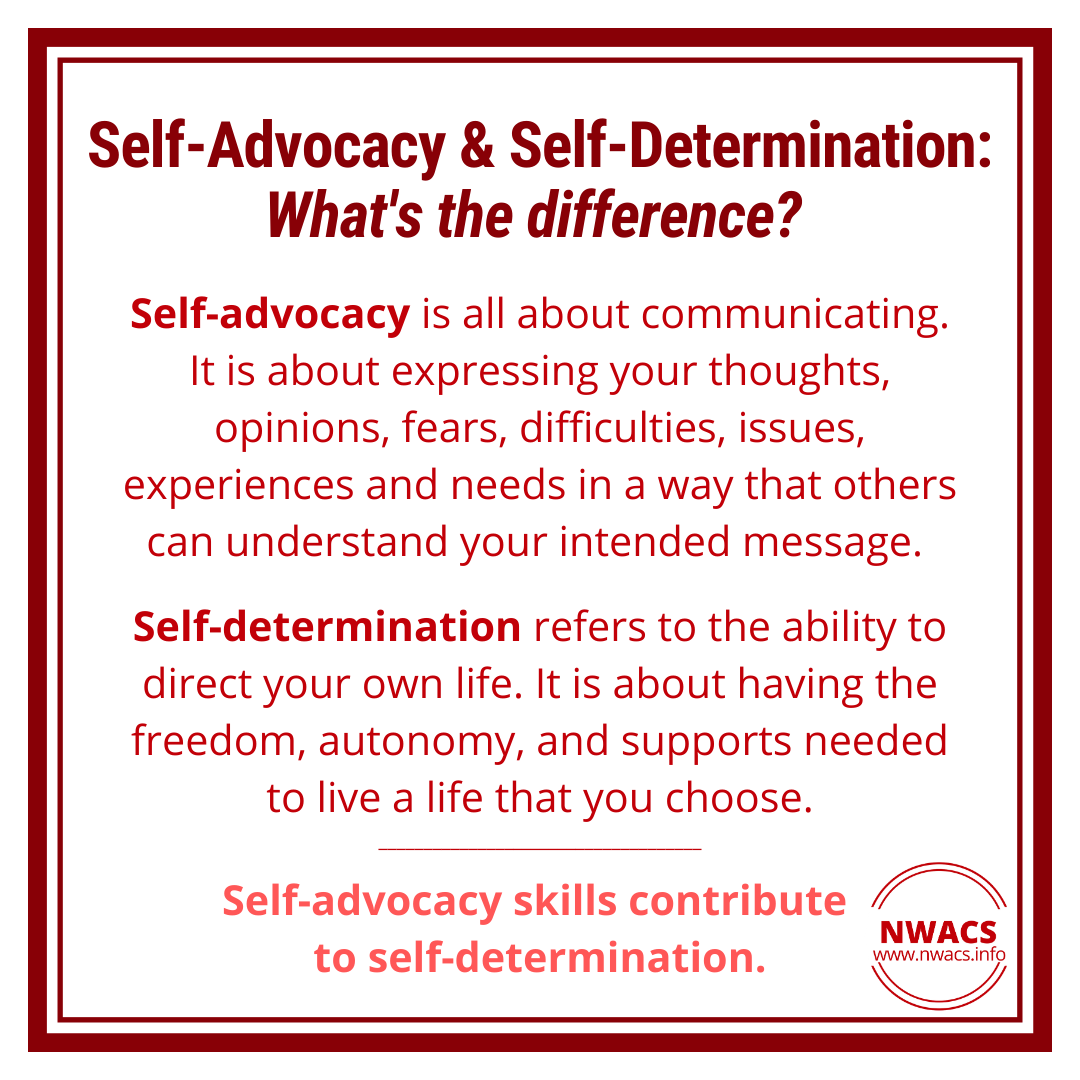
It is important to continue developing communicative competence. To be a full participant in daily life, to self-advocate, and to have self-determination, a person must have autonomous communication! Human beings have the capacity to learn even in adulthood.
It bears repeating. Many, if not most, agencies and organizations that provide job help to disabled adults look for the disabled person to have strong independent communication skills. Even many adult day programs need the people attending their program to be able to communicate without caregiver help. This is unfortunate. Many disabled adults who can successfully (and autonomously) communicate using partner-assisted methods, may not have the physical capacity for completely independent communication.
Age-related changes.
“We have largely achieved the goals of integration in terms of where the disabled live. But we have fallen short of those goals in terms of how they live.”
Samuel Bagenstos
2015
As people with IDD become adults, there are new age-related issues that influence communication and AAC use, as well as quality of life.
- Often young adults age out of the school system without an AAC system they own, leaving them without an AAC system as an adult.
- There are still many adults that have no or limited history of AAC use, which means they have developed a lifetime’s worth of behaviors and unique signals that serve as their primary means of communication. They may have also developed learned passivity and lack of interest in using AAC based on their life experiences.
- If the adult does have an AAC system, often there is limited appropriate vocabulary available to them.
- Some adults with IDD are emerging communicators. Emerging communicators of any age can be tricky! Some seem to show little response to or interest in interacting with others. Most communication partners are not taught how to engage older emerging communicators.
- The majority of communication partners in adult settings have a lack of AAC knowledge and training. So if the adult relies on a communication partner to assist with their communication, communication gets abandoned.
- There is a huge lack of SLP, PT, OT support in adult day or residential programs. Many adults go YEARS without appropriate support of communication tools.
- Available SLPs, OTs, PTs often lack AAC expertise, which often means no focus on AAC.
- Adults with IDD will age and likely face health care issues – both their own and related to their aging parents. Aging means potential need for modifications to AAC systems and/or new AT equipment or interventions to accommodate new developing issues (e.g., arthritis, vision issues, hearing loss, cognitive changes, etc.).
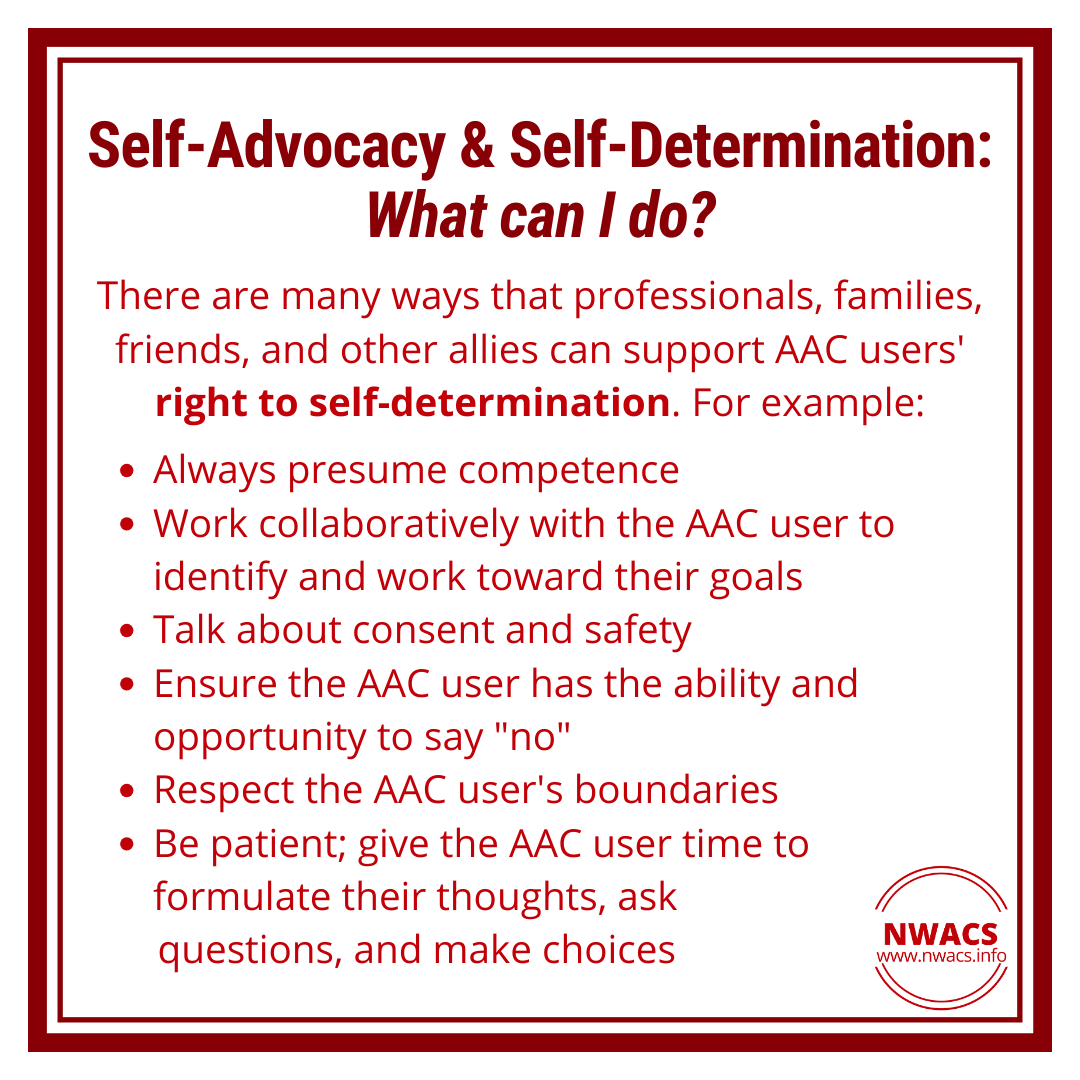
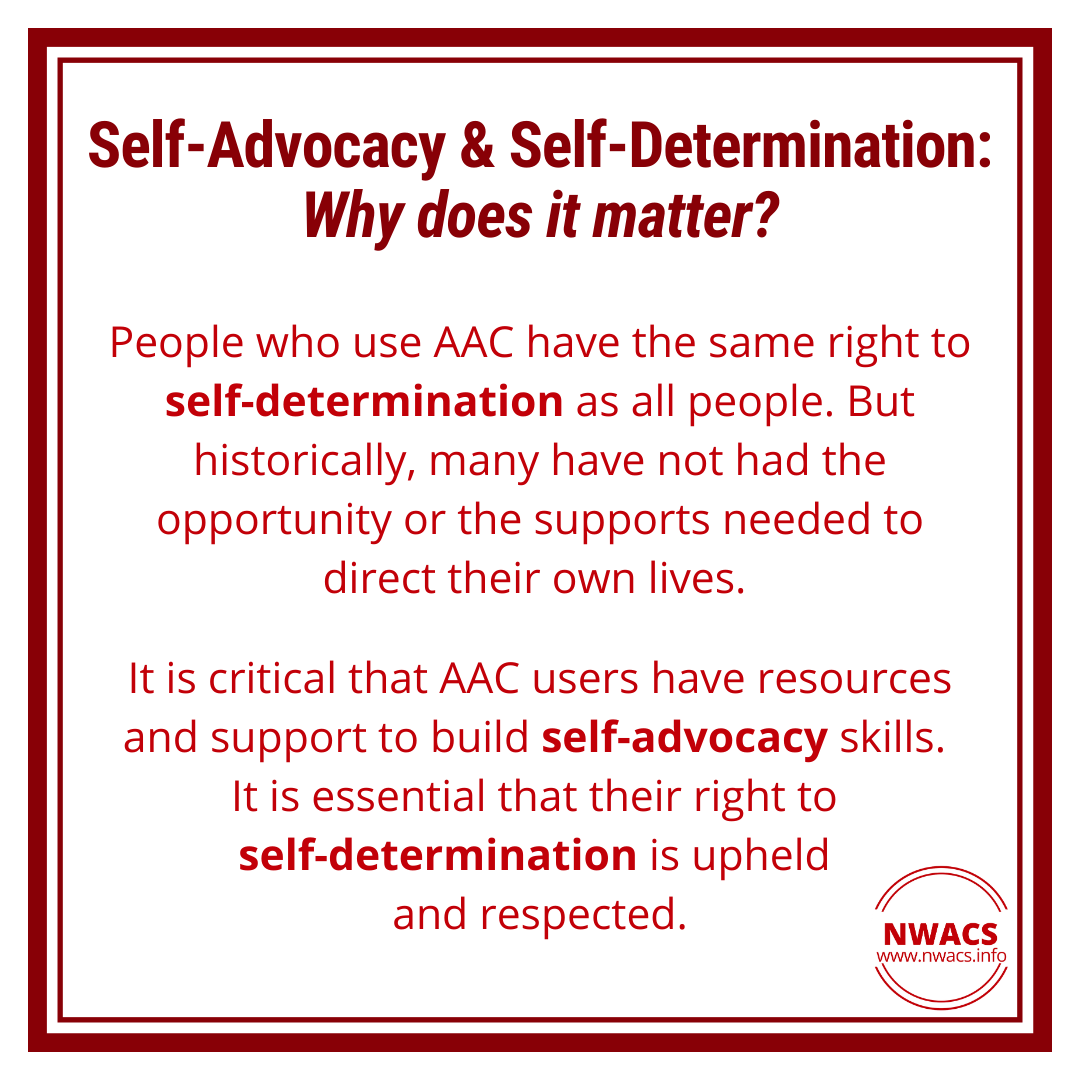
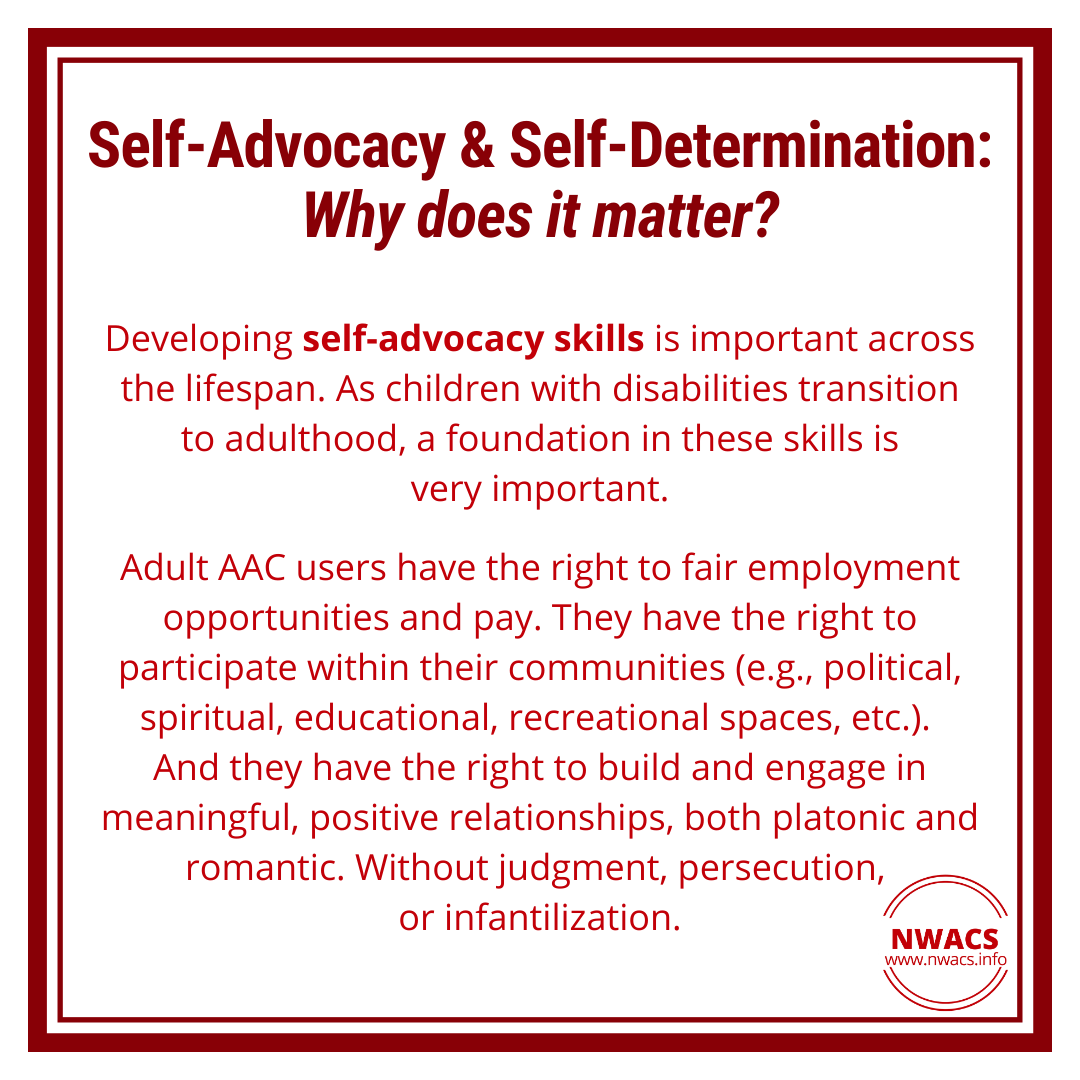
- Adult AAC users have the right to fair employment opportunities. They have the right to participate within their communities (political, spiritual, education, recreational spaces, etc.). And they have the right to build and engage in meaningful, positive relationships, both platonic and romantic. Without judgement, persecution, or infantilization.
Key Goals
- the person’s goals
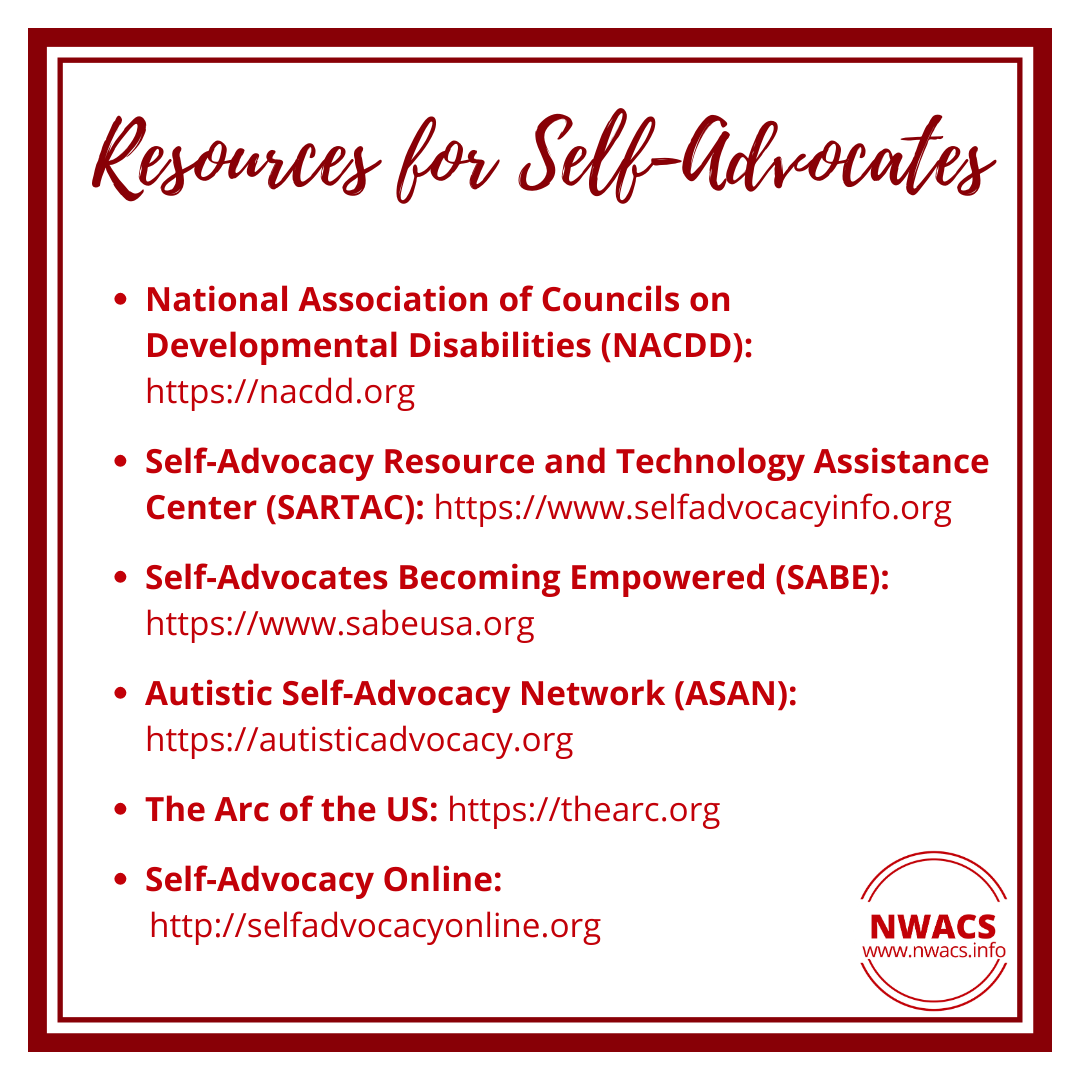
- self-advocacy
- self-determination
- communicative competence
- literacy skills
- work and leisure activities
- developing, maintaining, and sustaining social networks
- supportive and effective communication partners
What AAC Looks Like
- multimodal (also see this blog post for more information about multimodal communication)
- allows them to fully communicate about anything in all environments with all people they encounter
- matches the access needs and other features needed by the adult
“I am a human being, not a human doing, not a human island. I am interdependent. So I need help with some things, OK maybe a lot of things. Also, I am helpful and worthwhile to others in some other things, because that is the real meaning of life.”
Elizabeth (Ibby) Grace
from the blog post ‘I Am Not Independent.‘
Helpful Implementation Strategies
- ask the AAC user how you can be a good communication partner
- provide enough wait time
- be flexible
- ensure AAC options are always available
- accept all forms of communication
- presume potential/competence
- communication is more about social closeness (building and maintaining relationships)
- support conversation skills and strategies
- adults need language and skills related to
- physical, mental, emotional, sexual health (including sex education)
- boundaries, consent, healthy relationships
- medical, disability, care needs
- safety, abuse, rights
- learning never stops!
- use supports and strategies based on the communicator’s strengths, needs, likes, and interests; implementation strategies such as those mentioned on our AAC in School-Age resource page may still be useful
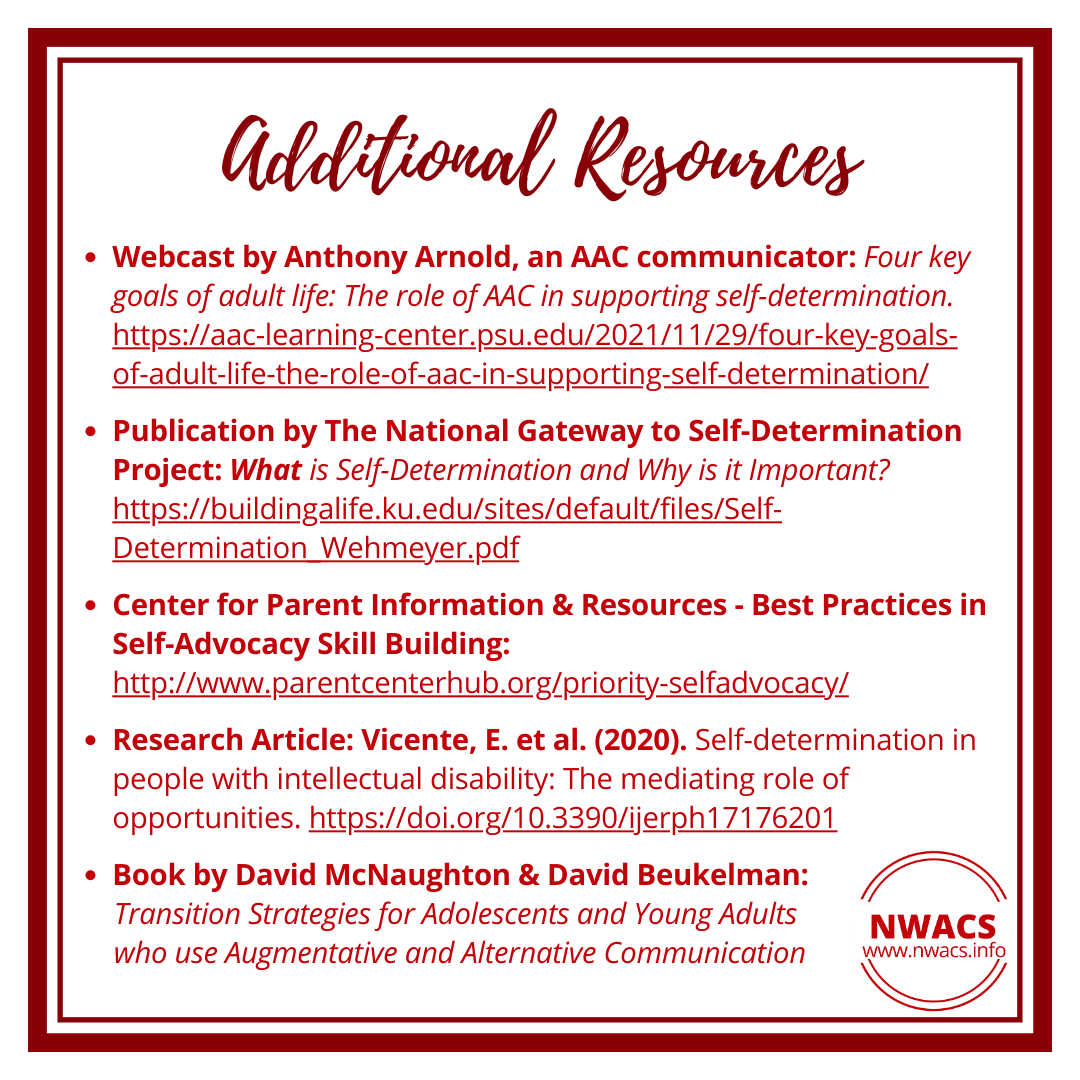
Resources to Explore
Articles, Books, and Documents
- AAC for All: Culturally and Linguistically Responsive Practice (2022) by Mollie Mindel and Jeeva John
- Augmentative and Alternative Communication: Challenges and Solutions (2021), Billy Ogletree
- Chapter 9: Challenges in Providing AAC Intervention to People With Profound Intellectual and Multiple Disabilties by Jeff Sigafoos, Laura Roche, and Kathleen Tait
- Augmentative and Alternative Communication: Engagement and Participation (2017) by Erna Alant
- Fundamentals of AAC: A Case-Based Approach to Enhancing Communication (2023), Nerissa Hall, Jenifer Juengling-Sudkamp, Michelle L. Gutmann, and Ellen R. Cohn (eds)
- Supported decision-making when you cannot speak, AssistiveWare blog
- The Right to the Accommodation of Time, NWACS
Websites
- NWACS website
- TalkingMats: “A Talking Mat is a visual communication framework which supports people with communication difficulties to express their feelings and views.”
- Washington State Division of Vocational Rehabilitation (DVR)
Webinar Recordings
- AAC in the Cloud presentation recordings
- AAC and Self-Determination – Autonomy and Safety in Home/Community-based Services by Courtney Johnson (2023)
- AAC in the Workplace by D. Burrow (2019)
- Powerful Insights from Adult AAC Users That Challenge How We Practice AAC by Amanda Hartmann (2019)
- Symbols, Multimodal Communication and Screen Readers – Adapting AAC and Reading and Cognitive Support Needs in Adults by Saoirse Tilton (2021)
- Taking My AAC Into Adulthood by Cristian Rosas (2021)
- UCF AAC Collaborative webinar recordings
Other Resources
- OCALI Assistive Technology Internet Modules – AT for Adult Life
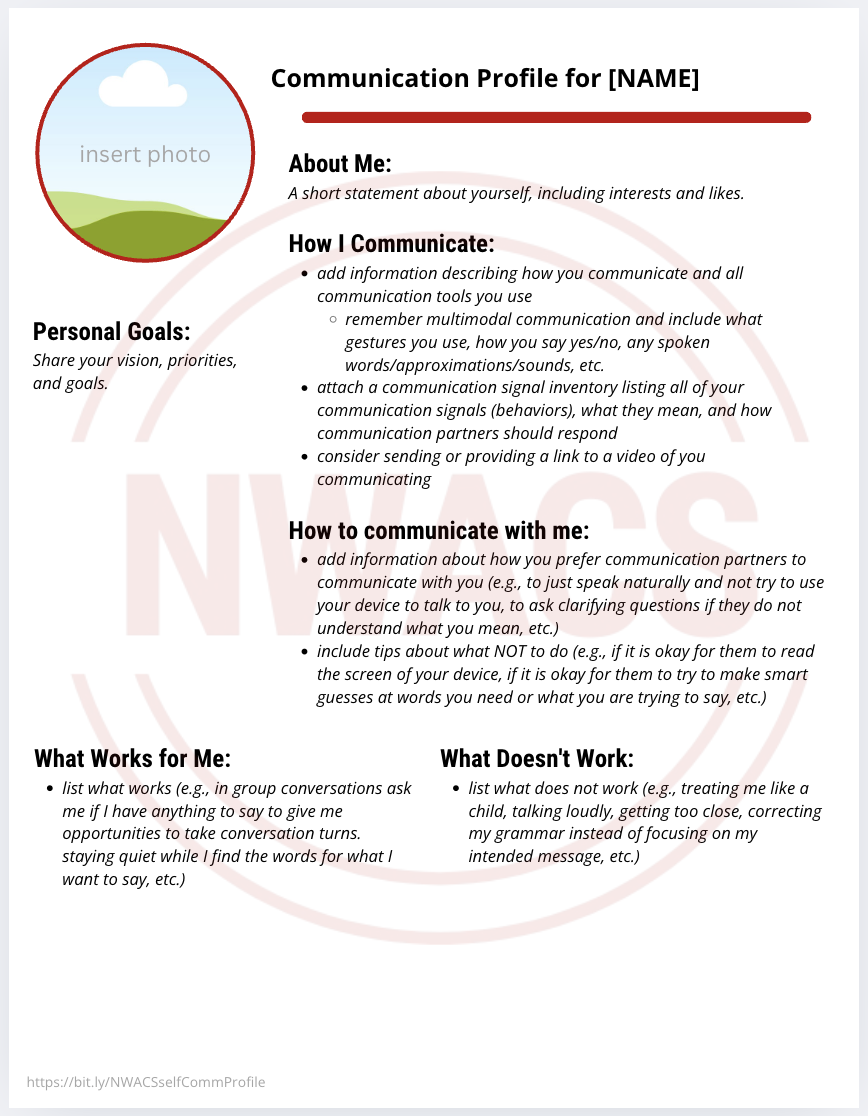
- Self-Advocate Communication Profile template (from NWACS)
Useful Tips
- Provide time, patience, and more time, and more patience! Intentionally create space in conversations and discussions for AAC users to be able to take a turn and be an active participant!
- Communicating through an AAC system – even the most robust, best-fit system – is slow and hard.
- Beware of ableism and infantilization!
- Adult AAC users are adults and deserve to be treated as the adults they are.
- Adult AAC users deserve the dignity of risk.
- Adult AAC users deserve to be heard. They deserve to make decisions and direct their life.
- Communication partners need training and ongoing support!
- Focus on communicative intent, not how the message was communicated.
- Find your support networks!
- AAC Users:
- ISAAC PWUAAC Online Chats – The International Society for Augmentative and Alternative Communication (ISAAC) invites people who use AAC to meet online for informal chats. Check their website and/or their social media for dates and times.
- Facebook groups, such as:
- Ask Me, I’m An AAC User! (24-Hour Rule!) is a Facebook group run by AAC users where the thoughts and experiences of AAC users in the group are the focus
- AssistiveWare’s Adult AAC Users Community is a Facebook group for adults who use Proloquo2Go and/or Proloquo4Text
- Out and About: Creating Community Groups for AAC Users is a community group on Facebook for people of any age who use AAC
- The AAC Connection is a Facebook group for AAC users, family members, and communication partners
- The AAC User’s Social Network is a Facebook group for AAC users by AAC users. It is open to AAC users over 16 years old. You may have an assistant help you access the group.
- There may be other groups centered around your AAC device or communication app where you can connect with other AAC users.
- Other:
- Seattle Children’s Alyssa Burnett Adult Life Center offers virtual and in-person classes and outings for people 18 and older with developmental disabilities
- [Skagit County, WA] Cascadia Clubhouse offers recreational activities for adults with developmental disabiltiies
- Families / Caregivers / Support Staff:
- AAC vendors and app developers have pages on various social media channels. Many also have Facebook groups that can be a good place to connect with a support network.
- also look for social media accounts and/or Facebook groups related to specific diagnoses
- and look for social media accounts of AAC users and/or parents of AAC users
- AAC vendors and app developers have pages on various social media channels. Many also have Facebook groups that can be a good place to connect with a support network.
- Professionals:
- NAACHO: Networking for AAC and Hangout – This Facebook group (administrated by NWACS) is for SLPs in Washington State who support people who use AAC. It is for collaboration, networking, and supporting each other in the grand adventure of augmentative and alternative communication.
- AAC vendors and app developers have pages on various social media channels. Many also have Facebook groups that can be a good place to connect with a support network.
- also look for social media accounts and/or Facebook groups related to specific diagnoses
- and look for social media accounts of AAC users
- Facebook groups, such as:
- AAC Users:
Selected References
- ADA Requirements: Effective Communication, U.S. Department of Justice (2020)
- Article 21 of the Convention on the Rights of Persons with Disabilities, United Nations (2006)
- Bagenstos, Samuel R. “The Disability Cliff.” Democracy 35 (2015): 55-67. Available at: https://repository.law.umich.edu/articles/1722
- Brady, Nancy & Bruce, Susan & Goldman, Amy & Erickson, Karen & Mineo, Beth & Ogletree, Billy & Paul, Diane & Romski, MaryAnn & Sevcik, Rose & Siegel, Ellin & Schoonover, Judith & Snell, Marti & Sylvester, Lorraine & Wilkinson, Krista. (2016). Communication Services and Supports for Individuals With Severe Disabilities: Guidance for Assessment and Intervention. American journal on intellectual and developmental disabilities. 121. 121-138. 10.1352/1944-7558-121.2.121.
- Developmental Disabilities Act of 1984 (Public Law 98-527)
- Disability Rights Washington: Six Self Advocacy Steps for Meetings
- RCW 71A.26.030 Client rights—Notification.
- WAC 284-43-5965 Effective communication for people with disabilities.
- White, R., Bornman, J., & Johnson, E. (2015). ‘Testifying in court as a victim of crime for persons with little or no functional speech : vocabulary implications’, Child Abuse Research: A South African Journal, vol. 16, no. 1, pp. 1-14. URI: http://hdl.handle.net/2263/49693
- World Health Organization. Division of Mental Health. (1994). Life skills education for children and adolescents in schools. Pt. 1, Introduction to life skills for psychosocial competence. Pt. 2, Guidelines to facilitate the development and implementation of life skills programmes, 2nd rev. World Health Organization. https://iris.who.int/handle/10665/63552

Share your comments or questions.