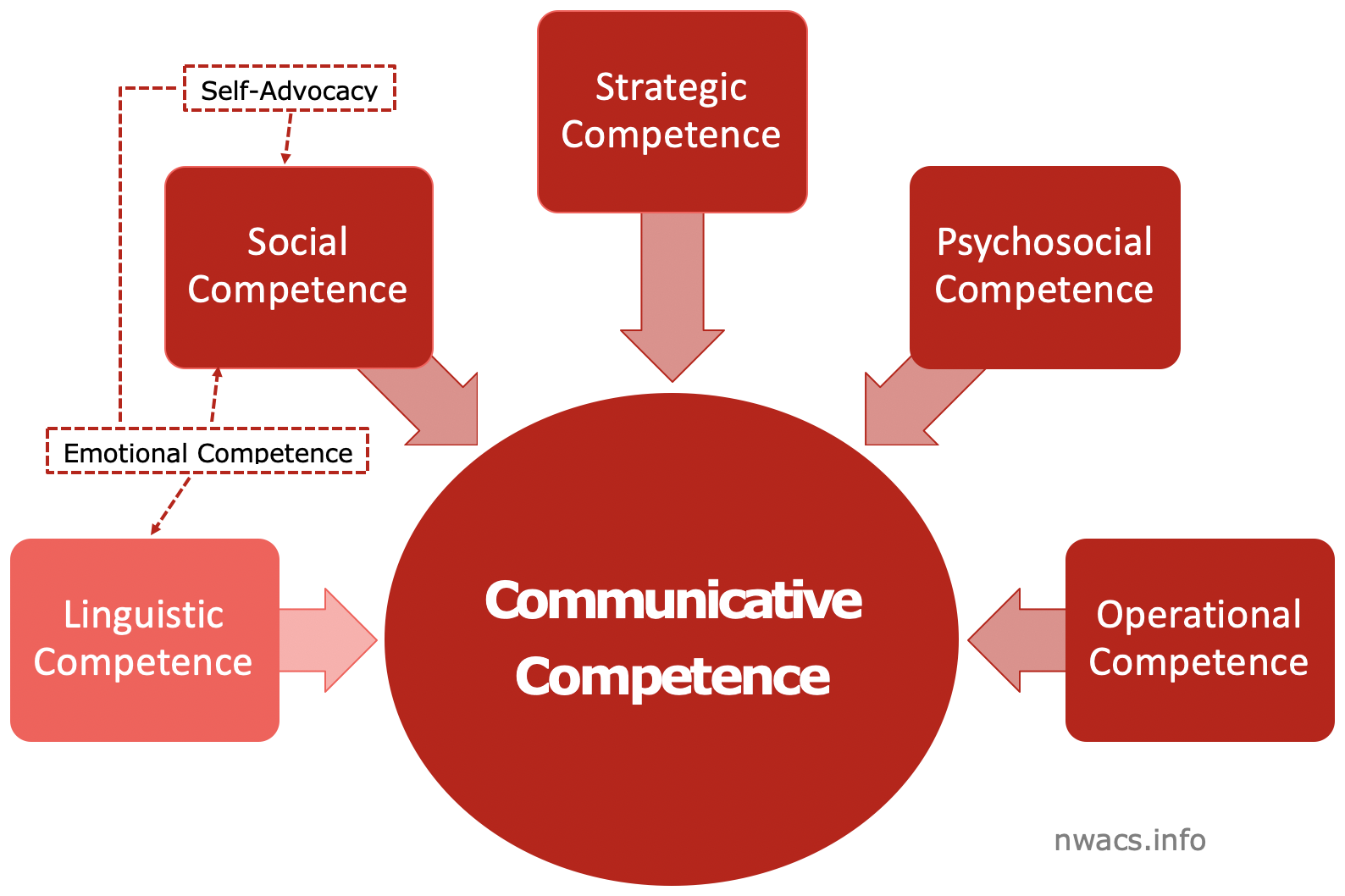
“…the attainment of communicative competence is predicated, at least in part, upon linguistic skills, including receptive and expressive skills in the spoken and written language(s) of the individual’s home and broader social community, as well as skills in the language code of the AAC systems used to communicate in these environments.”
Light & McNaughton (2014)
What are we talking about?
“AAC therapy is language therapy.“
Have you seen or heard this before? The linguistic competence skill area is what they are talking about. The actual language skills a person needs to be able to communicate anything they want.
Language skills are not the only skills needed to be a proficient communicator (as illustrated in the infographic above). But, a huge part of achieving communicative competence is learning language skills. Language is often what we focus on first when starting AAC with someone. We want them to realize the power of the tool we are trying to help them learn to use. And we want to hear all their thoughts and feelings and ideas and stories and everything else they want to tell us!
Language skills include:
- receptive language (understanding)
- “spoken” and written
- expressive language (ability to communicate a message to someone else)
- “spoken” and written
For people who use AAC, this is double (or more) the work. They have to learn the language(s) used in their home and community, as well as the language code(s) of their AAC system.
The Skills
Skills within the linguistic competence area include knowledge, use, and judgement of:
- vocabulary (words)
- grammar/syntax (rules of how to put words together)
- morphology (word structure and meaning of word parts, such as -s added to the end of a word to mean more than one)
- symbols (including those needed for written language, signs, pictures, and other symbols used in their AAC language)
The Goal
The goal is for the person to be able to understand and use language the same as their same-age peers. This includes having literacy abilities equal to their same-age peers. We can use what we know about language development as a guide to help us plan our interventions.
Useful resources for Linguistic skills:
- These language charts from AAC Language Lab (accessible with subscription, currently an annual fee of US$19.95)
- Augmentative & Alternative Communication Profile – A Continuum of Learning: (paid tool) based on the work of Dr. Janice Light (1989)
- Brown’s Stages of Syntactic and Morphological Development on speech-language-therapy dot com/Dr. Caroline Bowen’s website
- The Dynamic AAC Goals Grid – 3 (DAGG-3): (free tool) based on the work of Dr. Janice Light (1989)
- Speech-Language Milestones Resource List from Spiffy Speech blog (Feb 6, 2021)
- Grammar Development Handouts (paid product) from Allison Fors SLP
- Grammatical Targets Spreadsheet (free tool) from Shape Coding by Susan Ebbels
- Robust Receptive Vocabulary Instruction for Students with Significant Cognitive Disabilities Who Use AAC article from Lori Geist & Karen Erickson, includes a proposed “5-Day Instructional Cycle”
Do you have a favorite resource that we missed? Leave a comment to share!
References
- Geist L, Erickson K. Robust Receptive Vocabulary Instruction for Students With Significant Cognitive Disabilities Who Use AAC. TEACHING Exceptional Children. June 2021. doi:10.1177/00400599211018836
- Janice Light (1989) Toward a definition of communicative competence for individuals using augmentative and alternative communication systems, Augmentative and Alternative Communication, 5:2, 137-144, DOI: 10.1080/07434618912331275126
- Janice Light & David McNaughton (2014) Communicative Competence for Individuals who require Augmentative and Alternative Communication: A New Definition for a New Era of Communication?, Augmentative and Alternative Communication, 30:1, 1-18, DOI: 10.3109/07434618.2014.885080



Share your comments or questions.