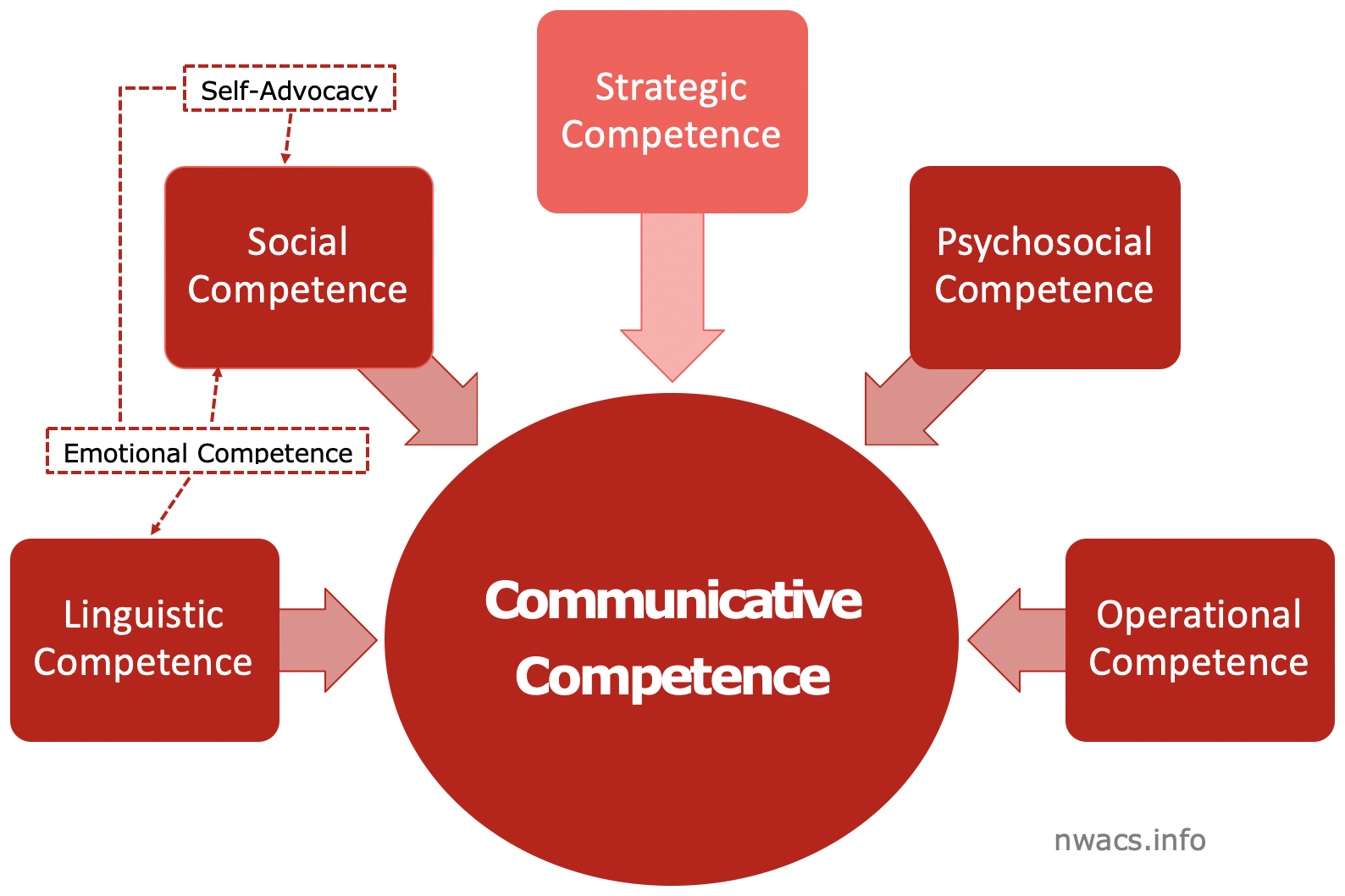
“Because of their significant disabilities, the substantial environmental barriers confronted in society, and the inherent restrictions of AAC systems, individuals with complex communication needs invariably confront limitations in their linguistic, operational, and/or social competence. In these cases, they must develop coping strategies that allow them to bypass these limitations and to make the best of what they do know and can do (McNaughton et al., 2008; Todman, Alm, Higginbotham, & File, 2008; Williams, 2004).”
Light & McNaughton (2014)
What are we talking about?
Strategic competence is having ways to fix communication issues. And ways to increase the effectiveness of one’s communication. And knowing when and how to use them. Strategies may be temporary (like when developing skills in other areas) or long-term. Strategic competence…
“largely determines the extent to which an individual is able to participate in the interaction process when using a communication system.” (Alant, 2017, p. 27)
It is the ability to realize there is a communication problem and take steps to fix it. It is knowing that being kind and polite will get different results than being surly and rude. It is knowing how to best use the features of the AAC system to get a message across with as little effort and time as possible.
The Skills
Skills within the strategic competence area include knowledge, use, and judgement of:
- telling that a word is not available and giving clues for the partner to guess
- asking for choices when the needed word is not available
- using word prediction to increase rate of communication and/or decrease fatigue
- using pre-stored messages in some situations – when on the phone, with the doctor, to explain about AAC, etc.
- using gestures to help communication
- choosing a way to communicate that fits the situation – using whisper-mode or lite-tech AAC during a movie, etc.
- being creative to fix communication errors, breakdowns, or problems
- using telegraphic communication (not full, grammatically correct sentences) to improve rate of communication
- changing the “formalness” of communication based on the communication partner
The Goal
The goal is that the person effectively and efficiently meets their communication goals. With all partners and in all environments.
Do you have a favorite resource for developing strategic competence skills? Leave a comment to share!
References
- Alant, E. (2017). Augmentative and Alternative Communication: Engagement and Participation. Plural Publishing.
- Janice Light & David McNaughton (2014) Communicative Competence for Individuals who require Augmentative and Alternative Communication: A New Definition for a New Era of Communication?, Augmentative and Alternative Communication, 30:1, 1-18, DOI: 10.3109/07434618.2014.885080



Share your comments or questions.