
“While linguistic and operational skills ensure that individuals with complex communication needs have access to the tools necessary to communicate, it is social skills that allow individuals with complex communication needs to use these tools effectively to meet communication goals.”
Light & McNaughton (2014)
What are we talking about?
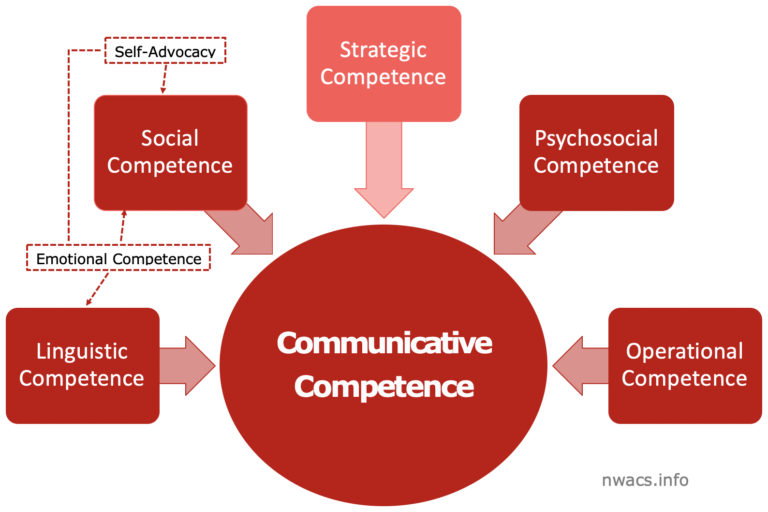
Social Competence is about figuring out the
- who,
- what,
- when,
- where,
- why,
- and how
of communicating (or not communicating) in the moment. It is about how “suitable” and successful one’s communication attempts are. And also about the parts of communication that support making and keeping relationships. People with complex communication needs often have significant barriers to relationships.
“We need to take seriously the importance of experiencing meaningful contact with another as an intrinsic motivation for the development of communication competence.”
Alant (2017, p 113)
The Skills
Skills within the social competence area include knowledge, use, and judgement of:
- engagement – level of involvement
- intention to communicate
- the way one attaches meaning to symbols
- participation – active involvement
- how well one can do turn-taking behaviors or activities
- pragmatics, or conversation skills
- starting an interaction
- taking turns
- staying on topic
- code-switching
- commenting and asking questions that are not needed (e.g., “Cool!”, “Me too”)
- etc.
- different communicative functions
- requesting attention
- requesting information
- sharing information
- joking/humor
- commenting
- rejecting
- etc.
- using polite social forms (e.g., “please”, “thank you”)
- questions and comments to show interest, concern, etc. in others (e.g., asking “How are you feeling?” when a caregiver returns from sick leave)
- switching between and using different modes of communication
The Goal
The goal is that the person is able to use their communication tools effectively to meet their communication goals. This includes making and keeping relationships.
Useful resources for Social skills:
- Add-on Social Pages for use with Core Vocabularies – free downloads from TALC (Products → Free Resources)
- Social Stories developed by Carol Gray
- Video Modeling
Do you have a favorite resource that we missed? Leave a comment to share!
References
- Alant, E. (2017). Augmentative and Alternative Communication: Engagement and Participation. Plural Publishing.
- Janice Light & David McNaughton (2014) Communicative Competence for Individuals who require Augmentative and Alternative Communication: A New Definition for a New Era of Communication?, Augmentative and Alternative Communication, 30:1, 1-18, DOI: 10.3109/07434618.2014.885080


Share your comments or questions.