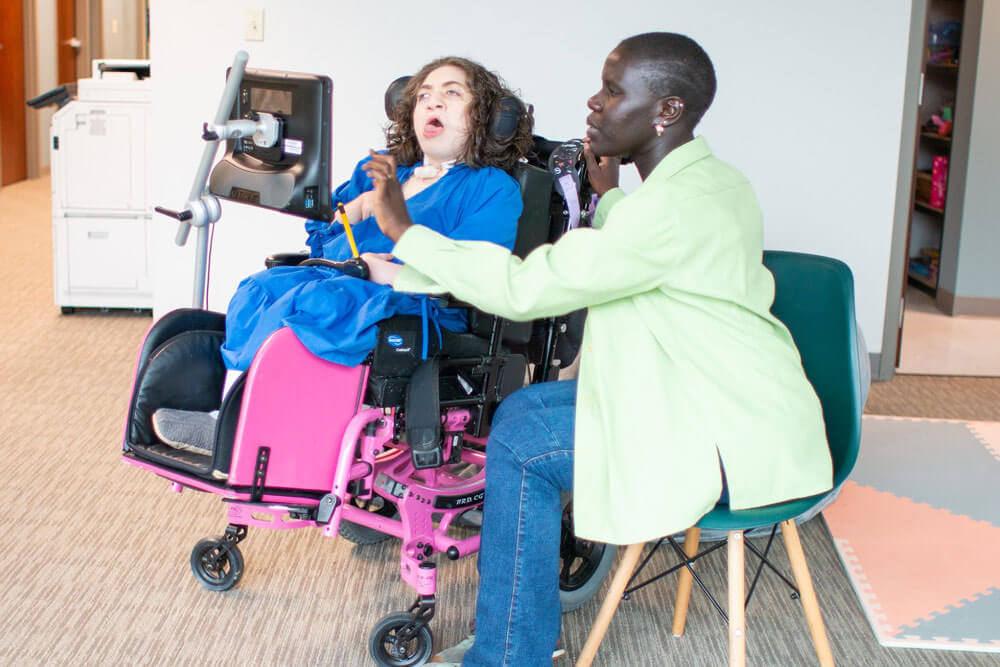
“young adult in blue sweater talks with young adult in green jacket suing AAC communication device” by UK Human Development Institute (public domain) is licensed under CC by 3.0
This is a collection of information and resources related to transition planning.
This is not an exhaustive list. Do you have a favorite resource that we missed? Leave a comment to share!
Explore key issues related to this topic. Jump to When should transition planning happen?
Explore relevant resources. Jump to Resources
- Articles, Books, Documents
- Materials
- Related Websites
- Related Podcasts
- Related Videos and Webinars
- Other Resources
Jump to Selected References
When should transition planning happen?
Transition planning is so important for children who use AAC. There are two times during a child’s education when there are rules for transition planning. Formal transition planning is required:
- when moving from Early Intervention (birth to three) services to Early Childhood Special Education (special education preschool), and
- when transitioning from high school to adulthood, which may include:
- employment
- post-secondary education
- community living
- other post-school programs
However, there will be many more times of transition in your child’s first 18-21 years of life:
- Moving from preschool to elementary school.
- And then to middle school.
- And then to high school.
- Changes from grade to grade.
- Any time there is a change in the team (e.g., teachers, aides, SLP, etc.).
All of these transitions require planning, preparation, and information that needs to be shared. Developing strong transition plans at each step along the way will help set up your child for the life they want when they grow up. This planning and preparation helps prevent teams from starting “from scratch” at each transition. It will help your child keep a consistent system of communication and support a positive trajectory. Including your child in this process, as much as they are able, builds self-advocacy and self-determination skills. Along with skilled AAC use, these are important to your child’s success.
Parents/Guardians: remember that you are an important member of your child’s team! In fact, you are the most consistent and long-term team member your child will have. So your input and involvement with transition planning are essential. Transition planning and transition services must be written into your child’s IEP. AAC/AT devices and services needed for transition must also be written into the IEP. AAC/AT devices and services will not be provided if they are not written into the transition plan.
According to QIAT (Quality Indicators for Assistive Technology Services), there are six quality indicators to guide transitions involving AAC and AT. These are guidelines to consider when planning for an upcoming transition. (Note: we have adapted these indicators to be actionable.)
- Identify the AAC/AT needs of the student, including:
- roles of team members on the old team and assign these roles to members of the new team
- any training needs of the new team
- detail what AAC/AT systems and/or strategies that are working for the child
- include an overview of systems/strategies that have been tried and were not optimal
- include a plan of next steps for supporting growth of the child’s system and skills
- who will communicate with the new team through (and after) the transition to ensure completion of tasks and efficient transfer of the AAC/AT
- roles of team members on the old team and assign these roles to members of the new team
- Include the student in the transition planning at a level appropriate to age and ability.
- Identify who will be advocating for any equipment and/or training needs.
- Identify everything that will be needed in the receiving environment, including:
- all equipment
- support strategies and tools
- environmental requirements
- knowledge and skills (training)
- Create a timeline individualized to the child to map out action steps, target dates, and ongoing needs.
- Ensure that all equipment/system items arrive to the receiving location in working condition, along with any manuals and/or instructions.
- include a plan for ongoing maintenance (including funding) and technical support (including training)
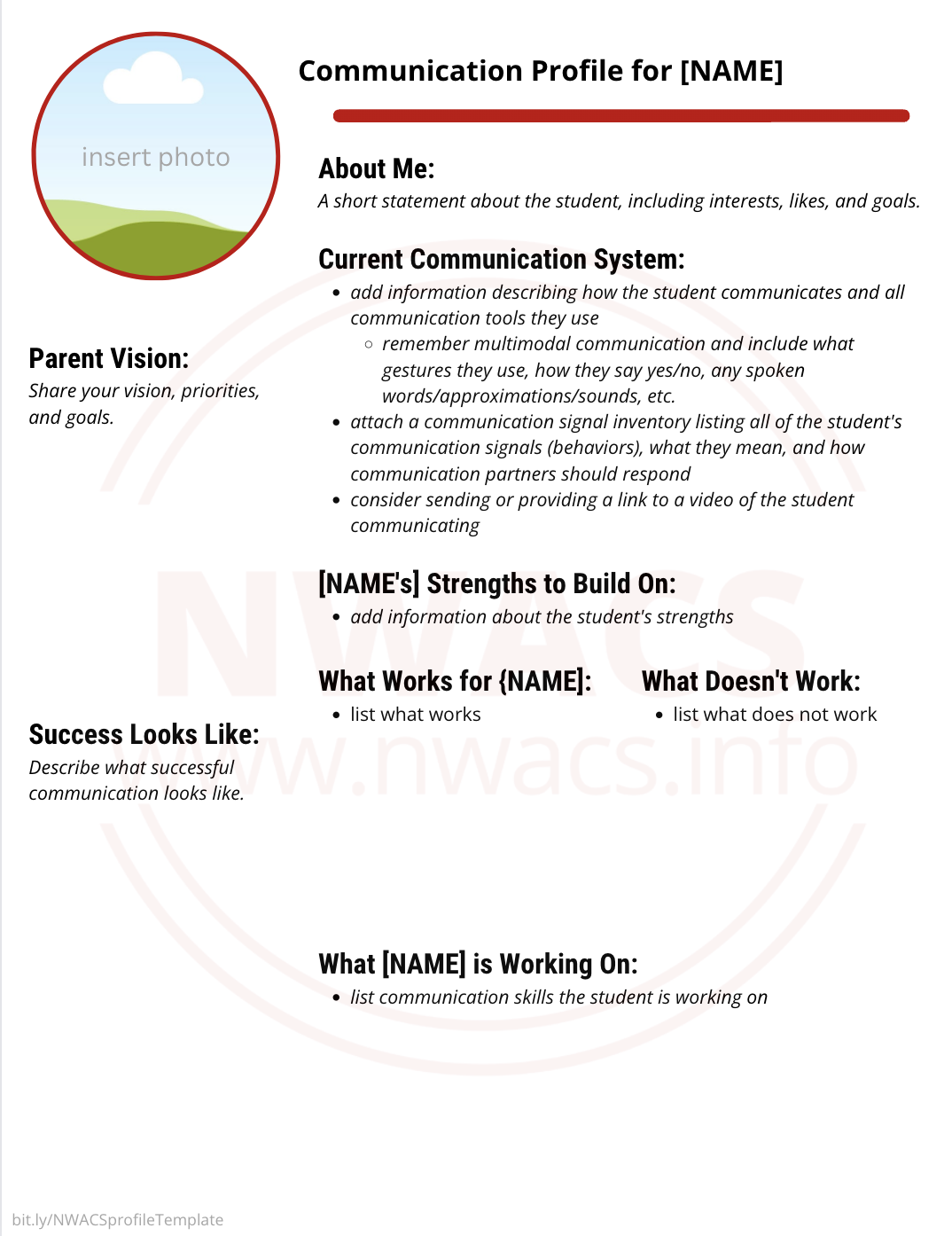
PRO TIP: Create a document to attach to the child’s IEP that includes the above information.
“We’re pretty good about caring for our disabled citizens – as long as they’re children. It’s time to put equal thought into their adulthoods.”
Samuel R. Bagenstos
Resources
Articles, Books, and Documents
- AT Act Programs Contribute to AT Transition Planning (2026) by Gayl Bowser
- Charting Paths: Supporting the Journey Beyond High School (2023) by Twyla Perryman from the ASHA LeaderLive
- Education Tech Points
- Education Tech Point #7: Transition for students who use AT
- Fundamentals of AAC: A Case-Based Approach to Enhancing Communication (2023), Nerissa Hall, Jenifer Juengling-Sudkamp, Michelle L. Gutmann, and Ellen R. Cohn (eds)
- Chapter 14: Services for Young Adults Using AAC Transitioning to Adulthood by Diane Nelson Bryen
- IDEA Transition Overview: K-12 to Postsecondary Education and Employment – Successes and Barriers
- OCALI Transition to Adulthood Guidelines
- Planning for Post-secondary Transition to Adult Health Care (2024) by Adena Dacy from the ASHA LeaderLive
- Transition Strategies for Adolescents and Young Adults Who Use AAC (2010), David McNaughton and David Beukelman (eds)
- Transitioning Students Using AAC: Strategies to Promote Full Inclusion (slides from 2018 USSAAC presentation by Tracy Rackensperger, PhD and AAC User)
- Transition To Adulthood Communication Matrix Collection by Cynthia Green (2018)
Websites
- Center for Change in Transition Services (CCTS) at Seattle University
- FACT Oregon Transition to Adulthood
- Informing Families
- National Technical Assistance Center on Transition
- OCALI Lifespan Transitions Center
- PACER’s National Parent Center on Transition and Employment
- PAVE transition planning information
- PEACE NW Transition Resources
- Quality Indicators for Assistive Technology Services
- Guiding Document Assistive Technology in Transition (located on the Resources page)
- Indicators and Matrices
- Quality Indicators: AT in Transition
- Quality Indicator Matrices: Matrices AT in Transition
- Resources (Useful Links): Assistive Technology Transition
- Transition Planning Worksheet for AT Users (located on the Resources page)
- To Be Self Determined – resources for self-determination
- Washington Office of Superintendent of Public Instruction
- Early Childhood Transition from Part C to Part B
- Special Education: Guidance for Families: Transition Services (Ages 16 – 21)
- Washington State DVR
- Wrightslaw Transition, Transition Services, Transition Planning
- Zarrow Institute On Transition & Self-Determination (The University of Oklahoma)
Podcasts
- LOMAH Disability Podcast – podcast from a mom planning for the future of her nonspeaking teen
Videos/Webinars
- AAC in the Cloud presentation recordings:
- AAC & Transition – Planning for an Everyday Life by Kathryn Helland (2021)
- AAC and Transition Planning – Supporting all students to make decisions for the future by Erin Sheldon (2020)
- CCN/Complex Bodies: Building Meaningful Activities for Older Students Who Are Switch Users/AAC Communicators With Transition in Mind by Sharon Redmon (2019)
- Addressing Mental Health in Youth with Intellectual and Developmental Disabilities during Transition to Adulthood from MHDD National Training Center
- AT in Transition QIAT Book Study Ch. 7
- QIAT Session 7: AT Transition
Other Resources
- Framing a Future Tool from The Bridge School
- Just For Youth: Self-Determination and Planning for the Future from FACT Oregon
- ME! Lessons for Teaching Self-Awareness & Self Advocacy from The University of Oklahoma’s Zarrow Center for Learning Enrichment
- Project10’s Self-Advocacy & Self-Determination webpage includes a variety of resources including: assessments, curricula and courses
- TalkingMats: “A Talking Mat is a visual communication framework which supports people with communication difficulties to express their feelings and views.
- The Self-Determination Assessment
- Wrightslaw’s Self-Advocacy webpage includes a variety of resources
Selected References
- Bagenstos, Samuel R. “The Disability Cliff.” Democracy 35 (2015): 55-67. Available at: https://repository.law.umich.edu/articles/1722
- Bryen D. N. (2008). Vocabulary to support socially-valued adult roles. Augmentative and alternative communication (Baltimore, Md. : 1985), 24(4), 294–301. https://doi.org/10.1080/07434610802467354
- Bryen, D., Potts, B., & Carey, A. (2007). So you want to work? What employers say about job skills, recruitment and hiring employees who rely on AAC. Augmentative and alternative communication (Baltimore, Md. : 1985). 23. 126-39. 10.1080/07434610600991175
- Carey, Allison & Potts, Blyden & Bryen, Diane & Shankar, Jui. (2004). Networking towards Employment: Experiences of People Who Use Augmentative and Alternative Communication. Research and Practice for Persons with Severe Disabilities (RPSD). 29.
- Carter, E., Austin, D., & Trainor, A. (2012). Predictors of Postschool Employment Outcomes for Young Adults With Severe Disabilities. Journal of Disability Policy Studies. 23. 50-63. 10.1177/1044207311414680
- Carter, E., Ditchman, N., Sun, Y., Trainor, A., Swedeen, B., & Owens, L. (2010). Summer Employment and Community Experiences of Transition-Age Youth with Severe Disabilities. Exceptional Children. 76. 194–212. 10.1177/001440291007600204
- Chadsey, J. (2007). Vocational Skills and Performance. Handbook of Intellectual and Developmental Disabilities (pp. 619-634). 10.1007/0-387-32931-5_31
- McNaughton, D., Arnold, A., Sennott, S., & Serpentine, E. (2010). Developing skills, “Making a match”, and obtaining needed supports: Successful employment for individuals who use AAC. Transition Strategies for Adolescents and Young Adults Who Use AAC. Brookes.
- McNaughton, D., & Bryen, D. (2007). AAC technologies to enhance participation and access to meaningful societal roles for adolescents and adults with developmental disabilities who require AAC. Augmentative and alternative communication (Baltimore, Md. : 1985). 23. 217-29. 10.1080/07434610701573856
- Rossetti, Z., Lehr, D., Pelerin, D., Huang, S., & Lederer, L. (2016). Parent Involvement in Meaningful Post-School Experiences for Young Adults With IDD and Pervasive Support Needs. Intellectual and Developmental Disabilities. 54. 260-272. 10.1352/1934-9556-54.4.260
- Trembath, D., Balandin, S., Stancliffe, R., & Togher, L. (2010). “Communication is Everything:” The Experiences of Volunteers who use AAC. Augmentative and alternative communication (Baltimore, Md. : 1985). 26. 75-86. 10.3109/07434618.2010.481561
- Wehman, P. (2013). Life Beyond the Classroom: Transition Strategies for Young People With Disabilities (5th Edition). Baltimore, MD: Paul H. Brookes Publishing. 584 pages, ISBN-13: 978-1598572322

Share your comments or questions.