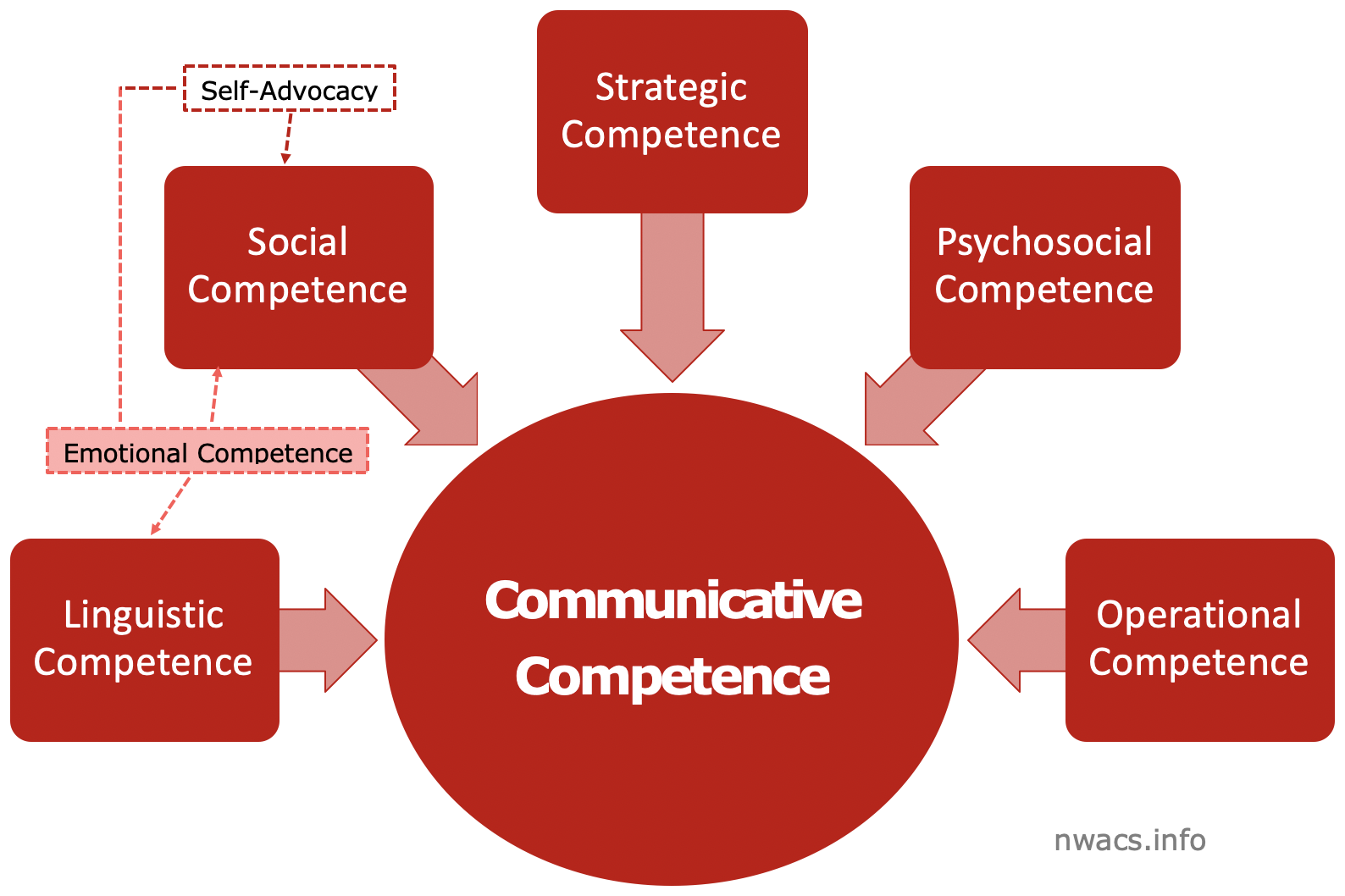
“Communication is not an end in itself, but rather a means to many ends in all aspects of life. Thus, desired outcomes in AAC are not achieved through the learning of symbols, the production of utterances or the use of a speech generating device (SGD). Instead, AAC interventions are only successful to the degree to which individuals can productively use AAC strategies, techniques, and technologies to participate actively in family and community life, develop and maintain friendships, garner self-esteem, achieve personal goals, gain employment, learn to read and write, get an education, take on adult roles, become productive members of their families, contribute to their communities and self-actualize (Beukelman & Mirenda, 2005; Blackstone, Williams, & Wilkins, 2007; & Williams, Krezman, & McNaughton, 2008).”
Blackstone & Wilkins (2009)
What are we talking about?
Emotional competence is being able to identify, respond to, and manage your own emotions as well as the emotions of others. It develops over time within the person’s social and cultural experiences. Factors both inside and outside the person influence it. Language growth supports emotional learning. Emotional growth supports language learning. Emotional competence is key to many parts of life, such as:
- self-advocacy – being able to speak up for oneself and one’s interests
- self-determination – being able to make decisions about one’s own life
- making and keeping social relationships
- school and job success
- self-regulation – being able to manage one’s energy, emotions, thoughts, and behaviors
- community integration – being able to fully take part in one’s community
Emotions are felt inside the body as a response to something. Often there are also physiologic changes in the body. Emotions are then communicated in many different ways. In typical development, caregivers provide guidance and spoken input. They teach children the socially and culturally acceptable ways to
- identify,
- label,
- reason about,
- and respond appropriately to
emotions and emotional situations. People who use AAC need modeling and direct teaching to learn to label, discuss, and reason about emotions. They also need access to the needed words so that they can label, discuss, and reason about emotions.
The Skills
Skills within the emotional competence area include knowledge, use, and judgement of:
- being aware of emotions
- naming emotions
- identifying the reason for an emotion
- finding a solution or response to an emotion/emotional situation
- talking about own emotions
- talking about other people’s emotions
- understanding others might have different emotions
- empathy
- self-regulation
- self-talk
- communicating their feelings and sense of self in a way that feels satisfactory to them
- coping strategies
- mixed/complex emotions
- masking or hiding emotions
The Goal
The goal is for the person to have the needed tools, understanding, and language to recognize, interpret, and respond constructively to emotions in self and in others.
Useful resources for Emotional skills:
- Early Development of Emotional Competence (EDEC) assessment tool (Na et al., 2017)
- Early Development of Emotional Competence Profile (EDEC-P) (Rangel-Rodriguez et al., 2021)
- Social Stories (Gray & Garand, 1993)
- Strategies for Talking about Emotions as PartnerS (STEPS) instructional program developed by Na & Wilkinson (2015, 2017)
- The SCERTS Model (Prizant, Wetherby, Rubin, & Laurent, 2014)
Do you have a favorite resource that we missed? Leave a comment to share!
References
- Blackstone, Sarah & Wilkins, David. (2009). Exploring the Importance of Emotional Competence in Children With Complex Communication Needs. Perspectives on Augmentative and Alternative Communication. 18. 78-87. 10.1044/aac18.3.78.
- Development of Emotional Competencies in AAC: An Area That Deserves Our Attention (handout) by Sarah Blackstone
- Development of Emotional Competencies in Children with Complex Communication Needs: Implications for Practice and Research (handout) by Blackstone et al.
- Ji Young Na & Krista M. Wilkinson (2018) Communication about emotions during storybook reading: Effects of an instruction programme for children with Down syndrome, International Journal of Speech-Language Pathology, 20:7, 745-755, DOI: 10.1080/17549507.2017.1356376
- Na, J., & Wilkinson, K.M. (2015). Communication about Emotions Using AAC during Storybook Reading: Effects of an Instruction Program for Parents of Children with Down Syndrome. Paper presented at the Annual American Speech Language Hearing Association (ASHA) Convention, Denver, CO, USA. [Google Scholar]
- Na JY, Wilkinson K, Karny M, Blackstone S, Stifter C. A Synthesis of Relevant Literature on the Development of Emotional Competence: Implications for Design of Augmentative and Alternative Communication Systems. Am J Speech Lang Pathol. 2016 Aug 1;25(3):441-52. doi: 10.1044/2016_AJSLP-14-0124. PMID: 27537831.
- Na, Ji Young; Wilkinson, Krista; Liang, Jiali (2017): Early Development of Emotional Competence (EDEC) assessment tool (Na et al., 2017). ASHA journals. Dataset. https://doi.org/10.23641/asha.5643076.v1
- Rangel-Rodríguez, Gabriela A.; Martín, Mar Badia; Blanch, Sílvia; Wilkinson, Krista M. (2021): Early Development of Emotional Competence Profile (Rangel-Rodríguez et al., 2021). ASHA journals. Journal contribution. https://doi.org/10.23641/asha.14219777.v2
- Wilkinson, K; Na, JY; Rangel-Rodriguez, G; Sowers, DJ. (2021). Fostering Communication About Emotions: Aided Augmentative and Alternative Communication Challenges and Solutions. In BT Ogletree (Ed), Augmentative and Alternative Communication Challenges and Solutions (pp. 313-338). Plural Publishing, Inc.



Share your comments or questions.