
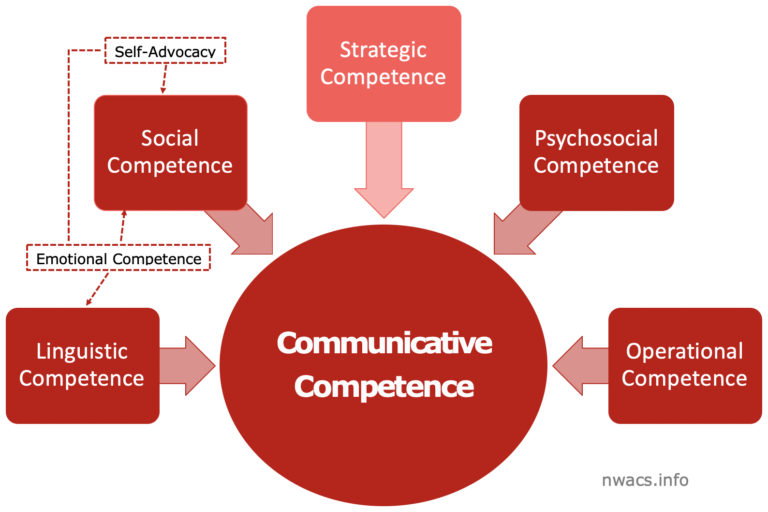
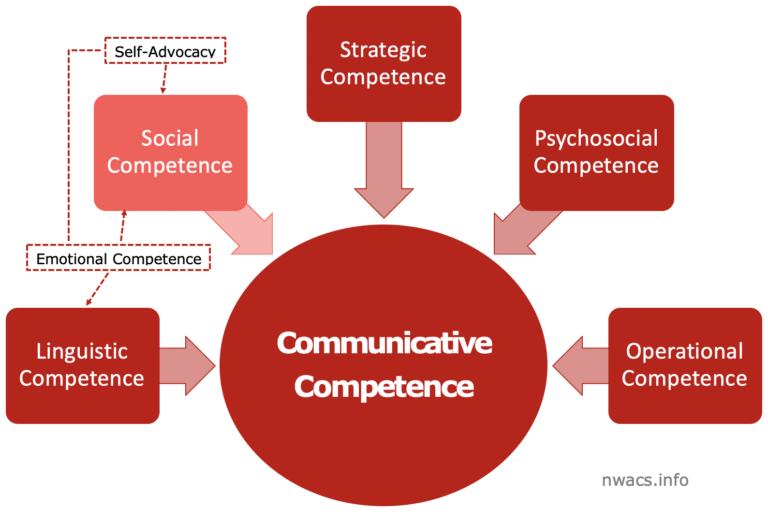
“In 2003, Light expanded the preliminary model of communicative competence and argued that the attainment of communicative competence by individuals with complex communication needs is impacted by not just their linguistic, operational, social, and strategic competence but also a range of psychosocial factors including motivation, attitude, confidence, and resilience.”
Light & McNaughton (2014)
What are we talking about?
Psychosocial and environmental factors shape a person’s communicative competence. Psychosocial factors are inside the person. Environmental factors are outside the person.
Psychosocial Supports and Barriers
Psychosocial competence is the ability to (WHO, 1997; retrieved from ASHA AAC Practice Portal 8/1/21):
- manage the demands and challenges of daily life
- maintain a state of mental well-being
- and show adaptive and positive behavior during communication
Psychosocial Factors
According to Light (2003), psychosocial factors include:
motivation
motivation: the desire to communicate and belief that it is important and doable
AAC is complex and involves significant
- motor demands
- cognitive demands
- sensory perceptual demands
- linguistic demands
A person is more likely to take on these demands to communicate when they are highly motivated to do so. If their motivation is low (or not high enough), these demands may be too overwhelming. This leads to the person choosing to not communicate.
Bruce Baker (2005) talked about this with his “motivation formula” (depicted in this infographic):

When the desire to communicate is bigger than the effort and time to do it, communication will happen. But if the effort or time is more than the desire to communicate, communication will not happen.
To build motivation, people who use AAC may need
- a lot of positive communication experiences and
- a lot of successful communication experiences
Attitude
attitude: ideas about the use of AAC that influence AAC use (or lack of use) in a given situation
AAC use (or lack of use) may change based on:
- the attitude of the AAC user toward AAC
- the attitude of the people around the AAC user toward AAC
confidence
confidence: believing in your ability to successfully communicate in a given situation
Seeing or interacting with other people who use AAC may be important to build the person’s confidence.
resilience
resilience: the ability to get through challenges, fix problems, and recover from failures
Protective factors that support resilience include:
- problem-solving skills
- self-esteem
- optimism
- faith
- encouragement and support from family, mentors, teachers, employers, peers, or other communication partners
These supports help the person deal with hard times and failures.
Environmental Supports and Barriers
Communication does not happen in a bubble by ourselves. Environmental and partner factors impact a person’s communicative competence. Barriers in the environment may get in the way of communicative competence. Supports in the environment may improve communicative competence.
Environmental Factors
Environmental factors include (Light & McNaughton, 2014):
- policy and practice barriers and supports
- legislation about accessibility and inclusion
- policies impacting funding for AAC systems and other assistive technologies
- legislation about discrimination against individuals with disabilities
- policies about universal design of technologies
- evidence-based, client responsive, culturally competent services
- provider expertise in AAC
- funding support
- availability of appropriate technologies
- attitude barriers and supports
- advocacy, public education, promoting awareness of rights and abilities of individuals with disabilities
- meaningful opportunities to communicate and interact with peers
- appropriate expectations
- knowledge and skill barriers and supports
- knowledge of:
- funding sources and AAC resources
- AAC symbols and transmission techniques
- positioning requirements
- strategies for vocabulary selection, layout, organization, and keeping it updated
- daily care and maintenance
- strategies for
- technical trouble shooting
- integrating AAC into daily life
- partners who use interaction strategies to support successful communication
- knowledge of:
All people who use AAC will run into environmental factors. The effect these factors have depends on:
- the strength of the person’s linguistic, operational, social, and strategic skills
- how developed their psychosocial factors are
References
- Janice Light & David McNaughton (2014) Communicative Competence for Individuals who require Augmentative and Alternative Communication: A New Definition for a New Era of Communication?, Augmentative and Alternative Communication, 30:1, 1-18, DOI: 10.3109/07434618.2014.885080
- Jennifer J. Thistle & Krista M. Wilkinson (2013) Working Memory Demands of Aided Augmentative and Alternative Communication for Individuals with Developmental Disabilities, Augmentative and Alternative Communication, 29:3, 235-245, DOI: 10.3109/07434618.2013.815800
- Light, J. (2003). Shattering the silence: Development of communicative competence by individuals who use AAC. In J.C. Light, D.R. Beukelman, & J. Reichle (Eds.), Communicative competence for individuals who use AAC: From research to effective practice (pp. 3–38). Baltimore, MD: Paul H. Brookes.
- WHO (1997). World Health Organization. Life Skills Education for Children and Adolescents in Schools. Programme on Mental Health Organization, Geneva : WHO.



Share your comments or questions.