
In the Spotlight: William, AAC User
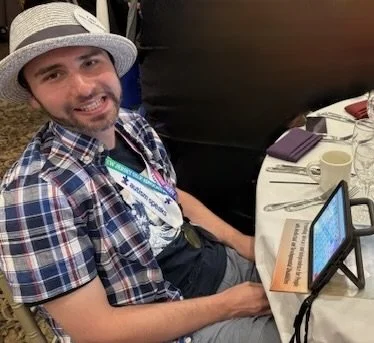
I had the opportunity to interview William. He is an autistic adult who has worked hard to achieve his communication and advocacy goals. William lives with his mother, who is also a speech-language pathologist. Together they have a remarkable story to share. We went through several questions, which William received in advance so he could prepare his responses.
During our hour-long conversation, we discussed
- his AAC journey,
- the barriers and supports he has encountered,
- and his recommendations for communication partners.
William generated his responses using a combination of symbols, prestored messages, and spelling.
Getting to Know William
William shared that he loves his Zoom sessions with other AAC users. They began during the COVID-19 pandemic and have continued ever since. Because there are so few autistic adults who use AAC, he’s grateful to have found a small but meaningful community. William enjoys being, “Out in the forest with live people,” connecting with others in real life.
Fun fact: William has tried downhill skiing, though he doesn’t ski anymore.
AAC Use and Communication
William communicates using a Wego 8 speech-generating device with TouchChat and WordPower software on a 60-cell layout. He describes this as his favorite system so far, especially since the speakers are loud enough for everyone to hear him. He also uses the Notes app—copying responses from TouchChat—so that he can compose messages in advance.
In the past, William had difficulty with iPads because others often couldn’t hear him. As he puts it, “I think my favorite is with me today.”
William’s AAC journey began with him writing in his mother’s hand. As a child in the early 2000s, he was given a large computer with a removable touchscreen. But it was frustrating to use and difficult to calibrate. His teachers struggled with it as well. He’s grateful that today’s touchscreen devices are so much easier.
Something he still wishes for, however, is more expressiveness: “I want tone of voice.” William would love his device to convey emotions like happiness through vocal tone.
One of his favorite things to do with his device? “I can tell to get quite delicious food.” William especially loves ordering decaf iced coffee. He also shared, “I want to date.”
William uses his device to text, email, and stay connected with friends. He also uses it for social media, including Facebook. He is very active:
“I am chair of New Jersey Self Advocacy Project Council 2.I have worked in DC for 5 years with For Autism Speaks. My day program, JoyDew, is teaching me robotics, AI, and radiology screening. My day program was training the Ridgewood Police, and we all got paid for it. I am with the JoyDew Day Program, enactor of special needs aspects of emergency situations.”
William sees his AAC device as essential: “I need this for communication, and without having use of it, the many things I am able to do cannot happen.”
Supports and Barriers
We also discussed how others can best support William’s communication. He suggests: “you can tell people to wait for me to finish, work with me to position the device, and show the message to people by turning the screen around.” He added, “I’m sitting at a kitchen table with my device in the right spot. My work is using my voice because I did not get mine for a time in school.”
William has always struggled with speech therapy in office settings. He prefers “community inclusion.” For example, when he was younger, his school team thought he couldn’t tell the difference between a capital A and a capital B. His mother, Laura, recalls: “But I could take him to an Italian restaurant. He liked salad, he would read all the ingredients, and decide which salad he wanted.” Despite demonstrating literacy skills in real-world situations, William often couldn’t—or wouldn’t—show them in clinical settings.
When asked what people often misunderstand about AAC, William replied, “Inclusion. Not office setting. I don’t understand how to make office work for me later. People don’t listen to me in daily life with my device. I can see and hear you without being able to speak.”
Hopes and Recommendations
We concluded our interview with William’s hopes for doctors, therapists, and educators. He said, “I am doing my turn to help people in the community to make place for us and get respect for our mental ability.”
Doctors
William shared that he struggles with volitional control of his breath: “Control. I don’t take a breath, my body is not in my control.” When a doctor instructs him to breathe, it isn’t that he doesn’t understand. It’s that he cannot always control his diaphragm, ribs, and larynx.
SLPs
William emphasized, “I can’t do apraxia testing!” He finds it very frustrating when asked to do things like stick out his tongue, which he cannot do. His mother, Laura, wishes SLPs would explain that assessments are mainly for eligibility purposes. That they do not dictate appropriate goals or treatment.
Laura also urges clinicians to understand monotropism. Monotropism is the tendency to focus on one thing at a time. This makes it difficult for some people to listen and respond simultaneously. She wonders whether brain-computer interfaces may be the only effective option for people with both motor challenges and monotropism.
Final Thoughts
William concluded our interview with an important message: “I love you all, and you need to love yourself.”
What a powerful reminder from William—a person who has faced significant barriers to communication access but has persisted and achieved so much.
Thank you, William, for sharing your story!



Share your comments or questions.