
This is a collection of information and resources related to supporting augmentative and alternative communication (AAC) in children ages three to five years.
This is not an exhaustive list. Do you have a favorite resource or strategy that we missed? Leave a comment to share!
Explore key issues related to this topic. Jump to:
- What does supporting communication development look like at this age?
- Key Goals
- What AAC Looks Like
- Helpful Implementation Strategies
Explore relevant resources. Jump to Resources
- Articles, Books, and Documents
- Learning Modules
- Websites
- Podcast and Webinar Recordings
- Other Resources
Jump to Useful Tips
Jump to Selected References
What does supporting communication development look like at this age?
FUN! It looks like having fun!
The work of children is play. Play is not frivolous. Play is brain building. Play is powerful! Children learn best through play and exploration. So many skills can be learned and developed through play – including communication!
Child-led and play-based! It looks like following the child’s lead.
When working with young children, we follow their ideas and interests. We build upon and within what they are doing and are focused on. We adapt to their preferred items, activities, and interests. We can talk about what they are doing. We can model language within whatever they are drawn to. We can target core words during play.
We can
- comment
- describe
- ask and answer questions
- share opinions
- refuse, reject, disagree
- make a plan
- negotiate
- take conversation turns
And more! Most importantly, we can play with them and reinforce connections that are happening. We can show them the joy of connecting and communicating with another person!
Emergent literacy! It looks like supporting emergent literacy skills.
Language and literacy develop in tandem – language development supports literacy development, and literacy development supports language development. So supporting communication development looks like lots of shared reading. It looks like developing concepts of print. It looks like playing with sounds, letters, and words. It looks like developing letter-sound correspondence. It looks like shared writing. And it still looks fun!
We want young children interested in people and motivated to interact. We want them willing to take the risk and make the effort to engage and communicate.
“Scientists have recently determined that it takes approximately 400 repetitions to create a new synapse in the brain – unless it is done with play, in which case, it takes between 10 and 20 repetitions!”
Dr. Karyn Purvis
Key Goals
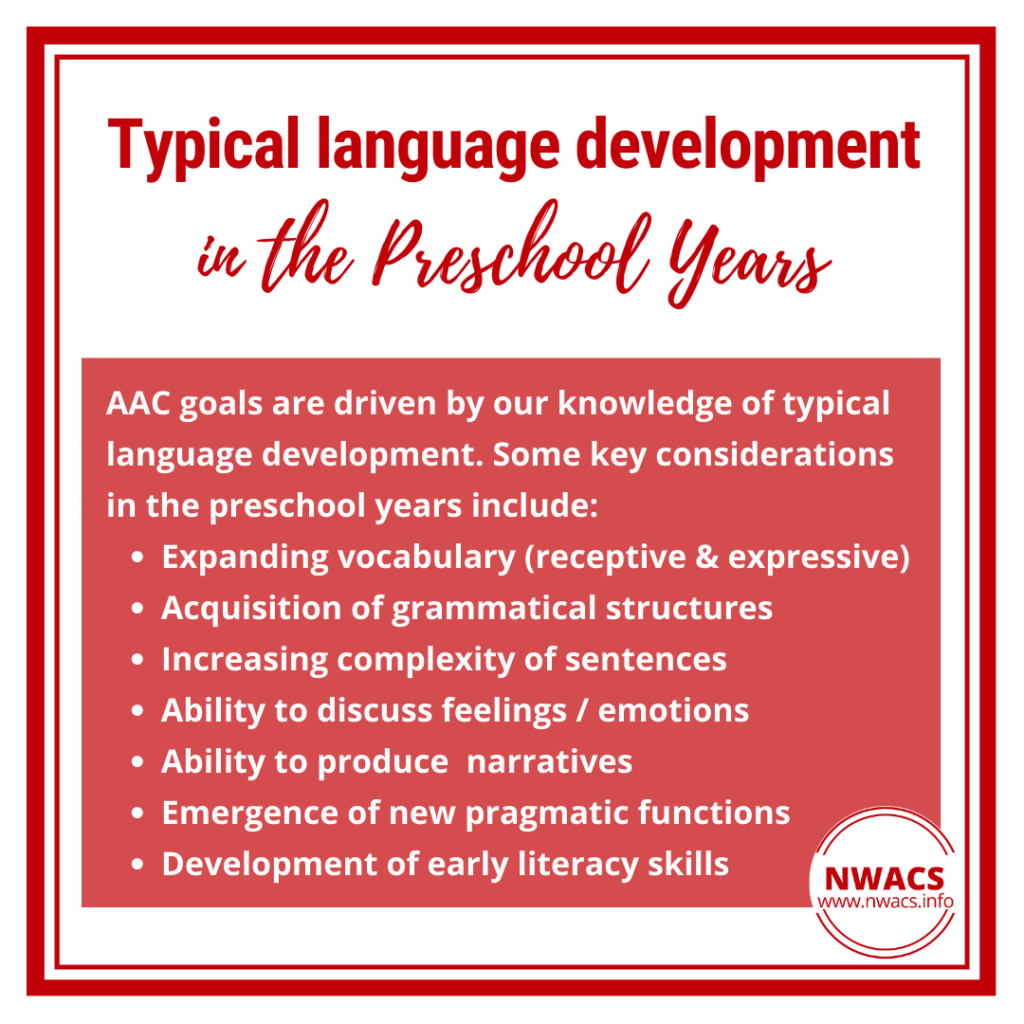
- support language and communication development
- continue using language development as a guide
- vocabulary development
- verbs (action words)
- describing words
- pronouns/people’s names
- “power words” / words to self-advocate
- morphological development
- grammar development
- moving from words to sentences to short narratives
- answering questions
- keep gestalt language/natural language development in mind in case the child is a gestalt language processor
- vocabulary development
- continue using language development as a guide
- social connection and engagement
- communication partner training and education
- early literacy development
- listening comprehension
- alphabet knowledge
- phonological/phonemic awareness
- print knowledge/concepts of print
- emergent writing
What AAC Looks Like
- multimodal (also see this blog post for more information about multimodal communication)
- environmental supports for communication
- able to grow with the child
- matches access and other features needed by the child
“AAC represents a developmental pathway to communication and language competence.”
Dr. Stephen von Tetzchner
Helpful Implementation Strategies
- communication partner training and support
- attribute meaning
- verbal referencing
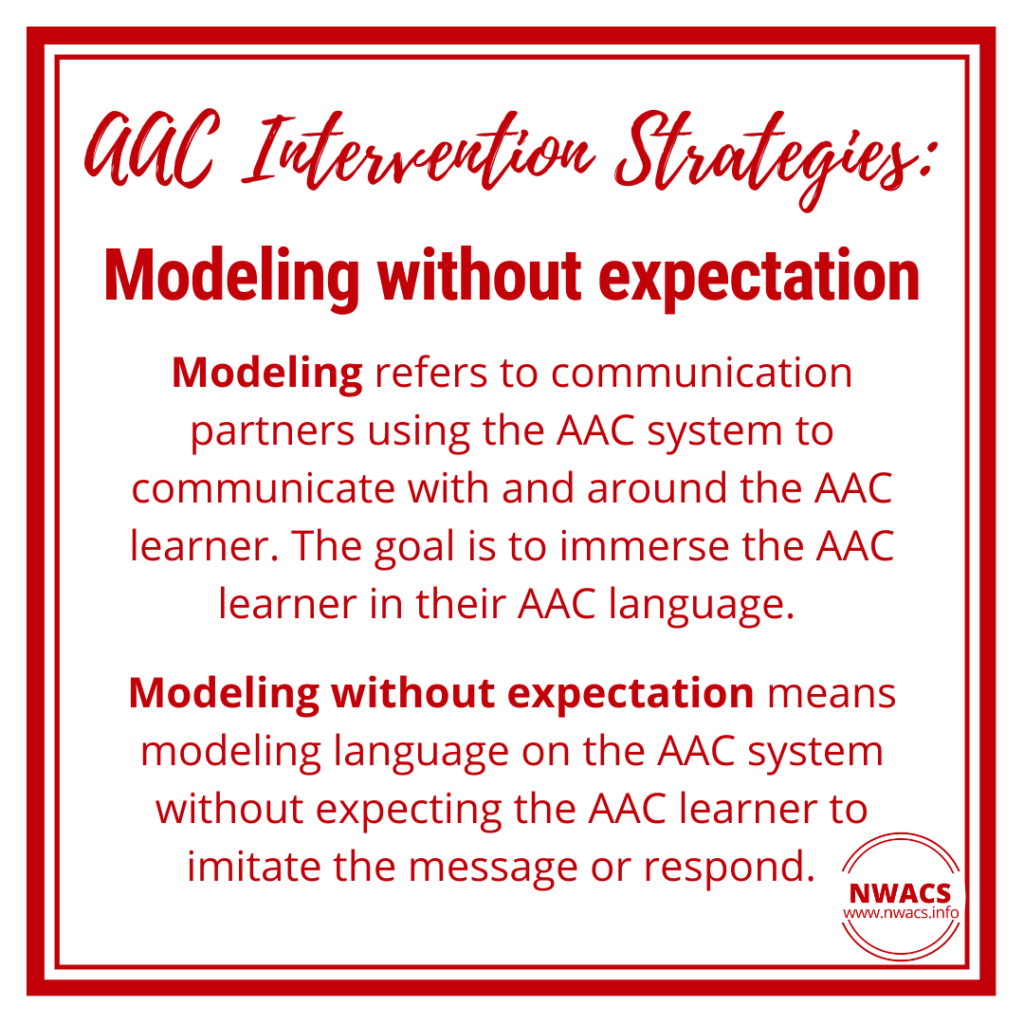
- modeling without expectation
- model language for a variety of communicative functions
- create communication and learning opportunities through experiences
- embed AAC in daily routines (motivating, repetitive, predictable)
- partner-assisted/co-constructing messages
- expectant pause
- core words
- language expansion and extension
- descriptive teaching/language
- CAR and CROWD (during shared reading)
- identify, reason and talk about, and respond to emotions
- explicitly teach concepts and word meanings
“HOW I expressively communicate may be different, but not WHAT I needed to develop linguistically in order to communicate.”
Faye Warren, AAC Communicator




Resources to Explore
Articles, Books, and Documents
- AAC Implementation in Inclusive Early Childhood Settings Communication Matrix Collection by Amy Starble (2017)
- Augmentative and Alternative Communication: Challenges and Solutions (2021), Billy Ogletree
- Chapter 3: AAC in Preschool: Navigating Challenges in Language and Literacy Instruction by Andrea Barton-Hulsey, Marika King, and Jennifer Lyons-Golden
- Comprehensive Literacy for All: Teaching Students with Significant Disabilities to Read and Write (2020) by Karen A. Erickson and David Koppenhaver
- Creating a Learner’s Environment at Home by Melissa Lim (2022) NWACS Blog
- Emergent Writing Communication Matrix Collection by Eric Sanders (2017)
- Fundamentals of AAC: A Case-Based Approach to Enhancing Communication (2023), Nerissa Hall, Jenifer Juengling-Sudkamp, Michelle L. Gutmann, and Ellen R. Cohn (eds)
- Shared Reading Communication Matrix Collection by Melissa Pebly (2018)
- Strategies for Talking about Emotions as PartnerS (STEPS) instructional program developed by Na & Wilkinson (2015, 2017)
- TELL ME: AAC in the Preschool Classroom (2016) by Carole Zangari and Lori Wise
- also check out these related posts on the PrAACtical AAC blog
Learning Modules
- AAC Learning Center Moodle resources for learning about augmentative and alternative communication (AAC) by the RERC on AAC and the AAC program at Penn State University
- Dynamic Learning Maps Professional Development modules related to communicating for a range of purposed and audiences
- explore other module topics including Emergent Writing, Writing with Alternative Pencils, and Predictable Chart Writing
- Literacy and AAC: Letter-Sound Correspondences
Websites
- NWACS website
- Early Childhood Resources from UNC Center for Literacy and Disability Studies
- Project Core implementation model to provide children with access to a flexible Universal Core vocabulary and evident-based communication instruction
Podcast and Webinar Recordings
- AAC in the Cloud presentation recordings:
- Pretend Play Power – Integrating Literacy Modalities & Tools by Kelly Fonner & Donna McNear (2023)
- Supporting Your Youngest Learners – How Carefully Curated Resources with Adult Facilitation Can Promote Language Development, Play, & Communication by Beth Poss (2020)
- You’ve Got This! Caregivers as the Driving Force in Early AAC Implementation by Kate Ahern (2019)
- Language Development & AAC: Back to Basics podcast from SLP Nerdcast with guests Dr. Cathy Binger and Dr. Jennifer Kent-Walsh (2021)
- The impact of early access to AAC webcast by Dana Nieder at the RERC on AAC State of the Science Conference (2018)
Other Resources
- Road Maps (Patricia Dowden, Ph.D., CCC-SLP, University of Washington; shared with permission at 2017 WSLHA Spring Workshop)
- Talking With Tech Podcast
Useful Tips
“The success (or failure) of the intervention will depend on the fit with the entire family system, not just the individual who requires AAC. The only way to ensure this contextual fit is to listen to families in order to understand their priorities and concerns.”
Beukelman & Light
- Families/caregivers of and professionals working with young children need to be told about the option and benefits of AAC!
- Families/caregivers of and multidisciplinary professionals working with young children need training and ongoing support!
- Stay family-centered and child-centered!
- pay attention to the pace that works best for the family
- Focus on communicative intent, not how the message was communicated.
- Learn about prompting hierarchies, different kinds of prompts/cues, and how to fade them.
- Being proactive and starting AAC early is research-supported!
- Research indicates that various types of AAC systems can be effective with children 0-6 years across a wide variety of disabilities (including high-tech, robust systems)!
- Presume competence! Presume Potential! Believe they CAN learn!
- Find your support networks!
- Families:
- Leslie Jeanne Berns Support Group for children who have communication challenges and their families (facilitated by University of Washington Speech and Hearing Sciences clinical faculty (SLP) and graduate students; meets virtually, monthly)
- Family AAC (hosted by NWACS) – This Facebook group (administrated by NWACS) is centered in Washington State, although any parent/caregiver interested in augmentative and alternative communication (AAC) is welcome. This group is for parents and other family members of children who are non-speaking or unable to meet all of their communication needs with mouth words. While this group does center the family perspective, other AAC stakeholders are welcome in the spirit of collaboration and shared learning!
- AAC vendors and app developers have pages on various social media channels. Many also have Facebook groups that can be a good place to connect with a support network.
- also look for social media accounts and/or Facebook groups related to specific diagnoses
- and look for social media accounts of AAC users and/or parents of AAC users
- Facebook groups, such as:
- Professionals:
- NAACHO: Networking for AAC and Hangout – This Facebook group (administrated by NWACS) is for SLPs in Washington State who support people who use AAC. It is for collaboration, networking, and supporting each other in the grand adventure of augmentative and alternative communication.
- AAC vendors and app developers have pages on various social media channels. Many also have Facebook groups that can be a good place to connect with a support network.
- also look for social media accounts and/or Facebook groups related to specific diagnoses
- and look for social media accounts of AAC users
- Facebook groups, such as:
- Families:
Selected References
- Binger, Cathy & Light, Janice. (2007). The effect of aided AAC modeling on the expression of multi-symbol messages by preschoolers who use AAC. Augmentative and alternative communication (Baltimore, Md. : 1985). 23. 30-43. DOI: 10.1080/07434610600807470
- Fallon, Karen & Light, Janice & Paige, Tara. (2001). Enhancing Vocabulary Selection for Preschoolers Who Require Augmentative and Alternative Communication (AAC). American Journal of Speech-Language Pathology. 10. 10.1044/1058-0360(2001/010)
- Lieberman-Betz, R. G., Brown, J. A., Wiegand, S. D., Vail, C. O., Fiss, A. L., & Laura J. Carpenter, L. J. (2023). Building Collaborative Capacity in Early Intervention Preservice Providers Through Interprofessional Education. Language, Speech, and Hearing Services in Schools. https://doi.org/10.1044/2022_LSHSS-22-00110
- Neal, C. & Brady, N. (2022). Narrative Interventions for Children Who Use Augmentative and Alternative Communication: A Call and Plan for Future Research. Perspectives of the ASHA Special Interest Groups, 7(6), 1619-1629. https://doi.org/10.1044/2022_PERSP-22-00007
- Pope, L., Light, J., & Franklin, A. (2022). Black Children With Developmental Disabilities Receive Less Augmentative and Alternative Communication Intervention Than Their White Peers: Preliminary Evidence of Racial Disparities From a Secondary Data Analysis. American Journal of Speech-Language Pathology. https://doi.org/10.1044/2022_AJSLP-22-00079
- Romski, M., Sevcik, R., Adamson, L., Cheslock, M., Smith, A., Barker, R. M., & Bakerman, R. (2010). Randomized Comparison of Augmented and Nonaugmented Language Interventions for Toddlers With Developmental Delays and Their Parents. Journal of Speech, Language, and Hearing Research. https://doi.org/10.1044/1092-4388(2009/08-0156)
- Sun, T., Bowles, R. P., Gerde, H. K., & Douglas, S. N. (2022). Supporting AAC Use for Preschoolers With Complex Communication Needs. Young Exceptional Children, 25(2), 101–112. https://doi.org/10.1177/1096250620959664
- Timpe, E., Kent-Walsh, J., Binger, C., Hahs-Vaughn, D., Harrington, N., & Schwartz, J. (2021). Using the ImPAACT Program with preschoolers with Down syndrome: A hybrid service delivery model. Augmentative and Alternative Communication, 37, 113-128. 10.1080/07434618.2021.1921025



Share your comments or questions.