
5 Things a Parent/Guardian Can Do
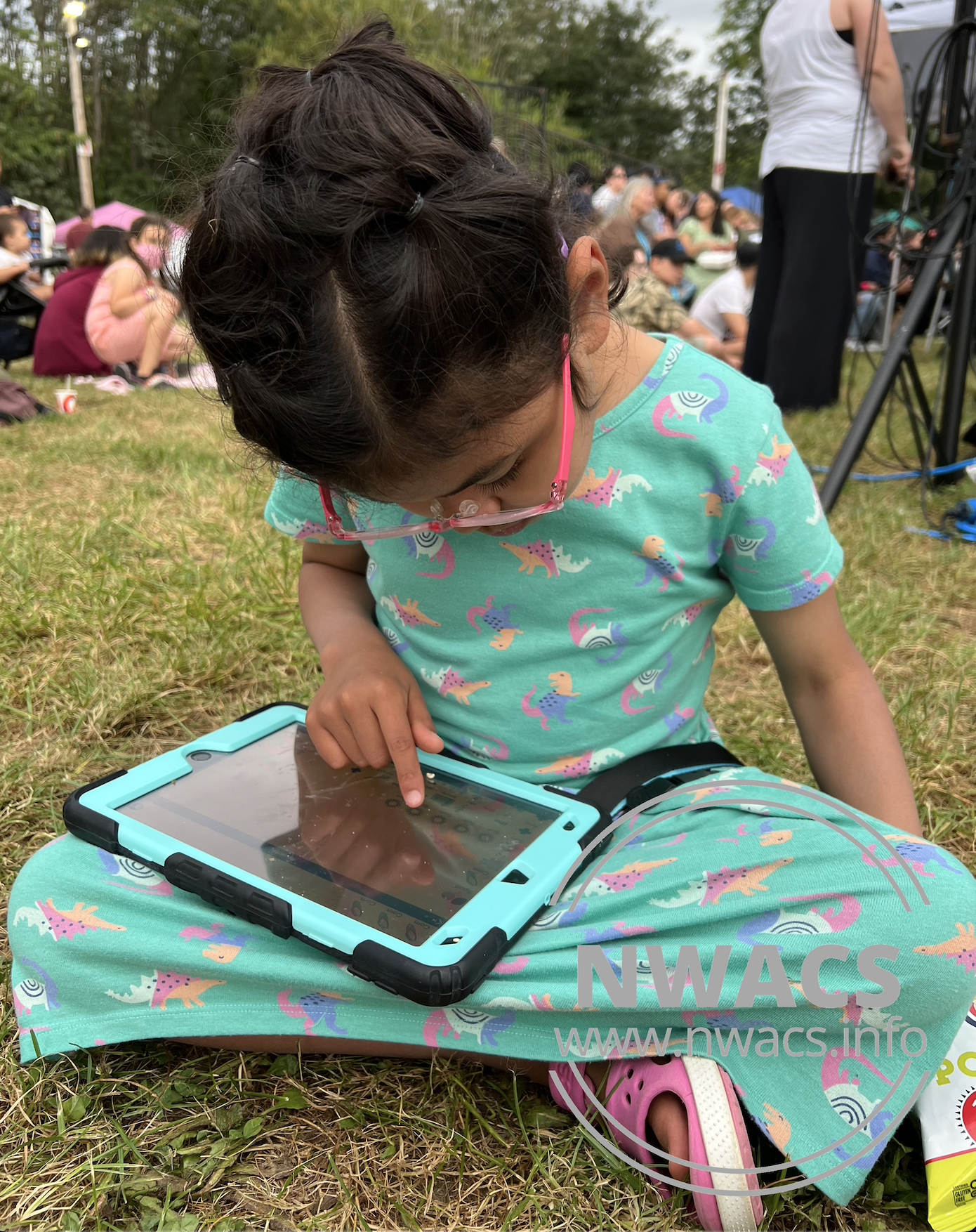
My kiddo has been using her AAC device (iPad with Proloquo2Go) for nearly 2 years. It wasn’t until I fully embraced the device, specifically this school year (2021-2022), that I began to see significant jumps in spontaneous use and even verbal language. **This is not to say that all children will begin to communicate verbally after using an AAC device. But it can give the child the opportunity to practice their confidence in verbal language by listening to the device saying the word over and over (and over) again to where they are ready to attempt to say the word verbally themselves.
Here are 5 things parents/guardians can do to help expose their child to their communication device.
1. Recognize YOU as the parent/guardian are a big player in the success of your child’s communication.
Guardians/parents of AAC users are a fundamental cornerstone in creating a “learner’s environment” within the home and the outside world. Outside of school and the therapy center, you are the primary model for your child.
According to a TechOWL AAC Community article, You are a Model,
“An 18-month-old child has been exposed to 4380 waking hours of oral language. A typical AAC user, exposed to modeling, two times a week for 30 minutes, would take 84 years to have the same level of exposure.”
It seems like a daunting task but we are building our children up for success and their own advocacy. So often we rely on the education system and outpatient therapies to provide these tools and exposure. Last year, with the pandemic, Zoom school, and maintaining a balance of life for a medically fragile child, I neglected the AAC device and focused on schoolwork. I now recognize that AAC must be embraced, encouraged throughout the day, and practiced daily.
2. Do your homework and educate yourself on AAC and its practice.
Here’s a list of a few sites, books, Facebook pages, podcasts, and even an AAC reading curriculum that I continue to refer to:
Curriculum:
Podcasts:
- Lomah Disability Podcast (recently did a series on Doing More with AAC episodes 164 – 175)
- Talking with Tech AAC Podcast
Websites:
- PrAACtical AAC
- The AAC Coach (Facebook, Instagram, YouTube)
- Edmonton Region Learning Consortium: Engaging all Learners and conversation with Dr. Musselwhite
Facebook Groups:
- Ask Me, I’m an AAC User! (24 Hour Rule!)
- AAC through Motivate, Model and Move out of the Way
- AssistiveWare (or look for a Facebook page/group for your child’s specific system)
Book:
- Erickson, K. A., & Koppenhaver, D. (2020). Comprehensive Literacy for All: Teaching Students with Significant Disabilities to Read and Write. Paul H. Brookes Publishing Co.
3. Now that you are filled with information, ask questions.
Who is modeling for your child now? Their speech-language pathologist (SLP)? In outpatient therapies? In school? Their teachers?
How are they modeling for your child?
Ideally, you can make a game plan with your child’s SLP(s). This shouldn’t feel intrusive. You are a part of the team and with good, consistent practice, they too will benefit.
Is the current level/program/design robust enough to continue to engage your child? Should we ramp it up?
My daughter was at first using Crescendo Intermediate 4×8 board. It wasn’t until her amazing SLP brought up that it may be limiting her communication that we jumped to 6×10. That’s 60 icons on the screen. That’s a lot of icons and I still had to tweak it to best suit my child’s needs.
Between the SLP(s) making changes and your child exploring their device, you need to know how to add/change items such as favorite foods, songs, shows, animals, etc. But there is a fine line between not taking the device away from your child and wanting to model/add/show/demonstrate.
This is where a session of just you and the SLP may be incredibly helpful. Learn how to:
- add a button
- add a folder
- utilize plurals
- make past tense verbs
- change the color contrast
- export the file
- back up the file
- change the speed of the voice
- change the tone
- change the voice
- add your own pictures
- utilize templates
- really the list can go on
For some of these items, you may have to just perform a web search or go to the manufacturer’s website. The frustrating thing is you need to be very specific and use the key terms in the search, at least with AssistiveWare (Proloquo2go). That’s why I find just going to YouTube and typing in “how to…” works a bit better. Also, like my learner, I’m a visual, auditory, and kinesthetic learner and how-to videos just work best for me. And of course, I’m doing this at night, when I’m not taking the device away from her.
Which brings me to…
4. Get to know your child’s device but don’t take away their voice.
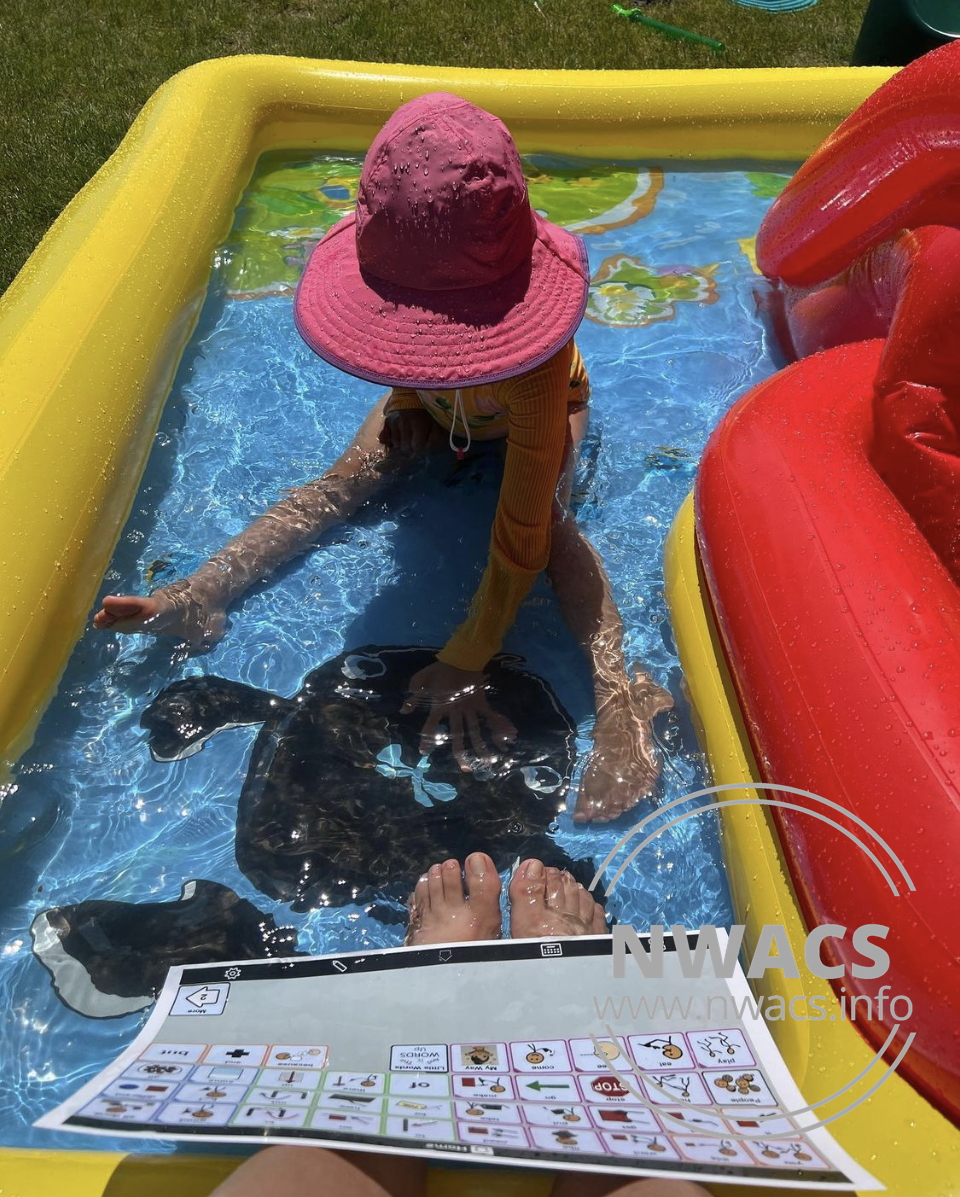
The need to remove the device can be remedied by having your own iPad with the program. Since she is on my iTunes account, I can put the app on any iPad that is attached to my account and “airdrop” the updated profile to it. I completely understand that this may not be feasible for all families, as it is hard enough to get the school device home for the summer. Due to her vision and the AAC device not being always available in every setting (think the pool, rain, extreme sun [it’s incredibly difficult for her to see]), I have requested that the Assistive Technology department of our school district create large print outs on No-Tear paper, a paper that can be printed on that doesn’t tear and is waterproof. We have 3 pages printed out. These printouts include the main page, her reading page, and chat page.
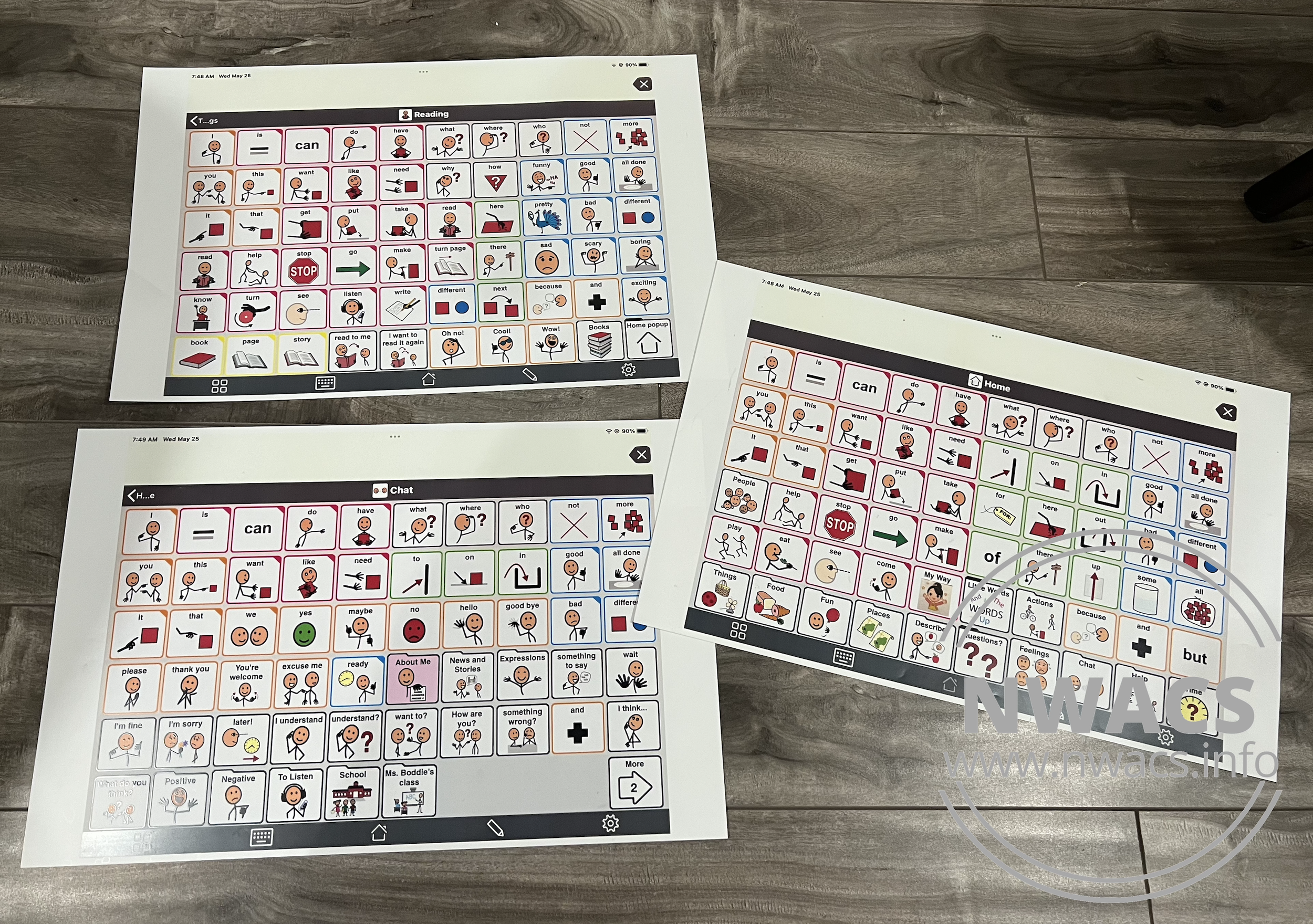
Having these 3 pages printed out allows me to continue to practice muscle memory with my child and demonstrate on it even in the (splash) pool! Because we use Crescendo Proloquo2go, the main core words, which are about 30 icons, remain in the same place in any given folder/page on her device. This helps with muscle memory of the location of “core words”. For example, “I” is always on the top left corner of her screen, go-to verbs such as “want/like/need/have” are to the right of the pronouns, etc. This allows me to practice with her when outdoors, even when it is not safe or practical to carry the device (raining, swimming, or running around the playground).
Ideally, you are modeling on an electronic device with voice output. This way you can demonstrate how to open mini folders for plurals, past tense options, etc. WHEN (because it does happen) you need to model for your child on THEIR device, I strongly suggest acknowledging that it is their device and you are asking to borrow it. Here is a sample of phrases I use:
“I understand you are frustrated trying to find the right words, can I help you?”
I then hold out my hand and wait for her to give it to me. If she doesn’t want me to demonstrate in that manner, I try my best to guide her to the folder she may need. I do not put my hand over her hand. I place my hand under hers and let her pointer finger do the touching.
“I would love to show you something I learned. May I borrow your device?”
“It can be hard, tomorrow it will be easier, today, I can help you.”
A great time to model AAC with new concepts is during breakfast, lunch, and/or dinner. They are busy eating and you can describe what they are eating, making a mental note to navigate away from the wants and needs vocabulary. Take this time to describe the food, ask questions, and narrate what you are modeling.
5. Reframe your mentality. Reframe your sentences of concerns with the word, “YET”.
My child isn’t really picking up the program…yet.
My child doesn’t use it for more than just asking for things…yet.
My child can’t figure out how to use more expressive language…yet.
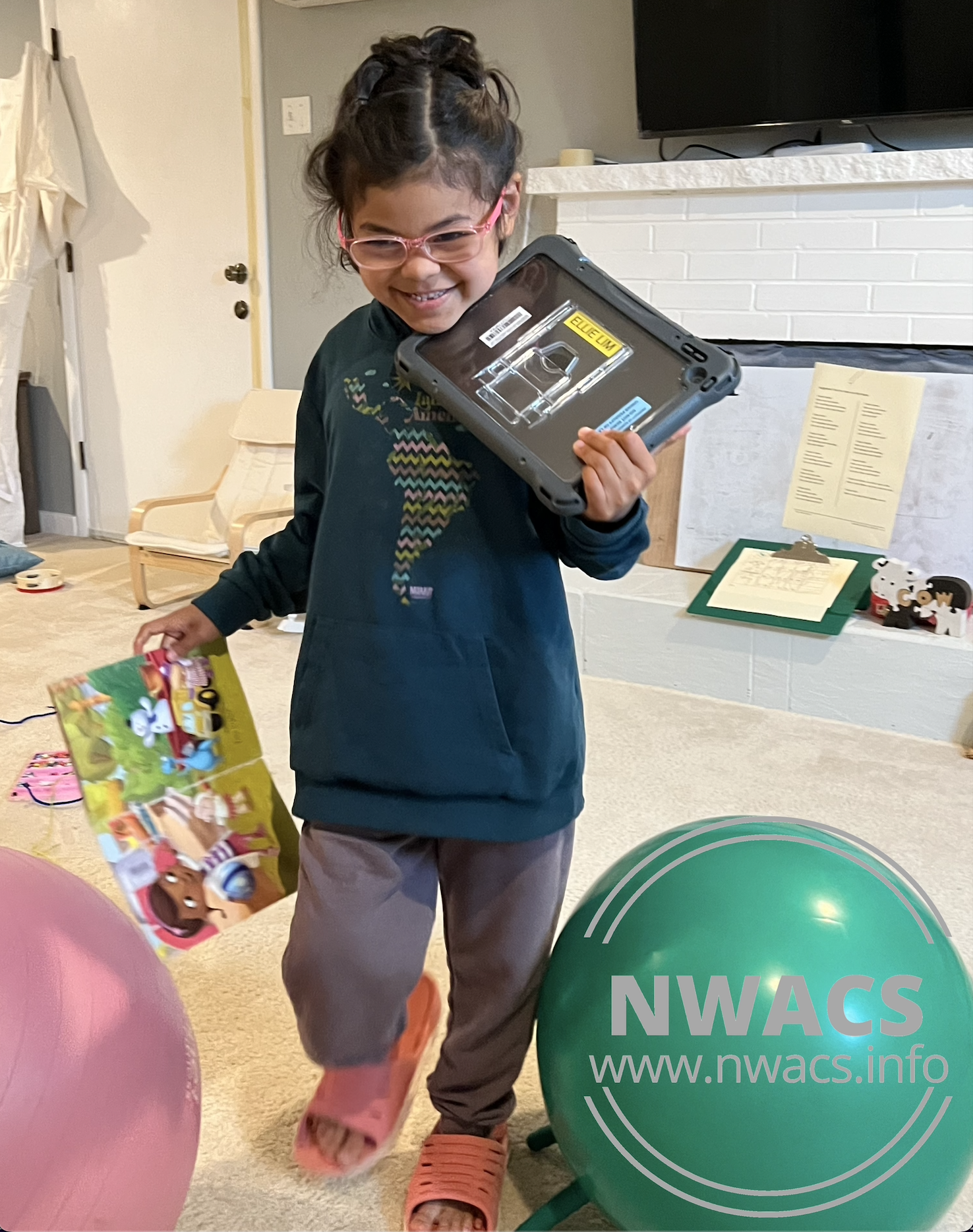
None of us came into this world knowing how to speak. We listened for a very long time before we even attempted our first words. As a parent, continue to model for your child. Just take small steps. Don’t overwhelm yourself. We took a week of reading different books and modeling “you” and “I” to get these concepts down. I did not model any other words on the devices when honing in on this goal. I would manipulate her pointer finger to point to herself and press “I”. Or “you” and take her pointer finger to point to my chest and then press “you”. Don’t overwhelm yourself with complete sentences – start with “I want” because what child doesn’t want to share their needs and how to meet them? But then branch out and include expressions and likes. What do you want to learn about your child?
“I like…”
“What?”
“Where?”
“Who?”
And they may not answer back today or tomorrow. But it will happen, it’s just a matter of time.
Take time out of your day to create opportunities within your home. I know that sounds daunting on top of so many other hats that you already may wear. Ultimately, when I am not here, I want my child to be able to advocate for herself. And it begins with small steps… or in this case, a press of an icon.
Reference
- You are a model. AAC Community. (2019, April 3). Retrieved July 31, 2022, from https://aaccommunity.net/ccc/you-are-a-model/#:~:text=A%20typical%20AAC%20user%2C%20exposed,we%20can%20speak%20the%20words.




Share your comments or questions.