Right To Access Interventions and Supports That Improve Communication


July 11, 2022

Home > Community > AAC Supporters > Training for Communication Partners
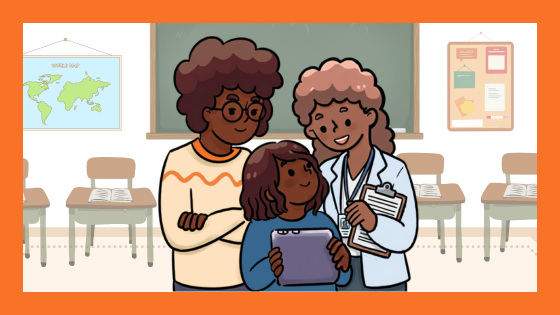
2 adults and a student standing together in a classroom. One adult is holding a clipboard. The student is holding an AAC device.

By: Jill Senner, SLP and Matthew Baud, SLP (speech-language pathologists)

Reading time: 3 minutes

We welcome Dr. Jill Senner and Matthew Baud to the NWACS blog. They developed the SMoRRES® approach to AAC partner training.


As an AAC parent or professional, what do you think of when you hear the word intervention? We’re guessing that most of you think about a strategy used during 1:1 speech therapy or maybe applied behavior analysis (ABA). What if someone said that supporting communication partners is an intervention? Yup, it’s true!

Sarah Blackstone has said that “Being an effective communication partner or AAC facilitator is not intuitive. It often requires one to change long-established, unconscious ways of communicating” (2006, p. 12). In fact, the research tells us that untrained family members, teachers, therapists, and even peers can

  • monopolize conversational turns,
  • control the topic of conversation,
  • and demand specific responses.

All of these habits may negatively affect communication development in AAC communicators.

There is a growing body of research evidence that communication partner instruction is an intervention. AAC communicators experience numerous communication gains as a result of parent and school staff instruction. Documented improvements include

  • increased conversational turns,
  • increased independence (i.e., initiation),
  • increased utterance length,
  • increased use of unique words,
  • and increased frequency of communication.

However, what we teach is as important as how we teach. We know that AAC modeling, in other words, partner-augmented input, is an effective strategy. However, it’s unlikely that a parent or teacher can simply read a handout or watch a YouTube video and then start modeling at home or in the classroom. Here the evidence suggests that using multiple instructional elements such as

  • talking about the importance of modeling,
  • demonstrating modeling on a device,
  • allowing communication partners time for hands-on practice modeling,
  • as well as coaching modeling in the natural environment,

are all important to changing communication patterns at home or in the classroom. This is why the SMoRRES® Training Program contains all of these features and more.
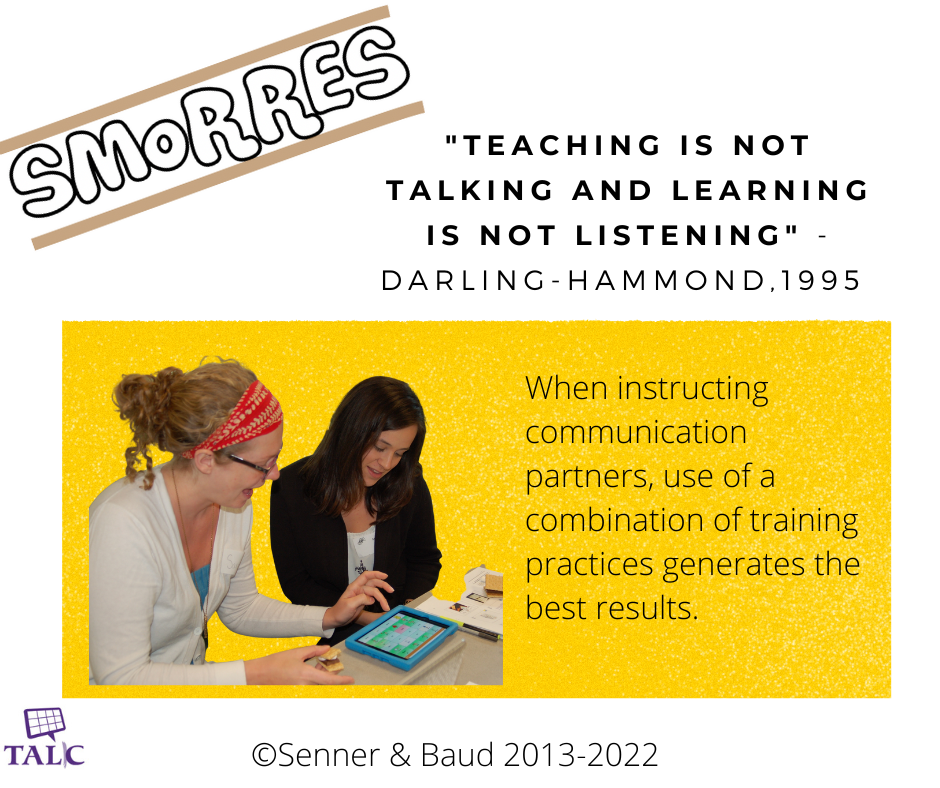
Infographic with a quote from Darling-Hammond (1995) that says, "Teaching is not talking and learning is not listening." Beneath the quote is a statement from Senner and Baud saying, "When instructing communication partners, use of a combination of training practices generates the best results.

After participating in the SMoRRES® Training Program, parents and school staff reported

  • increased familiarity,
  • more confidence,
  • and better comfort using the child or student’s speech-generating device (SGD).

Unfortunately, even though we know that using multiple training elements is an effective practice, the most common type of training is still a one-day in-service. How can we bridge this gap?

We know how hard it is to read a research paper and then implement a program as intended. This is why we provide several free SMoRRES® resources on the Technology & Language Center, PC website for those supporting AAC communicators including streaming videos, a poster, handouts in English and Spanish, and more! Increase the use of evidence-based practices in your trainings today to support communication partners and improve communication.

References

  • Blackstone (2006). Training partners: Learning more about what to do.  ACN, 18, 12-16
  • Senner, J. E., Post, K. A., Baud, M. R., Patterson, B., Bolin, B., Lopez, J. & Williams, E. (2019). Effects of parent instruction in partner-augmented input on parent and child speech generating device use. Technology and Disability, 31, 27-38. DOI: 10.3233/TAD-190228 
  • Senner, J. E. & Baud, M. R. (2017). The use of an 8-Step instructional model to train school staff in partner-augmented input. Communication Disorders Quarterly, 38(2), 89-95. DOI:10.1177/1525740116651251


Share your comments or questions.

Your email address will not be published. Required fields are marked *

Jill Senner

Jill E. Senner, PhD, CCC-SLP

Dr. Senner has over 20 years of experience working with children with complex communication needs. She is the owner and director of Technology and Language Center where she specializes in providing augmentative and alternative communication (AAC) services via telepractice. Dr. Senner presents lectures on AAC topics online and around the world, has published research articles and textbook chapters on AAC, and is an adjunct professor of speech-language pathology at DePaul University.

Matthew Baud

Matthew R. Baud, MS, CCC-SLP

Matthew has been working with AAC for 20 years. He currently is the Assistive Technology Coordinator at Niles Township District for Special Education (NTDSE) performing evaluations, trainings, and coaching communication partners. Matthew also has his own AAC private practice working with individuals with complex communication needs from birth through adulthood. He is an adjunct professor at Saint Xavier University where he teaches a graduate course in AAC and has presented at national and state conferences. Matthew has published research in the areas of AAC.

More Content to Explore

  • Stepping Into AAC logo

    The Joy of “Stepping Into AAC”

    January 11, 2026

    Lisa shares about discovering the amazing – and free – “Stepping Into AAC” program.
  • Supporting Exemplar AAC Communication Partners: Model as a MASTER PAL with the MASTER PAL logo

    Model as a MASTER PAL Training

    11 training modules with slides, handouts, discussion prompts, links to videos, and activity suggestions.
  • close up of a person holding their hards in the shape of a heart

    Training for Supporters

    Links to trainings for communication partners.
  • NEW Discoveries: STAR: Supportive Training with Active Respect

    New Discoveries: Supportive Training with Active Respect

    July 7, 2018

    Highlighted Resource: Supportive Training with Active Respect (STAR Video Library), an online series of training videos
N W A C S logo

Northwest Augmentative Communication Society

Connect with us on social media!

Subscribe to Our Mailing List

Sign up to receive email, including news, updates, and marketing.

Donate to NWACS

Thank you for your ongoing support!


Important Website Information

By using this website, you agree that the content is for educational purposes only. It is not intended to be professional advice. Information and materials shared are to help guide creativity and support AAC use. Authored articles reflect personal perspectives and experiences. Please consult qualified professionals for specific AAC guidance. For more details, please see our Terms of Use.

Many resources shared on this website are not owned or maintained by NWACS. We are committed to accessibility, but some third-party content may not meet accessibility standards. Please review our Accessibility Statement. If you have any questions or encounter barriers, please contact us.

Privacy | Terms of Use | Accessibility Statement | Site Map

© 2016-2026 Northwest Augmentative Communication Society, a 501(c)(3) nonprofit organization