A couple of months ago I wrote about use of Partner Assisted Scanning (PAS) with students. I mentioned that this is a method of AAC access that should be considered with students that present with complex bodies. This type of access (considered alternate access) can sometimes be best for students that benefit from having a human “smart” partner that can slow the scanning, speed up the scanning, skip to key words, or read subtle body cues in the AAC user.
It is nearly impossible to use PAS with a student unless they have a way of indicating yes and/or no. This response is needed in order for the AAC user to pick or say his word. As the partner scans a list of words, the user indicates NO when they do not hear the word they want to say. The user indicates YES when they hear the choice they want to communicate. This yes/no response can be a head nod/shake, other gestures, or done with symbols/switches. Some users will have already learned a yes/no response, while others will need to be taught how to respond with a yes/no.
Again, I must reference my favorite family (We Speak PODD) that has many examples of PAS on their YouTube channel. It is much easier to completely understand PAS when it is seen in action. In this clip, the mother is using PAS with her daughter Angela. As you watch this video, pay close attention to the yes/no responses used by Angela.
I hope that after watching this video you can see that the yes/no response is how Angela picks what she wants to say. This is in contrast to direct selection where the AAC user touches or directly picks the symbol they want to say. As therapists, it is important we teach a yes/no response to users that we have evaluated and decided to use AAC with PAS.
There are a number of ways to teach a yes/no response. The best yes/no is the universal gesture for yes/no. This is a head nod (yes) or head shaking (no). Linda Burkhart suggests use of the Personal Talker for teaching this gesture. A switch with voice output is place at the child’s cheek and another at the chin. When the child moves their head right to left, the NO button is activated. When the head is moved up and down, the YES button is activated. The auditory feedback of the switches, along with communication partners honoring the yes/no response, reinforces use of head gestures for yes/no.
Here is a short video of switches being used for yes/no.
Once the child learns how to use the yes/no gesture, the communication partner can fade use of the switches. Not having to use switches is much easier for both the child and the communication partner.
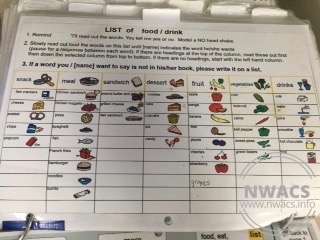
Another way to teach yes/no for scanning is the use of yes/no icons. Below is a picture of a yes/no board that I use with one of my students. This student uses a PODD communication book which includes auditory scanning of the ‘lists’. When the partner scans the list of words, the student answers yes/no for each word. For example, when scanning through the ‘food list’, the student is able to select what he would like to drink. He listens carefully to each choice and responds YES when he hears the choice he wants.

If you’d like to read more about yes/no, Kate Ahern at Teaching Learners with Multiple Special Needs ran a (6-part) blog series on yes/no responses. Although it was published in 2012, this is a resource that I continue to reference:
- The Yes/No Series – Part One – Ways to Indicate Yes and No
- The Yes/No Series – Part Two – Teaching Yes/No
- The Yes/No Series – Part Three – Sing it!
- The Yes/No Series – Part Four – Using Games to Teach and Reinforce Yes/No
- The Yes/No Series – Part Five – Using Books to Teach and Reinforce Yes/No
- The Yes/No Series – Part Six – “Best Yes” and Rewarding Successive Approximation
I’ve talked about a couple of ways to elicit a yes/no response for PAS. Are you using PAS? How are your students indicating yes/no?



Share your comments or questions.