A few years back I had a high school student on my caseload with a diagnosis of CP (Cerebral Palsy). She used a wheelchair for mobility and presented with complex communication needs. The student was able to lift her head to give a ‘yes’ response, but she did not have a consistent ‘no’ response other than not responding to the question. She could reach out for things, but was unable to grasp small objects. Also, she did not isolate a finger for pointing. Although she was in high school, she did not enter this setting with a comprehensive AAC system. I needed to figure out what would work for her given her motor skills challenges.
As I began to problem solve around an appropriate AAC system, including the access method, I reflected on notes taken from a 5-day PODD (Pragmatic Organization Dynamic Display; Gayle Porter) course that I attended a couple of years prior to working with this student. This class described Partner Assisted Scanning (PAS) as a method that could be used with students with motor challenges. It works by having a communication partner (typically the teacher, SLP, or parent) scan through a predictable set of words/phrases. When the AAC user hears the word they want to say, they signal ‘yes’. When a word is spoken by the communication partner that the AAC user does not want, then the user responds with a ‘no’ signal. The ‘yes’ response becomes, in essence, the way they select or point to the button on the page.
There is a family that uses PAS that has a Facebook page called We Speak PODD. Many of their videos are posted on YouTube. Here is a short example of how PAS works.
After watching the video you will see that PAS is a challenging system. It is time intensive and requires skill and patience. Despite this, I began using PAS with my student and trained staff on how to use the technique. The teacher working with the student sometimes complained that this method was too hard. It would have been easy for me to abandon PAS at that time. Instead, I provided more training and support for the staff. After months of practice, the student was able to learn to request favored toys using PAS. On one occasion, she was able to tell us that her finger was hurting. This was huge! I attributed this success to the team of teachers that worked with this student on a daily basis. It was their consistent intervention of modeling and presuming competence that ended in success for this student.
Partner Assisted Scanning can truly be the best communication access method for certain students. These are our students with complex bodies that require a human (“smart”) partner that can read subtle cues. Or those students that need a low-tech back-up system for their high-tech scanning AAC devices. The key to implementation includes choosing or making concise and predictable scanning pages with pictures, words, or pictures and words. Therapeutic intervention should include opportunities for scanning practice in meaningful activities. Scanning can be done by grouping words or reading one word at a time and waiting for a response. In addition, aided language stimulation should be incorporated into therapy. Finally, staff training should be on-going so that teachers feel supported in implementing PAS all day long.
What intervention strategies have you found useful when using PAS?
Connected Post
One response to “Partner Assisted Scanning”
-
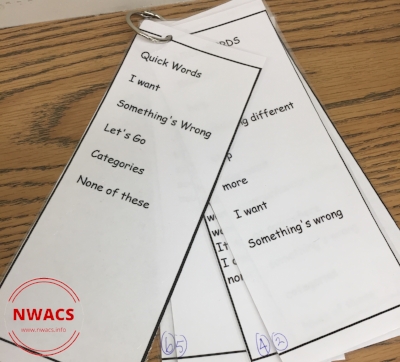
Thank you so much for this post! Is the PAS word list that is shown in the picture available as a resource to download? Or would you suggest creating a unique list for each individual?


Share your comments or questions.