
Pursuing AAC Through the Public Schools (USA)
The process for getting Augmentative and Alternative Communication (AAC) looks a little different based on where you pursue it. With this post, my goal is to help explain the process of getting AAC through the public school system. Before we can dive into that though, it’s important to understand the Special Education process of public schools.
Individuals with Disabilities Education Act (IDEA)
The way that students get Assistive Technology (which includes AAC) in the schools is through the Special Education system. Children who have been found Eligible for Special Education will have an Individualized Education Program (IEP). Under the Individuals with Disabilities Education Act (IDEA) , all students are entitled to the supports and/or services they need to make progress and receive a Free and Appropriate Public Education (FAPE). That means, it is a school district’s responsibility to provide all students what they need to access their education. It sounds simple, but obviously, it can end up getting pretty complicated!
There are also differences in how states and local school districts choose to interpret this Federal law. It reminds me of the game of telephone. One person whispers something in someone’s ear, it gets passed around the circle, and by the time it comes back to the original person, the message has changed.
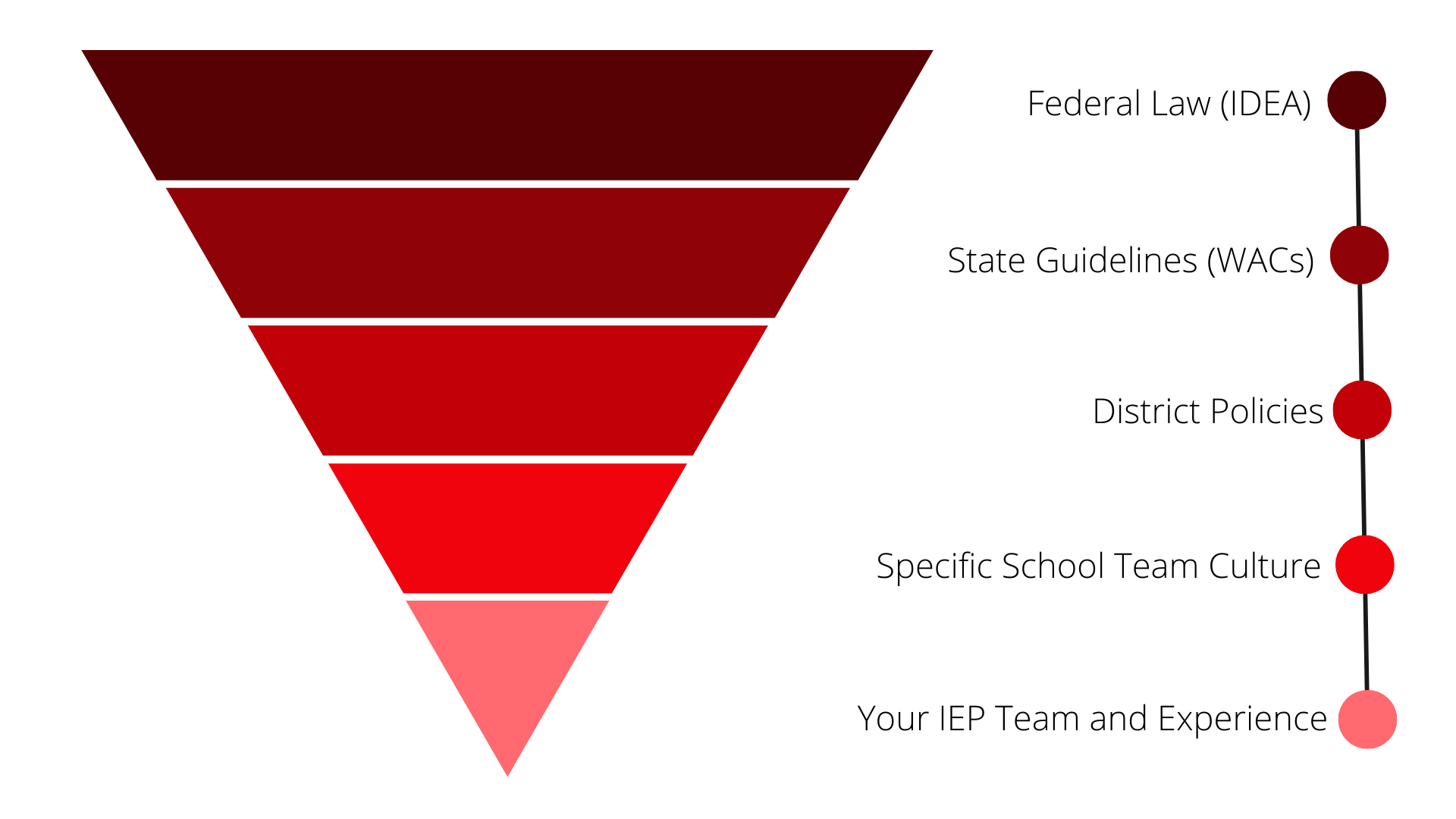
This infographic of a funnel illustrates five lenses through which IDEA is interpreted.
At the top is the Federal Law (IDEA).
Second level: each state interprets IDEA to form their state guidelines. In Washington State these guidelines are outlined in the WACs (Washington Administrative Code).
Third level: each school district in the state interprets their state guidelines to develop their district policies.
Fourth level: each individual school in the district interprets their district guidelines. That school’s “team culture” impacts how things work in practice.
At the bottom, each IEP team (and each person on the IEP team) uses their understanding and interpretation. This impacts your IEP experience.
The Special Education Process
Now that we can see the legal basis for special education, let’s dive into how it actually works.
- The first thing that needs to happen is someone needs to notice that there is a challenge that a student is facing with accessing the general education curriculum. This challenge could be academic, social, behavioral, or otherwise.
- Someone submits a request or referral for an evaluation.
- Oftentimes, referrals or requests come from teachers, BUT as a parent or guardian you have the legal right to request an evaluation!
- AND per the Child Find Mandate (part of IDEA), schools have a legal responsibility to find students eligible for special education.
- If the referral team has sufficient evidence, an evaluation for Special Education Eligibility will take place.
- A school psychologist is often the team leader for special education evaluations. The purpose of the evaluation is to determine if a student qualifies for special education services and in what eligibility category.
- If a student qualifies, then an Individualized Education Program (IEP) Meeting will take place.
Simplified, this process looks like this infographic:
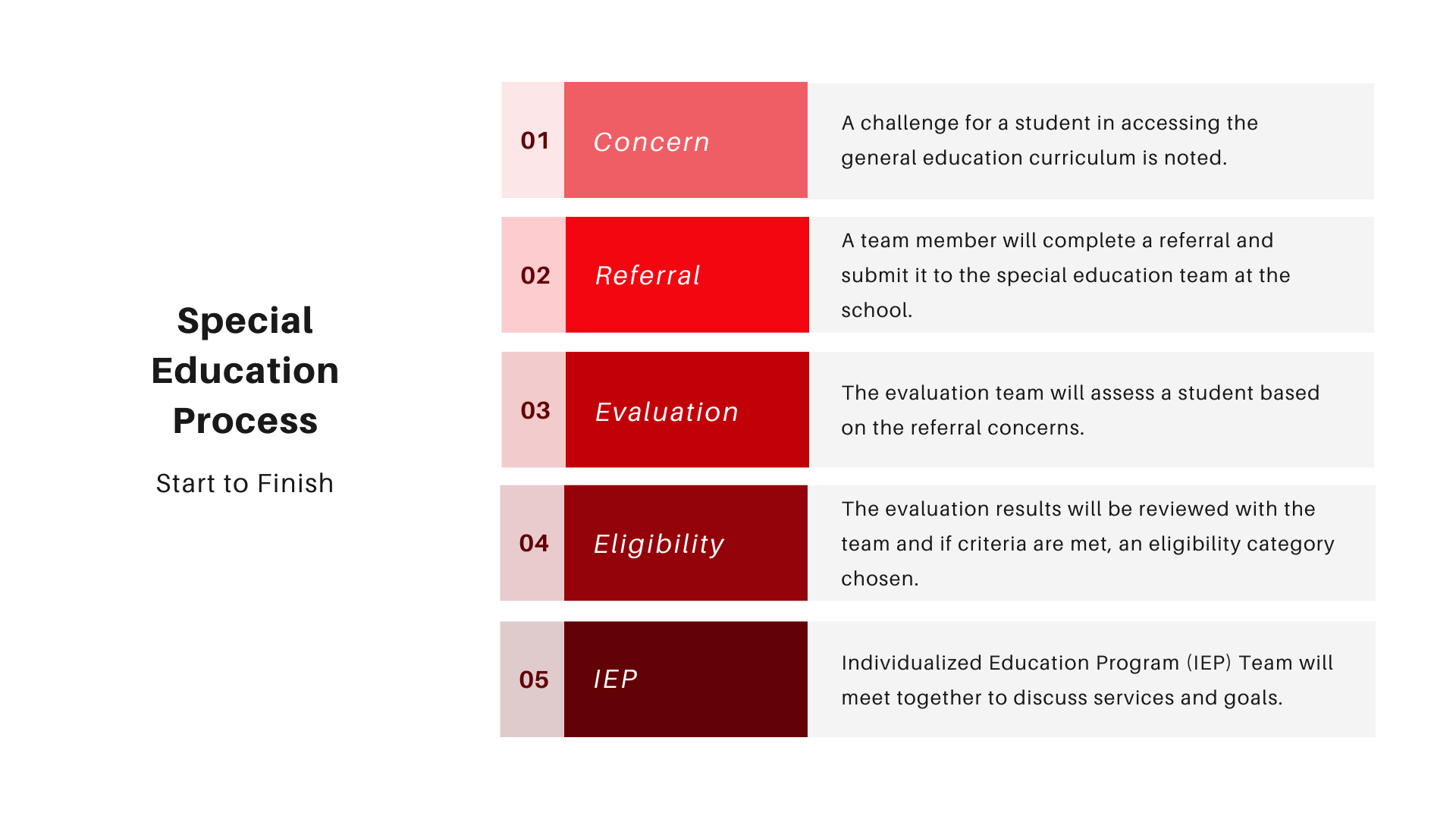
- Concern: A challenge for a student in accessing the general education curriculum is noted.
- Referral: A team member will complete a referral and submit it to the special education team at the school.
- Evaluation: The evaluation team will assess the student based on the referral concerns.
- Eligibility: The evaluation results will be reviewed with the team and if criteria are met, an eligibility category chosen.
- IEP: Individualized Education Program (IEP) Team will meet together to discuss services and goals.
The IEP Team
Most teams write a draft of an IEP and send it out before the meeting takes place. These documents are usually really long! Generally speaking, all IEP’s have the same sections, with some naming differences from state to state. The purpose of the IEP is to document what challenges have been identified, what supports and services will be put in place to address those challenges, and what specifically will be worked on during the next 12 months.
This infographic shows five groups of IEP team members.

An IEP lasts 12 months, meaning that the team reconvenes every 12 months to discuss progress and update goals. Eligibility lasts for 3 years. After 3 years, a student will be re-evaluated to see if they continue to be eligible and if the eligibility category still applies.
This process is…. A LOT! Why does this matter? Because…. at EVERY. SINGLE. IEP. Assistive. Technology. Is. Considered.
Every IEP team must consider 5 Special Factors, sometimes called “Considerations,” at every IEP meeting. These 5 special factors are specifically laid out in the Individuals with Disabilities Education Act (IDEA) — remember this one from the beginning of this post? One of these Special Factors (Considerations) is …. you guessed it…. Assistive Technology (including AAC)!


Share your comments or questions.