
This is a list of tools and resources that may be helpful when conducting a culturally and linguistically responsive assessment of early/emerging communicators with complex communication needs for people with a home language other than English.
Do you have a favorite tool or resource for evaluating culturally and linguistically diverse complex communicators that we missed? Leave a comment to share!
This is not an exhaustive list of all possible evaluation tools. Inclusion on this list is not an endorsement or recommendation. This information was current at the time it was posted. If you spot a needed update, please send us an email at info@nwacs.info. Thank you for helping us keep this information up-to-date and useful!
Culturally and Linguistically Responsive Evaluation Tools and Resources

AAC for ALL: Culturally and Linguistically Responsive Practices (book)
AAC for All: Culturally and Linguistically Responsive Practices is designed to serve as a resource for practicing speech language pathologists and augmentative and alternative communication (AAC) specialists working with culturally and linguistically diverse (CLD) populations.

Alberta Language Development Questionnaire (ALDeQ)
Alberta Langauge Environment Questionnaire (ALEQ)
The ALDeQ is a set of two parental questionnaires to obtain information about children’s language development and language environment, in both their first and second language.

All About Me Inventory
The All About Me Inventory is a culturally responsive tool from The Bridge School for learning about an individual.

Bilingual Input-Output Survey (BIOS)
The BIOS can be used to help determine current exposure to the student’s two languages at home and at school. This information can be helpful for guiding device/vocabulary selection and customizations.

Bilingual Spanish-English Parent/Caregiver Questionnaire and Family Culture Survey
Parent Questionnaire and Family Culture Survey written in Spanish and English. Both ask specific questions to help gather a vocabulary inventory for your client and insight to the family’s heritage.

Checklist for Creating a Culturally Inclusive AAC System
PRC-Saltillo has a free checklist to support creating and supporting a culturally relevant and sensitive AAC system.

Colorín Colorado
Corlorín Colorado is a national multimedia project that offers a wealth of bilingual, research-based information, activities, and advice for educators and families of English language learners (ELLs).
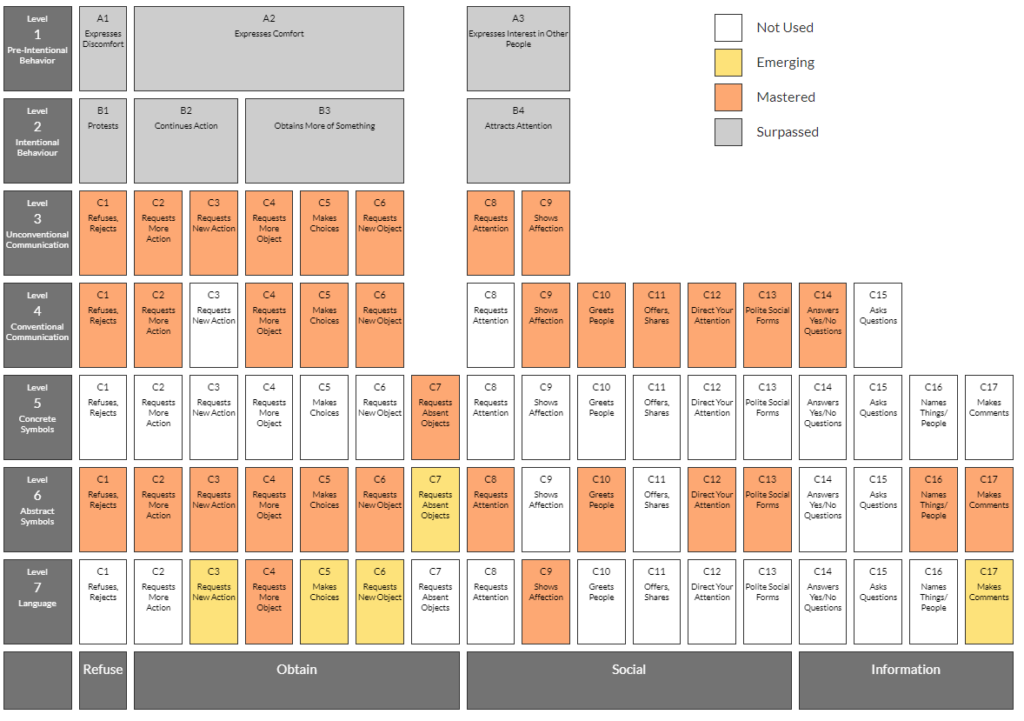
Communication Matrix
The Communication Matrix can be translated into several languages by using the translation menu option in the navigation toolbar of the website. There are also several translated versions of the assessment that can be downloaded as PDFs.

Culturally Responsive AAC (San Francisco State University)
Culturally Response AAC is a curated list of resources related to culturally and linguistically responsive AAC.
Dynamic AAC Goals Grid – 2 (DAGG-2) Spanish Adaptation
The DAGG-2 has a Spanish translation/adaptation that is available from Qinera (formerly BJ Adaptaciones). Note: the English version of the DAGG has been updated to the 3rd Edition (DAGG-3).
Learn more and access the adapted Spanish version in the blog post from Qinera
Early Development of Emotional Competence (EDEC)
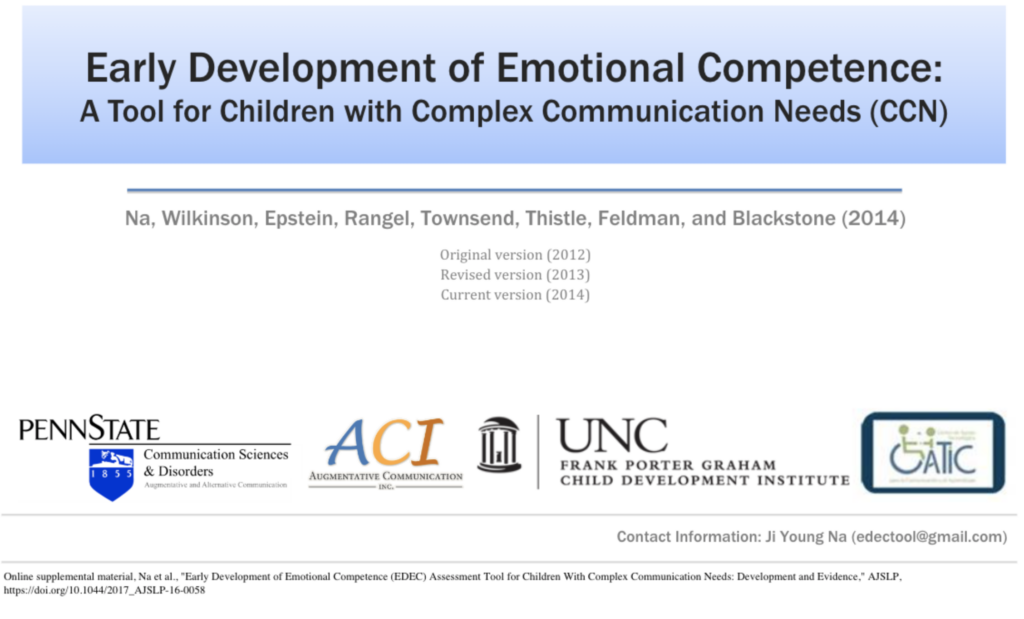
The Early Development of Emotional Competence is an assessment tool for children with complex communication needs (CCNs) ages birth to 10 years. It was designed to gather information about how families and professionals talk about emotions with children with CCN. It is useful to help ensure that a child’s communication intervention includes language to discuss emotions in ways that are consistent with the values and goals of the family. English, Korean, and Mandarin Chinese versions available. See supplemental Materials in the article linked below.
Learn more and download the EDEC assessment tool
Related:
- The Early Development of Emotional Competence Profile (EDEC-P) is a suggested profile to distill information gathered from the EDEC tool and present an analysis of perceived challenges, next steps, and possible strategies to achieve goals related to enhancing emotional communication in people with CCN that could benefit from AAC. English and Spanish versions available.

Family Impact of Assistive Technology Scale for Augmentative and Alternative Communication (FIATS-AAC)
The FIATS-AAC is a parent-report questionnaire designed to detect functional change associated with augmentative and alternative communication (AAC) interventions for children and youth, ages 3 to 18 years, and their families. It has 13 dimensions to measure overall and domain-specific functioning associated with AAC system use. Available in English, French, Italian, Norwegian, Portuguese, Serbian, Turkish, and Ukranian.
Learn more and access the FIATS-AAC on the Holland Bloorview website

Home Language Survey
The Washington Office of Superintendent of Public Instruction offers a home language survey available for download in a variety of languages. It is useful for gathering information about language practices in the individual’s home.
IRIS Center
The IRIS Center offers a Dual Language Learners with Disabilities: Supporting Young Children in the Classroom module among other resources

Language Manuals List
Files with detailed information about different languages and associated cultures.

LEADERSproject (Law and Evidence-based Approaches for Disability Evaluation and ReSources)
The mission of the LEADERSproject is to connect clinical practice with law and research in order to provide culturally and linguistically appropriate services.

MacArthur-Bates CDI
Adaptations of the MacArthur-Bates CDIs have been developed in a number of languages other than American English.
Visit the CDI Advisory Board website for more information and to search for available adaptations
Matching Person and Technology (MPT) Assessment
The Matching Person and Technology process is a person-centered resource. It can be used to foster user engagement and guide a team in the selection of the most appropriate assistive technology or support solution.

Multilingual Topics in Communication Sciences & Disorders (MultiCSD)
Information to learn about different languages and related cultures.

Phonemic Inventories and Cultural and Linguistic Information Across Languages
Resources intended to contribute to foundational awareness of potential cultural and linguistic influences.

Protocol for the Analysis of Aided Language Samples in Spanish (PAALSS)
“PAALSS can be used to describe the expressive language use of children who use aided AAC in Spanish and are in the early stages of language development. PAALSS can also be used as a guide to set goals for and measure outcomes of language therapy along four domains of expressive language including vocabulary, morphology, grammatical complexity, and syntax.” Note: click on the Supplementary Material link, then select/download Supplemental Material S1 for the protocol (this appears to be available even if you do not have access to the full article)

Social Networks
Versions of the Social Networks inventory are available in multiple languages. Contact Sarah Blackstone for more information at sarahb@augcominc.com

True Code Switching in Bilingual AAC Apps
OMazing Kids AAC Consulting has a blog post exploring true code switching and other information related to bilingual/multilingual AAC.
View the True Code Switching in Bilingual AAC Apps blog post from OMazing Kids AAC Consulting


Share your comments or questions.