The Paradox of Holding Multiple Competing Truths in AAC
The autistic community at large states that ‘autistic’ is the correct and preferred way to describe autistic people. AND some people with autism prefer to be described as ‘having autism’. Jonny is autistic versus Jonny has autism. We can – and must – hold space for both truths.
The larger AAC community states that the correct term to describe people who cannot meet their communication needs with mouth words is ‘nonspeaking’. AND some full-time AAC users feel that ‘nonverbal’ is a better word to describe them. Amelia is nonspeaking versus Amelia is nonverbal. We can – and must – hold space for both truths.
These are just two examples of the paradox of competing truths.
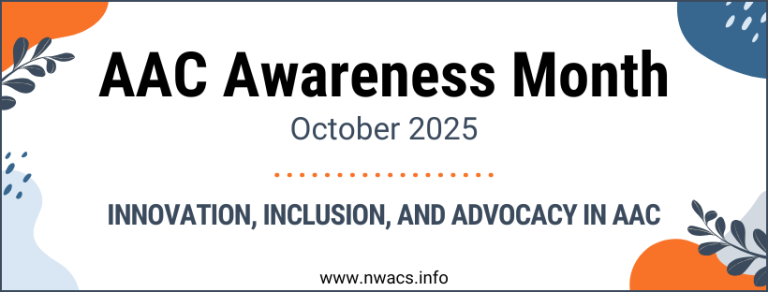
The theme for this year’s AAC Awareness Month is “Innovation, Inclusion and Advocacy in AAC.” I’ve been thinking a lot about that second word: inclusion. The topic of inclusion in AAC is quite varied! I’ve been thinking about aspects that require more nuance. Aspects that hold multiple competing truths.
Who ‘qualifies’ as an AAC user?
The American Speech-Language-Hearing Association (ASHA) defines AAC as “all of the ways that someone communicates besides talking.” [retrieved October 18, 2025]
The International Society for Augmentative and Alternative Communication (ISAAC) describes AAC as “a set of tools and strategies that an individual uses to solve everyday communication problems.” [retrieved October 18, 2025] The ISAAC website goes on to say:
“Effective communication occurs when the intent and meaning of one individual is understood by another person. The form is less important than the successful understanding of the message.”
Most conversations in the field of AAC revolve around AAC users using tools/technology to communicate words of some form.
Competing Truth
Not all people with complex communication needs learn to use tools/technology to communicate. Is this sometimes due to opportunity obstacles and barriers faced by the AAC user? Absolutely! Jordyn Zimmerman is a prime example of this. (If you haven’t seen it, This is Not About Me is a documentary telling her story.)
But even in the best of circumstances, some AAC users will not develop use of communication tools/technology. Some people will only ever use whatever sounds and movements they can make with their bodies to connect, interact, and communicate with others. They are AAC users too.
Also True
ALL people deserve access to and the opportunity to learn to use various tools/technology to expand the effectiveness of their communication. A person’s abilities can only be known and developed when they are provided:
- opportunities,
- access,
- and accessible instruction and support.
We can hold these competing truths as all true.
Robust Communication Tools
Best practice in AAC is for AAC users to have access to a robust vocabulary and the full alphabet. The only way for true authentic, autonomous communication is if the AAC user can spell and generate novel utterances. Until the AAC user is given the opportunity and support, we cannot know what tools, technology, and strategies will work for them.
Competing Truth
Tools that do not give access to robust communication can still be effective and useful!
Another Competing Truth
Not all AAC users will develop the ability to express themselves with language. Being present and in the moment with the AAC user opens the possibility of receiving the communication they are offering. Being fully present in the moment, connecting physically and through close observation, is communicating with each other.
Also True
We should absolutely be working toward the goal of robust communication. For all AAC users. Opportunity barriers should never be the reason a person is not able to develop effective language-based communication.
Another Truth
Some AAC Users will choose less robust forms as their primary means of communication. We can provide opportunities and access and accessible instruction and support. At the end of the day, it is the person’s choice how they communicate. They may switch between different options for different situations or different communication partners. Or they may always choose a way that seems less robust to us. It is their choice.
We can hold these competing truths as all true.
Literacy Skills
All people with complex communication needs deserve the right to accessible literacy instruction. All people, no matter how disabled, deserve the opportunity to learn. We cannot know what an AAC user can learn until we have provided accessible instruction and support.
Competing Truth
Not all AAC users will become literate even with accessible instruction. Some AAC users will not be able to show any ability to read and/or write. Some AAC users will develop emerging literacy skills and not progress beyond that.
Also True
Everyone deserves the opportunity to learn literacy skills.
Another Truth
An AAC user may decide they don’t want to learn to read and/or write. At least for now. It may feel too overwhelming. It may not be presented in a way that feels accessible to them. Whatever the reason, it is their choice.
We can hold these competing truths as all true.
No Communication Tool is Better or More Worthy
There is a persistent ableist view that using mouth words is the *highest* form of communication. A priority is given to developing spoken language over using AAC.
There is an ableist view that using complete, grammatically correct utterances is a “higher” form of communication. An AAC user who uses complete, grammatically correct communication is viewed as more capable.
Competing Truth
Even the most proficient AAC users are constantly weighing the time and effort required for full, grammatically correct utterances. They need to balance daily participation needs and being effective and efficient with their communication.
Also True
For some, a call button, though not robust, may be the most effective solution for a communication need. Sometimes, a mid-tech voice output device facilitates participation. But it is not a robust communication system allowing the AAC user to say anything they want. Using emojis and gifs are not the most robust forms of communication. But sometimes they are the perfect tool for the moment. We all use a variety of communication tools, technologies, and strategies. AAC users are also multimodal communicators. Just because a tool isn’t “robust” or “mainstream” (for the purpose of communication), doesn’t mean it isn’t a useful tool.
We can hold these competing truths as all true.
Competing Truths – Same Goal
Ultimately, our goal is connection. Engagement with the person and experiencing shared meaning. Having a shared understanding.
Sometimes that comes through the shared medium of language. Words communicated with the help of tools and technologies.
Sometimes that comes through intentionally being in the presence of each other. No words. But through attentive engagement. With looks, and sounds, and actions that if we listen carefully with our eyes and mind, reveal a subtle communication.
We can – and must – honor more than one truth. Even when those truths are seemingly at odds with each other.
What other competing truths in AAC would you add?
References
- About AAC from ISAAC
- Augmentative and Alternative Communication (AAC) from ASHA
- Dr. Sheridan Forster uses the term “attentive engagement” (https://sheridanforster.com.au/)

Share your comments or questions.