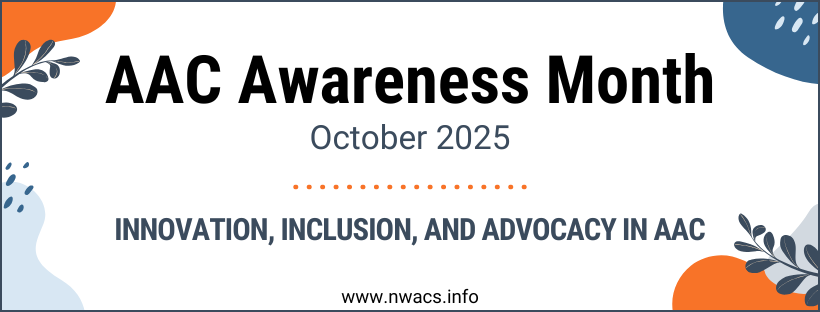
The International Society for Augmentative and Alternative Communication (ISAAC) established International AAC Awareness Month in October 2007. It is celebrated around the world each October. The goal is to:
- raise awareness of augmentative and alternative communication (AAC) and
- to inform the public about the many different ways in which people communicate.
Innovation. Inclusion. Advocacy.
ISAAC has chosen “Innovation, Inclusion and Advocacy in AAC” as this year’s theme for International AAC Awareness Month. ISAAC also asks that we use the hashtag #AACaware25 on social media.
Innovation. Inclusion. Advocacy. This year’s theme invites us to apply these three words to the realm of AAC.
innovation: something new or different that adds value and makes a meaningful impact
inclusion: giving equal access and opportunities to people of all backgrounds
advocacy: Tactively supporting or arguing for a cause, person, or policy
The Participation Model (Beukelman & Mirenda, 2013) encourages us to look closely at the barriers AAC users face. This framework breaks participation barriers into two categories:
- access barriers – the current communication skills of the person
- within the person
- with the communication system(s) and/or access methods the person uses)
- opportunity barriers – limitations based on:
- policy
- practices
- knowledge/skills of professionals and/or communication partners
- attitudes
As Light and McNaughton (2015) pointed out, most research and intervention focuses on issues related to access barriers. The good news is that there are far more options of AAC systems to choose from than there were even just a decade ago. AAC users have a right to tools individualized to their needs and preferences. The unfortunate news is that far less attention has been given to opportunity barriers for AAC users. Policies and procedures in particular lag woefully behind.
There are signs of change though! For example, in 2024 the RERC on AAC and CommunicationFIRST co-hosted the Future of AAC Research Summit. A group of 120 AAC users, researchers, funding agencies, developers, and service providers came together to identify new research priorities and to support new collaborations. It was the first conference
“…that was planned, organized, and realized through the equitable, shared leadership of people who use AAC, a community advocate, and university-based researchers. More than half of the presenters at the Future of AAC Research Summit were people who use AAC; more than half of the two-day meeting was devoted to their perspectives and experiences, and, most importantly, their priorities for future AAC research, technology development, professional training, and systems change.”
An exciting outcome from the Summit is a special issue of the AAC journal. All 21 of the articles in this issue were authored/co-authored by AAC users. The entire issue is free/open access.
Another positive: online platforms are facilitating more opportunities to listen to and learn directly from AAC users. For example:
- Follow CommunicationFIRST
- USSAAC’s AAC Speaker Connection
- Connecting directly with AAC users on social media
- Facebook groups like
- Ask Me, I’m an AAC User! (24 Hour Rule!)
- The AAC connection
How can we build on these glimmers to be good advocates and allies?
How do we encourage meaningful innovation?
AAC Users: What would you like to see?
Join the conversation and leave a comment below.
Take Action
This AAC Awareness Month is a good opportunity to take action on ways we can encourage Innovation, Inclusion and Advocacy in AAC! Here are some ideas to get you started:
LEARN MORE ABOUT BARRIERS AAC USERS FACE
- Read the articles authored/co-authored by AAC users in the 2025 special issue of the Augmentative and Alternative Communication journal (Volume 41, Issue 3)
- All are free or open access
- NWACS is working on plain-language summaries of many of the articles! Keep an eye out on the NWACS blog.
- Read the book Supporting Individuals Who Use Augmentative and Alternative Communication: Breaking Down Opportunity Barriers (2023)
LEARN MORE ABOUT AAC
- Explore the NWACS website
- we have lots of resources to check out
- we’ve been sharing about books featuring AAC on the blog this year
- watch for
- new interviews on the blog
- plain-language summaries of research articles
- Check out recorded sessions from AAC in the Cloud 2025 (free)
- Listen to podcasts (like Talking With Tech AAC Podcast)
- Avaz is hosting a free webinar series throughout October 2025 (1 hour each Thursday)
- SPG Therapy & Education is hosting Chris Bugaj (SLP) for a free webinar: Learning Language Using AAC by Creating a Culture of Inclusivity with a System of Multi-Tiered Supports (October 2, 2025)
- TechOWL is presenting a free webinar “lunch and learn” series throughout October 2025 (1 hour each Wednesday)
- Autism Little Learners is hosting a two-night event (the first night with AAC User Jordyn Zimmerman): The AAC Experience (October 20 & 21)
- Register for the ISAAC Virtual Event 2025 (October 28-29, 2025)
OTHER
- Display or share information about AAC! We created two printables as options you can use for free.
- Check out sales happening for AAC Awareness Month (graphic from Lauren Enders Gonzales, MA, CCC-SLP)
- Support NWACS
- Volunteer with NWACS! Send us an email to let us know your interest.
- Buy something in the NWACS Shop. Every purchase helps sustain NWACS.
- Make a donation to NWACS. We are a 501(c)(3) and donations are tax-deductible to the extent allowed by law. Our EIN is 91-1394307.
Check back throughout the month to see if we’ve found more ideas!
You may also find inspiration from ideas we shared in previous years: 2024, 2022, 2021, 2020, and 2019.
Stay connected with NWACS for more throughout the month and beyond!
- through our email newsletter (subscribe to our email list),
- through our blog and website,
- on social media: Facebook, Instagram, and LinkedIn
How are you celebrating and promoting AAC this AAC Awareness Month? Tell us on social media or below in the comments!
References
- Beukelman, D. & Mirenda, P. (2013). Augmentative and alternative communication: Supporting children and adults with complex communication needs (4th edition). Paul H. Brookes.
- Light, J. & McNaughton, D. (2015). Designing AAC research and intervention to improve outcomes for individuals with complex communication needs. Augmentative and Alternative Communication, 31(2), 85-96.

Share your comments or questions.