AAC Toolbox
Working with children with Autism and related communication challenges, there isn’t a day that goes by in my practice that I’m not reaching deep into my AAC tool box for support. The truth is, I would be lost in my sessions without this essential toolbox, and so would many – if not all – of my kids. In honor of AAC Awareness Month, it seems essential to not only remind ourselves of the important role of AAC for individuals without speech, but also how powerful AAC is in supporting those with emerging speech. Here are a few ways that I use AAC everyday with a spectrum of communicators, including those with verbal skills:
To Teach
For communicators without speech or other forms of language, I use AAC models along with my verbal language stimulation to teach new words, how to combine words, and which words to use for different contexts and functions (e.g., to ask for what you want during a meal or playtime, tell someone what you think, ask a question about a new experience). But I have learned how valuable this strategy of aided language modeling is for verbal communicators as well. For example, when am supporting a child with extensive use of echolalia, my AAC tools don’t necessarily act as a “voice”, but rather a systematic way for this communicator with auditory processing differences to process the verbal information floating around in space. AAC becomes a tool to help break down these “chunks” of language into component parts, which helps communicators

with high use of echolalia develop more generative messages over time. For these communicators, AAC models also help them process the meaning of new words and visualize how tagging on a seemingly little word like “not” – for example – to a known word, can make a big change to the overall message. Over time, I can use AAC tools with these communicators to provide the contextual cues they may need to retrieve the verbal language within their repertoire that is relevant in a given situation.
To Emphasize
Alongside the idea of using AAC to teach language through aided language modeling, using a range of AAC supports to emphasize key words in verbal dialogue and directions is powerful for many communicators who struggle to focus on what is most important in a more complicated message. These communicators may process just a few pieces of information from a complex message and usually process the piece or pieces at the end of the message. Paired with crafted verbal communication that is well paced, using AAC to emphasize key words can help these communicators know what to tune in to

and give them one more modality to assist processing. And we all know how important the visual modality is in supporting the auditory challenges often faced by individuals with Autism!
To Repair
I work frequently with children who experience a spectrum of challenges with motor planning for speech. Many of these children are quite motivated to communicate, some even verbally, but the process is quite overwhelming and frustrating for them. In addition, the high occurrence of communication breakdowns for verbal children with apraxia can add to this frustration and unsuccessful communication interactions can further hinder language and social development. AAC is an essential means of augmenting/supplementing the approximate verbal communication of these children. They benefit from the same level of aided language modeling warranted for any AAC learner, as well as distinct teaching on the process of recognizing when a partner has not received their verbal message clearly. Part of my teaching for these kids is focused on

helping them problem solve through these breakdowns using several compensatory strategies, including AAC.
To Empower
The presence of “challenging behaviors” with communication difficulties is apparent to all of us supporting emerging communicators. Many of the kids I work with have big emotions just like their typically developing peers and lack the inner speech to work through these big feelings. When I encounter “negative behaviors” from my kids, I always ask “why”, and my AAC then becomes a tool to help me give these communicators inner speech to validate and work through their big emotions. Sometimes my communicators use AAC to express these big emotions and ideas. But for emerging communicators, I may only use my AAC

tools to add a visual element to my narrative that validates their emotions and offers much needed language to give voice to their experiences.
In My AAC Toolbox
I like to have a wide range of supports available for modeling in my sessions, including:
- PECS
- Core language communication boards
- PODD books
- And high tech apps like Touch Chat HD – AAC with Word Power and Speak for Yourself
What’s In your AAC toolbox and how do you apply the power of AAC to the communicators you meet each day?
Related Post
5 responses to “How I Use AAC Everyday”
-
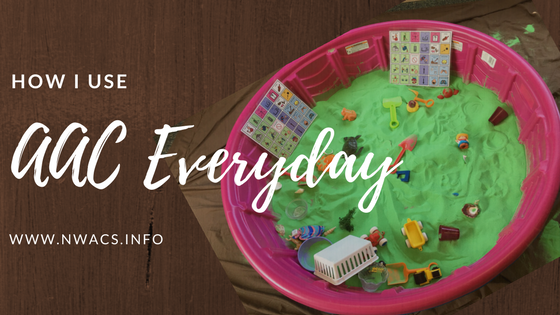
Hello! I really like the boards you are using with these activities. I’ve searched for something similar on Boardmaker, but I’m not finding exactly what I want. Where can I find these? Do you have the file on Boardmaker Online?
Thank you so much :)!Jessie Marinelli, CF-SLP-
Thank you for your comment and question, Jessie! Your question has been passed on to Tanna – I’m sure she will reply as soon as she has a moment. For now, though, if you search in Boardmaker Online by her name (Tanna Neufeld) some boards will pop up. Good luck!
-
Hi there!
Yes, I searched her name and they all came up! These are awesome, I’ve already had success using them with my little preschoolers! Thanks!
-
-
-
Hi Jessie 🙂 yes, you can find these on my Boardmaker Online profile at:
https://www.boardmakeronline.com/myboardmaker/myactivities#!?folderPath=%2FActivity%20Boards&page=1&searchText=&sortOrder=1
Hope you enjoy these as much as I do! -
Hi! I love this post. I have an eye gaze board, ipad with various communication apps, core boards, laptop for youtube videos, communication books, lanyards with icons.



Share your comments or questions.