
“Communicative competence is an individual’s ability to freely express ideas, thoughts, and feelings to a variety of listeners across contexts. It provides the means to achieve personal, educational, vocational, and social goals (Calculator, 2009; Light & McNaughton, 2014; Lund & Light, 2007). Individuals must achieve communicative competence whether they use natural speech or AAC, but their paths may vary (Light et al., 2003).”
The American Speech-Language-Hearing Association (ASHA)
retrieved 7/31/21 from Augmentative and Alternative Communication (Practice Portal)
The Competencies
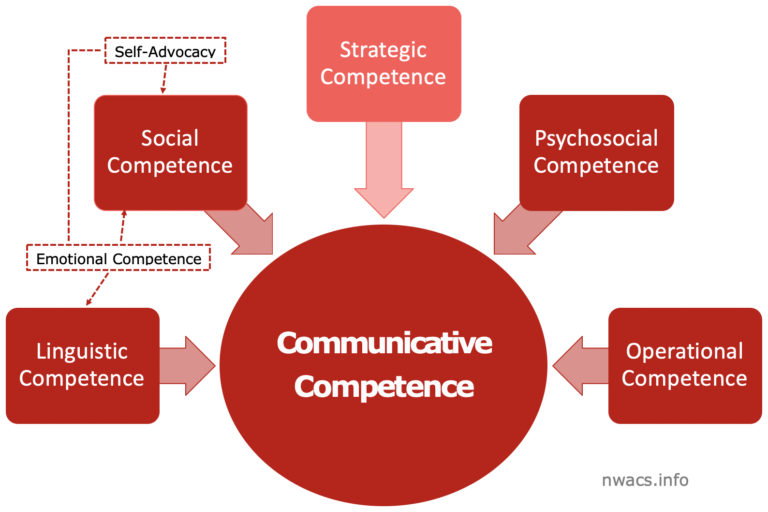
Communicative Competence is a group of skills that let a person communicate about anything to anyone. In 1989, Dr. Janice Light described communicative competence for people who use augmentative/alternative communication (AAC). She said that people using AAC had to learn and combine knowledge, judgment, and skills in four connected areas:
- linguistic,
- operational,
- social,
- and strategic.
She later (2003) added the area of psychosocial to her description. She also noted that barriers and supports around the person were a factor. A lot has changed since Light first described communicative competence in AAC, yet it is still a relevant and useful framework.
In 2009, Dr. Sarah Blackstone and Dr. David Wilkins looked at how emotional competence impacts the communication abilities of children with complex communication needs. They found that emotional competence relates to pragmatics, social communication, and self-talk. They advocated for the need to address this skill area. Emotional competence is part of the linguistic and social areas, but is important as its own skill area.
In 2014, Kate Ahern, M.Ed. suggested a “bonus” competency for AAC communicators: self-advocacy. Self-advocacy fits in the social area. But it is so important for people with complex communication needs that it is worth focusing on as its own skill area as well.
“Communicative competence is essential to the enhancement of the quality of life of individuals with complex communication needs; it is fundamental to the attainment of the basic human need, the basic human right, the basic human power of communication.”
Light & McNaughton (2014)
So, what does all this mean?
A person must have skills in each of these areas:
- linguistic,
- operational,
- social,
- strategic,
- psychosocial,
- emotional,
- and self-advocacy,
as well as a supportive environment.
We must teach skills in each of these areas to support the needs of AAC communicators. They need these skills to:
- express ideas, thoughts, and feelings,
- have social relationships,
- and engage and take part in daily interactions.
Why focus on communicative competencies in AAC?
When we first learn about using AAC to communicate, it is easy to focus on the tool. The AAC system. For communication partners, learning a new way to communicate, using a new tool to do it, can be overwhelming. And maybe even scary. But learning how to use the AAC system, the tool (operational competence), is only one skill area of many needed to use AAC to communicate effectively. The communicative competencies in AAC is a framework to help us remember many of the other skills that are also needed.
How can we apply this to AAC interventions?
Use these skill areas to choose appropriate goals and objectives to help the person develop the various skills needed to become a proficient communicator.
The Ultimate Goal
The goal of AAC interventions is authentic communication from the person. That the person can get their intended message across to their communication partner.
The Communication Bill of Rights states 12 specific basic communication rights of all people. These include:
- the right to express personal preferences, opinions, and feelings
- the right to ask for and give information
- the right to refuse or reject
- the right to make choices from meaningful alternatives
How can we apply this to AAC interventions?
Remember that communication is a basic human right. And that right means the person is able (and allowed) to say what they want, when they want, how they want, to whom they want.
Additional Considerations
The phrase “Maslow before Bloom” is shared a lot in education circles.

Maslow
Maslow’s hierarchy of needs is a theory that human’s are motivated by different levels of needs, arranged in a pyramid-like hierarchical order. Beginning with the most basic needs at the bottom that must be satisifed before progressing to higher-level needs. The five levels (from bottom to top) are:
- physiological
- safety
- love and belonging
- esteem
- self-actualization
A person’s basic bodily and ego needs need to be met before they can realize their full potential.
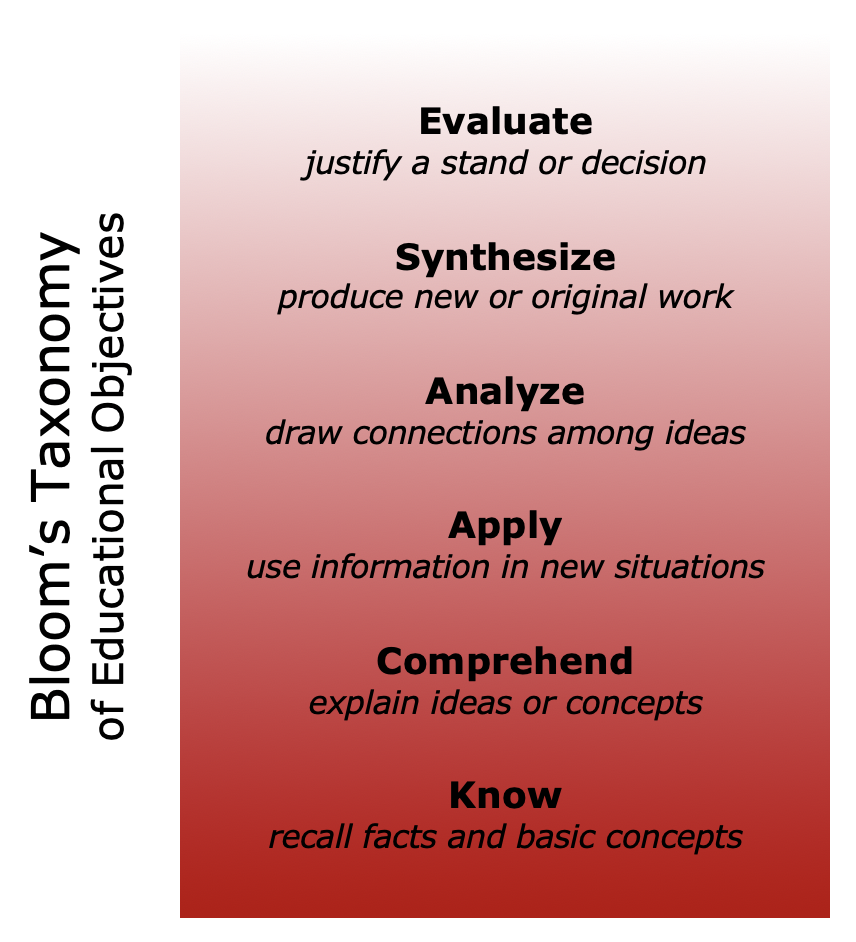
Bloom
Bloom’s taxonomy is a theory explaining the process of learning. It is classifies learning objectives into levels of complexity, from basic recall to higher-order thinking. The taxonomy is often visualized as a ladder, with simpler skills at the base and more complex skills at the top. The six levels (from the bottom to top) are:
- know: recall facts and basic concepts
- comprehend: explain ideas or concepts
- apply: use information in new situations
- analyze: draw connections among ideas
- synthesize: produce new or original work
- evaluate: justify a position or decision
Educators use this to structure their lessons, assessments, and learning experiences.
What does this mean? We must meet the person’s basic needs before they can focus on learning.
How can we apply this to AAC interventions?
When a person is having an “off day” with their communication, do a check of Maslow’s Hierarchy of Needs. When progress is not happening as quickly as we had hoped, do a check of Maslow’s Hierarchy of Needs.
Are there any basic needs that you can address? Is the person too hot, too cold, uncomfortable, tired, not feeling well, hungry, thirsty? Is the person dealing with emotions related to something that has happened? Is the person not feeling safe or comfortable in certain situations or with certain people?
Do you need to go back and first work on building rapport?
Do you need to provide more supports so that the person feels confident enough to try to communicate?
Learning to communicate with AAC takes time.
A lot of time.
“I just figured out how many hours a typically developing infant is awake and exposed to language via the spoken symbol before they begin to use the spoken symbol expressively at around 12-18 months of age. If you then look at a child with an AAC system who only gets exposure to his system 2 times a week for 20 minutes with the SLP, it will take him 84 years to have experience commensurate with the typically developing child. Taking that a bit further, we don’t say language is in it’s ‘adult form’ until between 9-12 years of age. That means that for that length of time, a typically developing child is practicing using the spoken symbol, getting feedback and correction from listeners, seeing it modeled over and over…. now you look at the child with a device who only gets access to the system twice a week for 20 minutes with the SLP – it will take him 701 years to have the same amount of experience as his typically developing counter part…. and all of this assumes that no one is ever sick or takes a vacation…. So when no one wants to use a device until it is ‘mastered’…. in therapy….. hmmmm… what IS wrong with this picture… One might assume that an atypical developer might need MORE time to practice, NOT less time…”
Jane Korsten (2011)
QIAT Listserv
By 18 months of age, babies have heard approximately 4,380 hours of spoken language. And they are just beginning to use spoken language. Children do not use fully developed (“adult form”) language until after 9-12 years. 9-12 years of teaching, modeling, practicing, feedback, and correction.
How can we apply this to AAC interventions?
When it feels like it is “taking too long” for the person to learn to communicate with their AAC system, check that you’ve provided an adequate amount of time. And that you have provided an adequate amount of aided language input (also known as AAC “modeling”). Many people who use AAC may need more time than their neurotypical peers to become proficient communicators.
AAC interventions must be culturally and linguistically responsive.
How can we apply this to AAC interventions?
Check that you have prioritized the person’s (and their family’s) goals and needs. At every stage of the process. Check that the AAC system includes vocabulary and symbols to match the cultural and language needs of the person.
What do we do if it feels like AAC is not working for a person?
More often than not, we need to change our intervention strategies, support, and/or expectations. Not the AAC system.
Let’s explore each of these skill areas further.
References
- Ahern, K. (2014, April 8). Meaningful and Evidence-Based Goals – Part One AAC. Teaching Learners with Multiple Special Needs. http://teachinglearnerswithmultipleneeds.blogspot.com/2014/04/meaningful-and-evidence-based-goals.html
- American Speech-Language-Hearing Association (n.d.). Augmentative and Alternative Communication (Practice Portal). Retrieved July, 31, 2021, from www.asha.org/Practice-Portal/Professional-Issues/Augmentative-and-Alternative-Communication/.
- Blackstone, Sarah & Wilkins, David. (2009). Exploring the Importance of Emotional Competence in Children With Complex Communication Needs. Perspectives on Augmentative and Alternative Communication. 18. 78-87. 10.1044/aac18.3.78.
- Bloom, Benjamin (et al), Taxonomy of Educational Objectives: The Classification of Educational Goals, originally published by David McKay Company, Inc., 1956.
- Brady, N. C., Bruce, S., Goldman, A., Erickson, K., Mineo, B., Ogletree, B. T., Paul, D., Romski, M., Sevcik, R., Siegel, E., Schoonover, J., Snell, M., Sylvester, L., & Wilkinson, K. (2016). Communication services and supports for individuals with severe disabilities: Guidance for assessment and intervention. American Journal on Intellectual and Developmental Disabilities, 121(2), 121–138.
- Janice Light (1989) Toward a definition of communicative competence for individuals using augmentative and alternative communication systems, Augmentative and Alternative Communication, 5:2, 137-144, DOI: 10.1080/07434618912331275126
- Janice Light & David McNaughton (2014) Communicative Competence for Individuals who require Augmentative and Alternative Communication: A New Definition for a New Era of Communication?, Augmentative and Alternative Communication, 30:1, 1-18, DOI: 10.3109/07434618.2014.885080
- Light, J. (2003). Shattering the silence: Development of communicative competence by individuals who use AAC. In J.C. Light, D.R. Beukelman, & J. Reichle (Eds.), Communicative competence for individuals who use AAC: From research to effective practice (pp. 3–38). Baltimore, MD: Paul H. Brookes.
- Light, J. C., Arnold, K. B., & Clark, E. A. (2003). Finding a place in the “social circle of life”. In J.C. Light, D.R. Beukelman, & J. Reichle (Eds.), Communicative competence for individuals who use AAC: From research to effective practice (pp. 361–397). Baltimore, MD: Paul H. Brookes.
- Maslow, Abraham. A theory of human motivation, originally published in the Psychological Review, 50(4), 370-96, 1943.


Share your comments or questions.