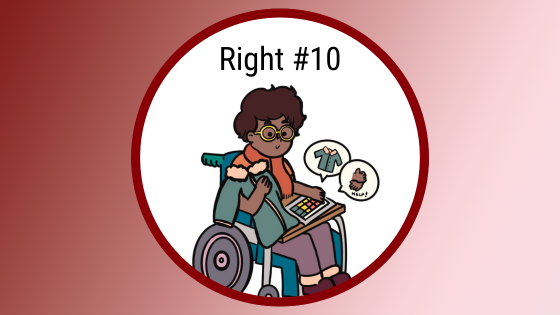
This page is an exploration of Right #10 of the NJC Communication Bill of Rights.
Planning for Offering Choices
Offering choices to a person with complex communication needs is often seen as easy and quick. But offering choices is a little more complex that first meets the eye.
When offering choices to a person with complex communication needs, a communication partner will need to decide:
- The amount of options
- Decide: 2 or more?
- Best Practice: Complete a dynamic assessment to see how many choices the person can choose from successfully.
- What specific options to offer
- Decide: Which choices? Physical objects? Actions? Categories? Yes or No?
- Best Practice: Determine the purpose of the choice. Use the context around you and what you know about the person to offer the most meaningful set of options.
- How the choices will be presented (presentation method)
- Decide: Physical objects, pictures, icons?
- Best Practice: CComplete a dynamic assessment to see what presentation method works best for the person. What is the most complex option you can offer while still achieving communicative success?
- How the person will be selecting their choice (selection method)
- Decide: Reaching, grabbing, pointing, eye gaze?
- Best Practice: Complete a dynamic assessment to see what presentation method works best for the person. If you are trying to teach a new selection method, shape from what is successful to the next level of difficulty. (Zone of Proximal Development!)
- How the person will indicate they don’t want any of the offered choices
- Decide: Option for communicating “I don’t want any of these choices” (something different, more, no?)
- Best Practice: Complete a dynamic assessment to see how the person communicates rejection/refusal. Determine if/how they can communicate that they don’t want any of the choices/want different choices.
Remember: the communication partner has all the control of the communicative interaction. The communication partner decides:
- the amount of options,
- the options themselves,
- the presentation method,
- and often what “selection” looks like.
The person with complex communication needs can only communicate the option they prefer from what has been offered. If that person can’t refuse or protest effectively, they cannot tell you “I don’t like any of these choices!” The interaction of choice-making is not open-ended or user-generated. Just because choices have been offered doesn’t mean those choices are meaningful to the person.
People with complex communication needs will interact with many communication partners across their lives. Not all communication partners will be trained in how to best support communication. Many people will fall back to offering choices as something that works. Making choices is also part of autonomy and self-determination – which is crucial for quality of life. So AAC users need to be able to make choices effectively.
The bottom line: Choice-making is not communication. Offering choices can be a quick and easy way to interact. Making choices is part of self-determination. But it should be used with caution. Making choices should be one of many components in the overall approach to supporting a person’s ability to communicate.
How do we promote this right?
For Communication Partners
- Make sure that everyone is aware of the Communication Bill of Rights.
- Inform and train communication partners on how they can best communicate and interact with AAC users.
- Model and scaffold language to make choices, including the ability to reject all offered options.
- Whenever possible, allow AAC users the chance to communicate their desire before offering choices.
For AAC Users
- Help people with disabilities understand and advocate for their communication rights.
- Provide culturally and linguistically responsive supports for AAC users to develop this skill area.
- Provide AAC users with opportunities to communicate beyond choice-making.
- Encourage AAC users to self-advocate.
What would you add? Join the conversation by commenting below!


Share your comments or questions.