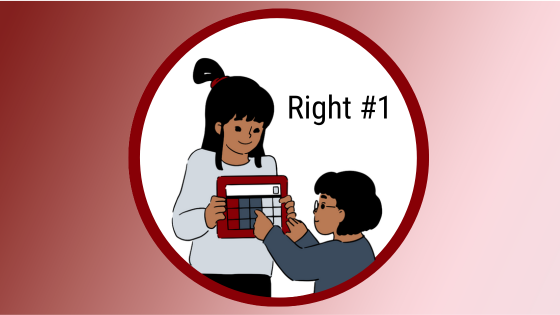
This page is an exploration of Right #1 of the NJC Communication Bill of Rights.
Words are a Choice
The words we feel comfortable using can depend on many factors. How we were raised. Where we were raised. Our culture. Our religion. Our values. The people we spend time with. Our needs. Our age. Where we are and who we are with. But ultimately, if we communicate using spoken language we get to choose the words we use. Our words, our choice.
Language Development
AAC users deserve the dignity and respect of being able to choose the exact words they want to use. That means they need to have access to words that some may consider “taboo” or “uncomfortable”. Or “too adult”. It is not our job to censor what words they can use. Our job is to support them to be able to say ANYTHING they want. And to understand possible consequences of the words they choose.
Learning “bad” words is part of language development. Did you know that swearing and use of “taboo” words starts around 2 years of age? And that swearing is adult-like by 11-12 years old? Or that, on average, a person says 80-90 taboo words per day?
Assault and Abuse
Disabled people are at higher risk of assault and abuse. Did you know that disabled people are 2.5 times more likely to be victims of a violent crime than their non-disabled peers? Or that people with intellectual disabilities are 7 times more likely to be sexually assaulted than non-disabled people? And that these crimes are less likely to be reported?
Vocabulary Changes with Age
Vocabulary develops over time with age. We need to be considering and adding these “taboo” words that their peers are saying. And regularly re-examining – and discussing with the AAC user – what new words to add.
- words related to body parts (including genitalia)
- slang words
- swear words
- words related to rights
- words related to sexuality
- words related to sex and relationships
- words related to identity
- words related to health and illness
- words related to life and death
- words related to politics
- words related to voting
- words related to what is going on in the world (e.g., discrimination, climate change, war, pandemics, killings, natural disasters)
- legal words
Infantilization
infantilizing: treating a person in ways that deny their maturity in age and/or experience
People with disabilities are infantilized far too often. So far in our discussion of Right #1 we have focused on needing words to talk about a variety of topics. Including sensitive or “taboo” topics. Having someone else decide you do not need words to say or talk about certain things because you are disabled (and they don’t think it is appropriate) is a form of infantilization. As this article highlights, how we talk to disabled people can be another way of infantilizing them. Our tone of voice and the words we use when talking to a disabled person can be offensive, patronizing, and condescending. AAC users have the right to be spoken to in an age-respectful manner.
Words matter. So does access.
In order for AAC users to communicate authentically and fully, they need access to all the words they want and need. Words matter. They matter for dignity. They matter for safety. They matter for health. They matter for being able to direct personal care. They matter for consent. They matter for relationships. They matter for reporting abuse. They matter for being able to participate in legal proceedings. They matter for expressing one’s authentic self. They matter for being seen and treated as the complete, autonomous person that they are. They matter for being able to participate as a full communication partner in all the environments and interactions an AAC user may experience. Their words, their choice.
We encourage you to explore and reflect on the information below.
Related References and Resources
PLEASE NOTE: THE FOLLOWING LINKS MAY CONTAIN LANGUAGE AND GRAPHICAL IMAGERY THAT SOME MIGHT FIND OFFENSIVE.

- AAC & Consent, Safety, and Dignity resource page from NWACS
- AAC users need vocabulary to talk about sex, sexuality, and body parts by Donnie TC Denome, MPH (article on AssistiveWare blog)
- Am I muted?!? Fostering Effective Self-Advocacy in AAC Users by Jaime Lawson, Melonie Melton, Heather Patton, and Melissa Clark (session from AAC in the Cloud 2022) – This session provides information about facilitating self-determination and self-advocacy in AAC users.
- Autonomy, Self-Determination, Dignity of Risk, and Harm Reduction for AAC User by Cole Sorensen & Donnie TC Denome (session from AAC in the Cloud 2021) – Autonomy, self-determination, and dignity of risk (the right to take risks and make mistakes) are often denied to AAC users, but are fundamental human rights. This session explores the importance of these rights, their relationship to trauma, how AAC users can exercise them, and the role of professionals/supporters.
- Consent in the Classroom – Why it’s essential to teach advocacy and boundaries at all age levels by Sarah Weber (session from AAC in the Cloud 2022) – When it comes to new skills practice is necessary for proficiency. Consent is no different. When supporting students with multiple disabilities and/or complex communication needs, who may not have bodily autonomy, this need is amplified. The presenter discusses how to teach consent across educational settings.
- Creating Low Tech AAC Supports to Improve Autonomy in Medical Appointments by Gemma White (session from AAC in the Cloud 2022) – The presenter discusses creating light-tech AAC boards as supports for medical appointments to improve patient participation and autonomy in medical care for the neurology and dental departments at an article 28 clinic. The importance of implementing an Aided Language Stimulation approach to medical care is also shared.

- Crime Against Persons with Disabilities, 2009-2014 Statistics
- Data from the Justice Department in The Sexual Assault Epidemic No One Talks About by NPR
- Ensuring Equitable Access to Health Care for AAC Users by Donnie TC Denome (session from AAC in the Cloud 2021) – This presentation discusses barriers AAC users face in accessing health care and what AAC professionals and supporters can do to address them. It covers the importance of autonomy and self-determination in health care for AAC users from the perspective of an AAC user in public health.

- How do you symbolize intimacy? For many AAC programs, not particularly well. By Donnie TC Denome (on their blog)
- Sexual Health Education for Young People with Disabilities by Mary Beth Szydlowski, MPH, CHES (PDF from Advocates for Youth)

- Lomah Disability podcast #167 – Slang, Swearing, Slurs…and AAC Censorship
- Talking With Tech AAC Podcast episode – Rebecca Moles: How AAC Can Help Prevent Abuse and Neglect
- The Importance of Consent, Relationships, and Sexual Education for AAC Users by Donnie TC Denome (session from AAC in the Cloud 2022) – This presentation talks about consent, relationships, and sexual education (CRSE) for AAC users of all ages. It discusses what CRSE is and what healthy, robust, and age-appropriate CRSE looks like. It talks about what the people watching the presentation can do to help AAC users be part of healthy, robust, and age-appropriate CRSE.
- Uncensored AAC: Exploring AAC Access to Profanity and Slang webinar by Hali Strickler (USSAAC/ISAAC) – Profanity, swearing, and slang are often considered “taboo”, yet they are aspects of social communication. Research even shows that children have a repertoire of 30-40 taboo words when they enter school. There is normative data to reflect use of profanity and other “taboos” across the lifespan. Despite its prevalence in everyday communication, AAC users are often limited in their access to these types of words. Many popular speech-generating devices and language systems do not have these words or concepts readily available. This presentation examines the research of colorful language and its implications for AAC users’ right to word choice. Please note, this presentation discusses explicit language, sexual health terminology, and abuse. Link to slides.
- Where is the penis? Equipping AAC users to discuss personal and body safety by Gemma White (session from AAC in the Cloud 2022) – This session discusses how we can help AAC users take the next steps with a goal driven curriculum for teaching body safety and personal safety. Using language from psychologists and lawyers who educate in grooming and sexual abuse prevention this session has an AAC relevant twist.
Do you have a favorite resource that we missed? Leave a comment to share!


Share your comments or questions.