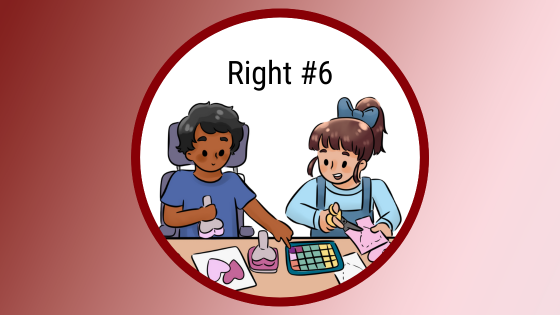
This page is an exploration of Right #6 of the NJC Communication Bill of Rights.
Socially Connected
Social closeness, engagement, and participation are important to our well-being and overall quality of life. In fact, feeling socially connected to others is so essential that it is considered a basic human need.
social closeness: our perception about how embedded in social networks we are
social connection: feeling close and connected to others
Being social is a basic human right. It is a basic human need. And it is also an area of communicative competence.
To develop relationships, we need:
- opportunities to interact socially with a broad range of people
- the desire to interact and the communicative means to do so
- if early attempts to be accepted or to communicate are not successful, a person may not be motivated to interact socially
- if the vocabulary needed for social exchanges is not accessible, or the person has not been taught to use the relevant vocabulary for various social communication needs, a person may not be able to successfully initiate and/or maintain social interactions
- effective communication partners
- supports to develop and maintain relationships, including:
- providing information and training to communication partners
- supporting a mix of communication methods for reciprocal, social interactions
- e.g., nonverbal communication, lite-tech communication tools, high-tech communication tools, interactive activities
- using strategies to facilitate and promote social interactions
In his article AAC in a Group Setting (on the AAC Language Lab blog), Lance McLemore gives us an important reminder. Interacting socially with one person is much different than trying to interact socially in a group. We need to support AAC users in developing the skills to advocate for their needs. They need to have “quick fire” messages programmed and ready for use – and know when and how to use them. Communication partners need to create time for AAC user participation. It is equally important that AAC users become comfortable and confident advocating for their needs. They need the skills so they CAN interact socially and build/maintain relationships in a group setting. Now – go read what Lance has to say about this!
How do we promote this right for our AAC users?
Here are a few ideas:
- Help people with disabilities understand and advocate for their communication rights.
- Make sure that everyone is aware of the Communication Bill of Rights.
- Provide opportunities for AAC users to interact with a wide range of people.
- Inform and train communication partners on how they can best communicate and interact with AAC users.
- Provide culturally and linguistically responsive supports for AAC users to develop this skill area.
- Make sure AAC users have access to a variety of ways to interact and build/maintain relationships.
- Provide AAC users with relevant vocabulary (e.g., greetings, social comments, common “quick fire” utterances, question words, etc.).
- Model using their AAC system to interact socially, build relationships, and maintain closeness.
What would you add? Join the conversation by commenting below! Share your thoughts, ideas, strategies, resources, and/or tips for supporting AAC users’ ability to interact socially, maintain social closeness, and build relationships.
Related References and Resources
- Alant, E. (2017). Augmentative and Alternative Communication: Engagement and Participation. Plural Publishing.
- Blackstone, S. W., & Hunt-Berg, M. (2012). Social Networks: A Communication Inventory for Individuals with Complex Communication Needs and their Communication Partners; Verona, Wisconsin: Attainment Company, Inc.
- Brady, N. C., Bruce, S., Goldman, A., Erickson, K., Mineo, B., Ogletree, B. T., Paul, D., Romski, M., Sevcik, R., Siegel, E., Schoonover, J., Snell, M., Sylvester, L., & Wilkinson, K. (2016). Communication services and supports for individuals with severe disabilities: Guidance for assessment and intervention. American Journal on Intellectual and Developmental Disabilities, 121(2), 121–138.
- Hunt, P., Doering, K., Maier, J., and Mintz, E. (2009). Strategies to Support the Development of Positive Social Relationships and Friendships for Students Who Use AAC. In G. Soto & C. Zangari (Eds) Practically Speaking: Language, Literacy, & Academic Development for Students with AAC Needs. Paul H. Brookes Publishing Co.
- Mayne, L.E., & Rogers, S.M. (2020). Augmentative and Assistive Communication with Children: A Protocol and Intervention Plan to Support Children with Complex Communication Profiles (1st ed.). Routledge. https://doi.org/10.4324/9780429317774
- Silverman, Ari B., “Well-being, meaningful activity, and social closeness for persons with disabilities: Findings from the American Time Use Survey (ATUS)” (2018). Graduate Student Theses, Dissertations, & Professional Papers. 11279. https://scholarworks.umt.edu/etd/11279

Share your comments or questions.