AAC Starts With Mindset


February 13, 2023

Home > AAC > Basics
AAC Starts with Mindset

By: Cassandra Stafford, SLP, ATP (speech-language pathologist and assistive technology professional); NWACS Board Member

Reading time: 3 minutes

Why mindset?

We are preconditioned to expect people to be able to use spoken language. It can be emotional and unexpected when a child has a disability that affects their ability to use spoken language. Or when an adult loses the ability to communicate using spoken language. Starting an AAC journey may mean first working on your mindset.

Mindset #1: We ALL use AAC

We do not usually think about it, but we ALL use AAC! AAC is any method of communicating other than spoken language.

  • When we use a chat feature in a virtual meeting, we are using AAC.
  • When we send a text message, we are using AAC.
  • When we send an email, we are using AAC.
  • When we write a letter or note to someone, we are using AAC.
  • When we draw a picture to help explain something, we are using AAC.
  • When we use emojis, we are using AAC 😲 [image: ā€œastonished faceā€ emoji].

I could go on. AAC options are so integrated into our lives that we do not even realize how frequently we use AAC to communicate! But for most of us, it is more about convenience or socially accepted standards. For our loved ones with communication disabilities, AAC is a necessity to meet their communication needs.

Mindset #2: AAC is NOT giving up

Because we are so used to people using spoken language, we hold an expectation that people should use spoken language. That spoken language is somehow superior to other forms of communication. The medical model approach to disability guides us to hold spoken language as the gold standard. To ā€œwait and seeā€. To treat AAC as a last option. This is wrong.

Babies start learning language and communication skills at birth! As we realized in Mindset #1, spoken language is only one way we communicate. While speech – the ā€œspokenā€ part of spoken language – is a common and easy method of communication for many of us, it is language (the meaning and messages) that makes communication, well… communication!

Disabled children need and deserve to have language access as soon as possible! Communication is an important factor in a person’s quality of life. AAC is a crucial early step to set a child up for meeting their greatest potential. For success in

  • social engagement,
  • language,
  • communication,
  • academics,
  • literacy,
  • work,
  • and yes, maybe even speech (if it is possible for them).

Mindset #3: Presume Competence

Presume potential. Believe all children CAN learn and develop skills. We do not know how far they can go if given the chance! I never want to be the reason a child is held back from their potential. If we believe in a child, they have a tendency to reach higher. If we set the bar low, children often stay in the box we build for them.

Every human being communicates. It may be different than how you communicate, or different than how you expect or want them to. But each one of us communicates. ā€œDifferentā€ is hard and sometimes scary. But the effort is always worth it!
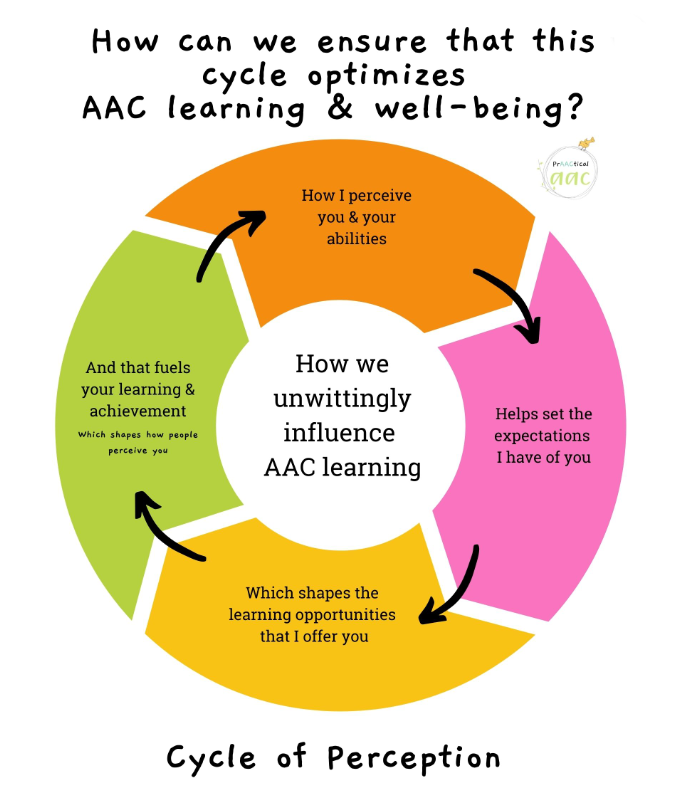
Circular graphic showing ways we unwittingly influence AAC learning: how I perceive you and your abilities, helps set the expectations I have of you, which shapes the learning opportunities that I offer you, and that fuels your learning and achievement (which shapes how people perceive you).
Cycles of Perception image from PrAACtical AAC

Mindset #4: Communication is Messy

Even between two people using spoken language! We are human. So our communication is rarely perfect. But communication is not about perfection. It is about connection and participation and engagement. Focus on the message and the connection. The rest will fall into place.

Mindset #5: Now is the Best Time

There is no good reason to wait.

It is never too early.

It is never too late.

A child (person) is never too disabled.

A child (person) cannot be too anything for AAC.

Share your comments or questions.

Your email address will not be published. Required fields are marked *

Casey Stafford

Cassandra Stafford, MS, CCC-SLP/L, ATP

Preferred Pronouns: she/her

Casey is a Speech-Language Pathologist and Assistive Technology Professional with a private practice (Vlinder Communication Therapies) in the Seattle area. She works primarily with children, however she also has experience with teens and adults with intellectual/development disabilities. She signed on with the NWACS board in 2015 to help with “webmaster” and social media duties, and knows just enough to almost look like she knows what she is doing. Despite having grown up in Eastern Washington where summer temps regularly reached triple digits, she now starts to wilt as the temperature creeps past 70. Casey enjoys reading, crocheting, card-making, and doting on her adorable nieces!

More Content to Explore

  • an eyeball character with a hat and briefcase holding a magnifying glass up to it's eye

    Seeing the Person in Front of Us

    July 19, 2026

    A discussion on the importance of seeing the actual person, meeting them where they are, and moving forward together.
  • National AT Awareness Day; a group of people of different ages with various assistive technology tools

    National AT Awareness Day: What the AAC Community Know That Others Don’t

    April 20, 2026

    Esther reminds us that access to assistive technology (including AAC) is a right, not an accommodation.
  • Why Do We Communicate?

    Why Do We communicate?

    March 29, 2023

    Casey describes different reasons we communicate.
  • drawings of AAC users across the lifespan using different AAC systems

    The Right to Access Services and Supports for Communication Across the Lifespan (Right #11)

    This page is an exploration of Right #11 of the NJC Communication Bill of Rights. Services and Supports This right is all about making sure…
N W A C S logo

Northwest Augmentative Communication Society

Connect with us on social media!

Subscribe to Our Mailing List

Sign up to receive email, including news, updates, and marketing.

Donate to NWACS

Thank you for your ongoing support!


Important Website Information

By using this website, you agree that the content is for educational purposes only. It is not intended to be professional advice. Information and materials shared are to help guide creativity and support AAC use. Authored articles reflect personal perspectives and experiences. Please consult qualified professionals for specific AAC guidance. For more details, please see our Terms of Use.

Many resources shared on this website are not owned or maintained by NWACS. We are committed to accessibility, but some third-party content may not meet accessibility standards. Please review our Accessibility Statement. If you have any questions or encounter barriers, please contact us.

Privacy | Terms of Use | Accessibility Statement | Site Map

Ā© 2016-2026 Northwest Augmentative Communication Society, a 501(c)(3) nonprofit organization
