
This is a collection of information and resources related to supporting augmentative and alternative communication (AAC) in children ages birth to three years.
This is not an exhaustive list. Do you have a favorite resource or strategy that we missed? Leave a comment to share!
Explore key issues related to this topic. Jump to:
Explore relevant resources. Jump to Resources
Jump to Useful Tips
Jump to Selected References
When is the right time to start?
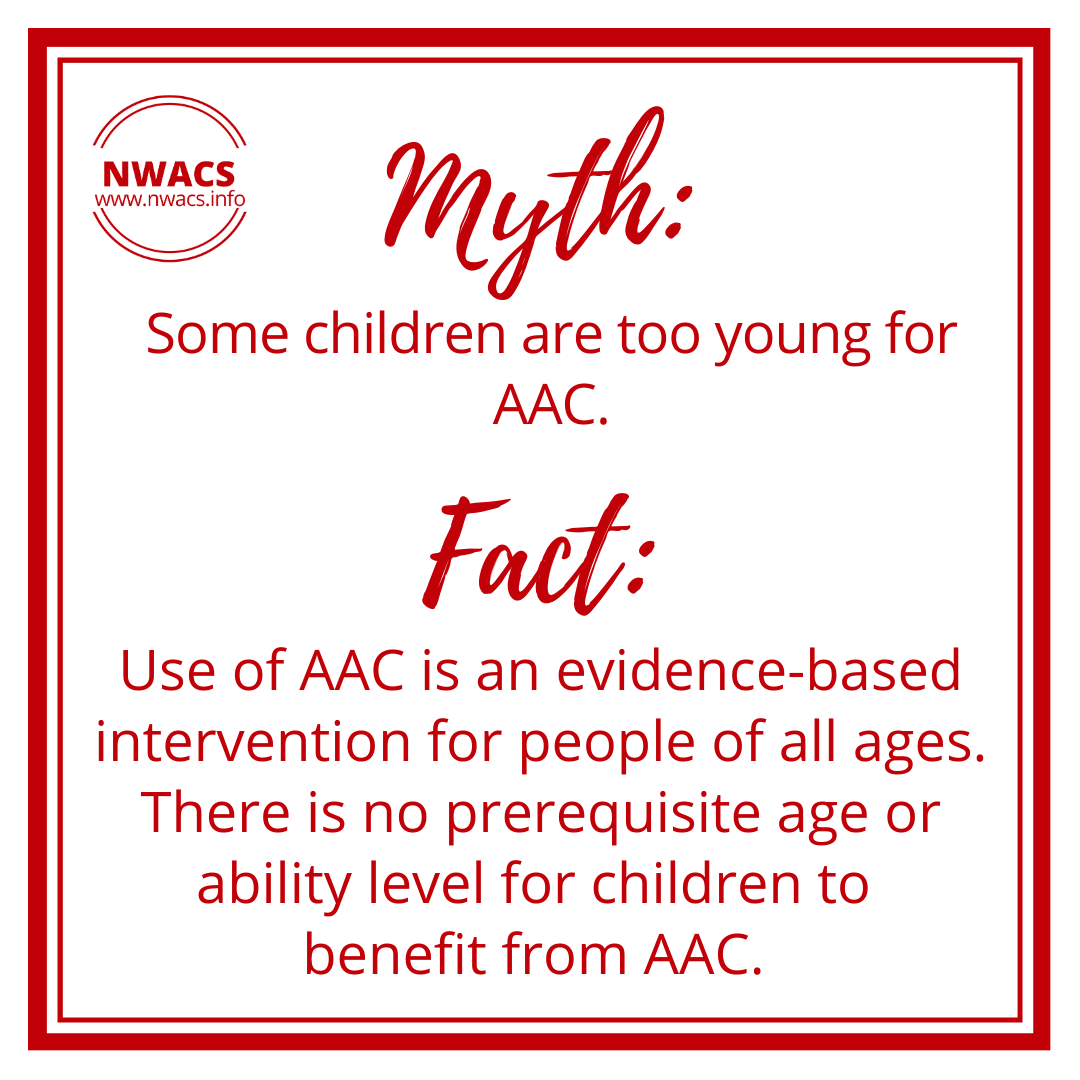
Now! If you are questioning starting AAC with a child, that is a gut-feeling you need to listen to. A child is never too young (or too old, or too disabled, or too anything) to start AAC.
Babies start learning language and communication skills at birth. All children have a right to access language and communication now – not after waiting to see if speech might develop. AAC provides the access to language and communication that their speech skills may not currently support.
There are NO prerequisites to start AAC!
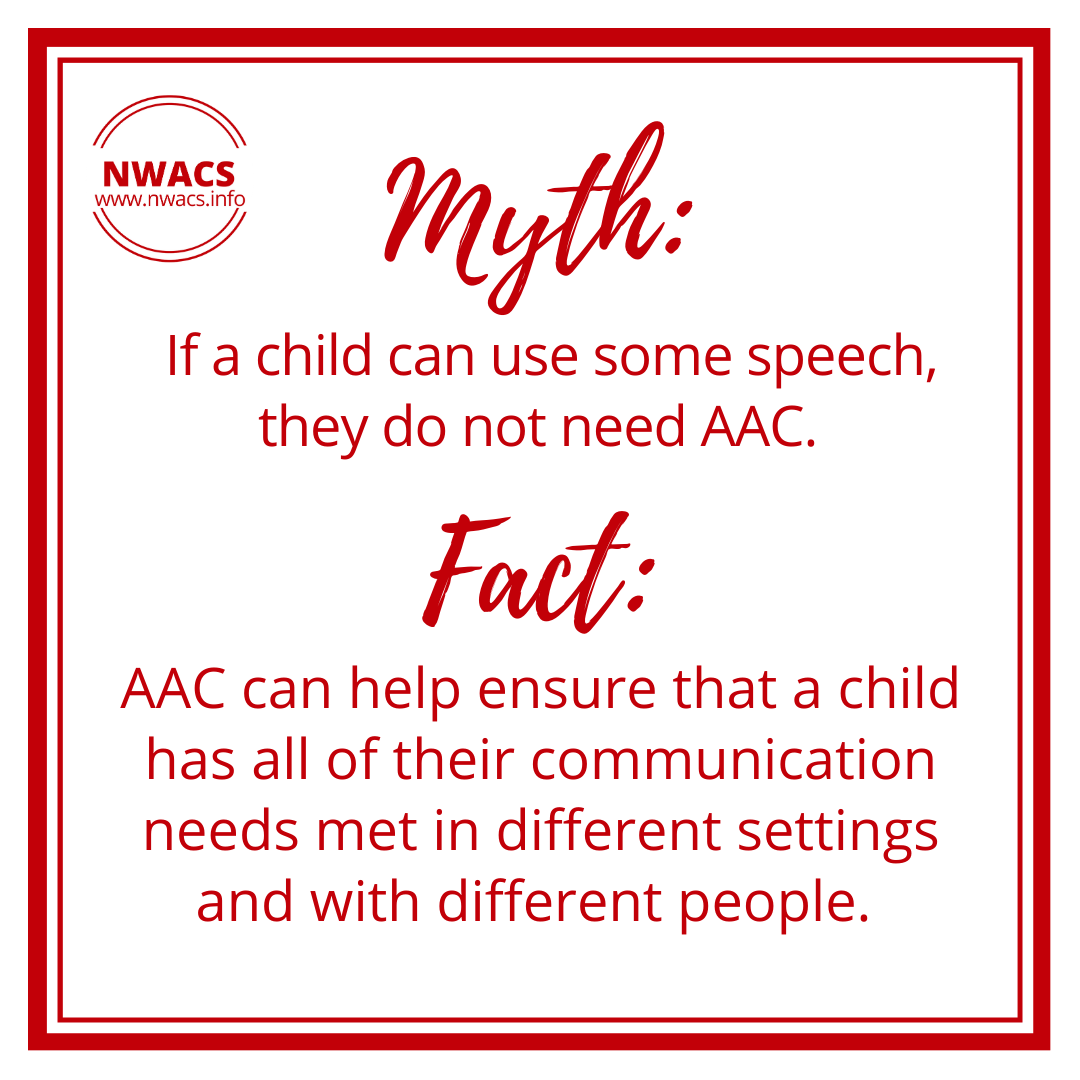
If spoken language is not meeting ALL of their communication needs, they need AAC support. If they have a diagnosis commonly associated with speech and/or language impairment, they need AAC support as soon as possible. If the child eventually develops speech that meets all of their communication needs, great! You will have given them the opportunity for language and other communication skill development as early as possible. Win-win!
Starting AAC early:
- provides many more language and communication learning opportunities
- decreases frustration and reliance on behavior to get wants and needs mete
- increases likelihood of engaging socially and experiencing success
- enhances learning and cognitive development
- supports play and literacy skills
“It is critical for an individual to not only have symbols, but also to have experiences with those symbols in a symbol-rich environment / print-rich environment. The typically-developing child will have been exposed to oral language for approximately 4,380 waking hours by the time he begins speaking at about 18 months of age.
If someone is using a different symbol set and only has exposure to it two times a week, for 20-30 minutes each, it will take the alternative symbol user 84 years to have the same experience with his symbols that the typically developing child has with the spoken word in 18 months!!!
The typically-developing child will demonstrate language competency around 9-12 years of age, having been immersed in and practicing oral language for approximately 36,500 waking hours. For 9-12 years, that child has been using and receiving corrective feedback while practicing with the spoken word.
At twice a week, 20-30 minutes each time, it will take the alternative symbol users 701 years to have the same experience.”
Jane Korsten
(2011) QIAT Listserv
Key Goals
- support speech, language, and social communication development
- use language development as a guide
- first words, vocabulary development
- morphological development
- grammar development
- moving from words to sentence
- keep gestalt language/natural language development in mind in case the child is a gestalt language processor
- targets should be
- motivating
- developmentally appropriate
- designed to increase participation
- use language development as a guide
- social connection and engagement
- caregiver training and education
What AAC Looks Like
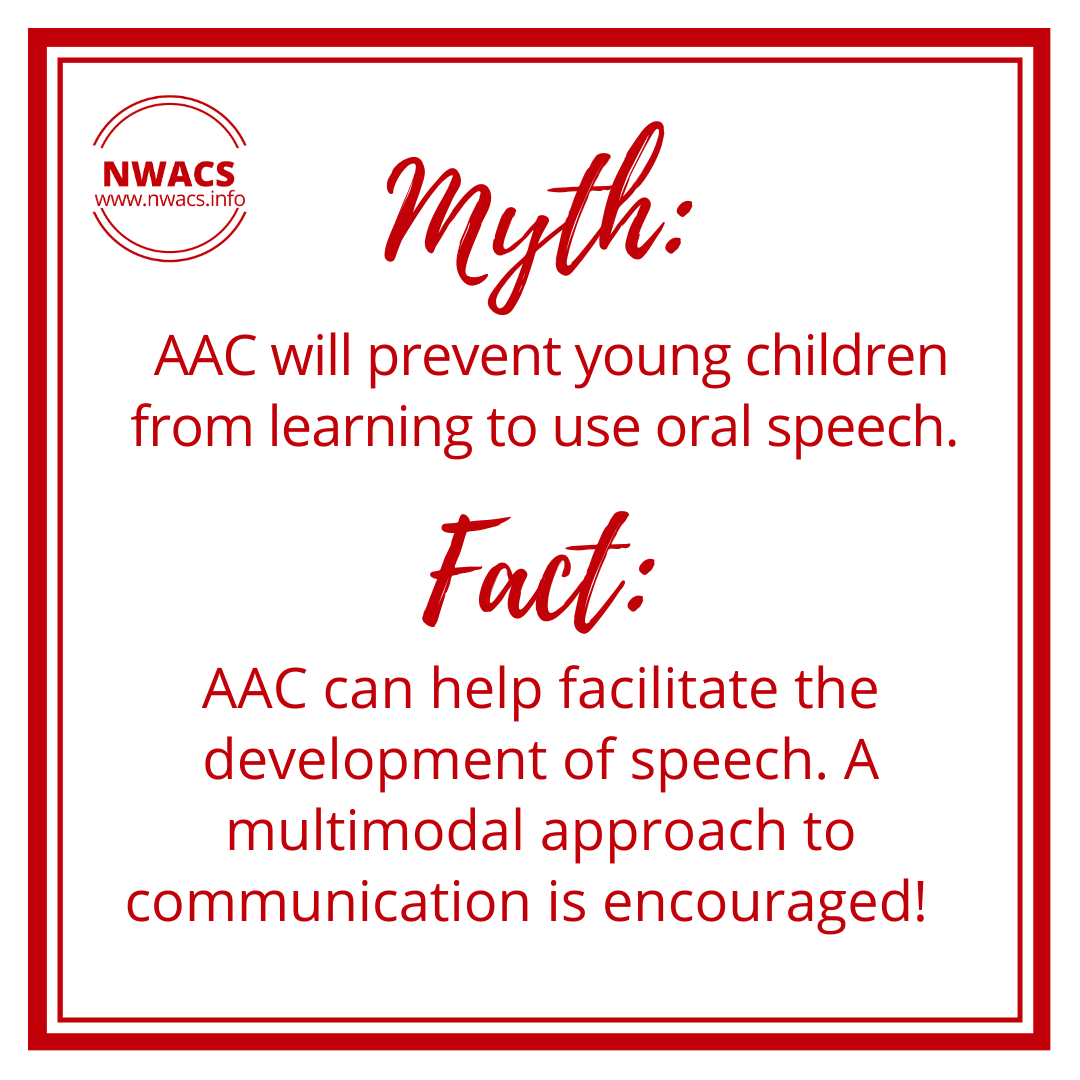
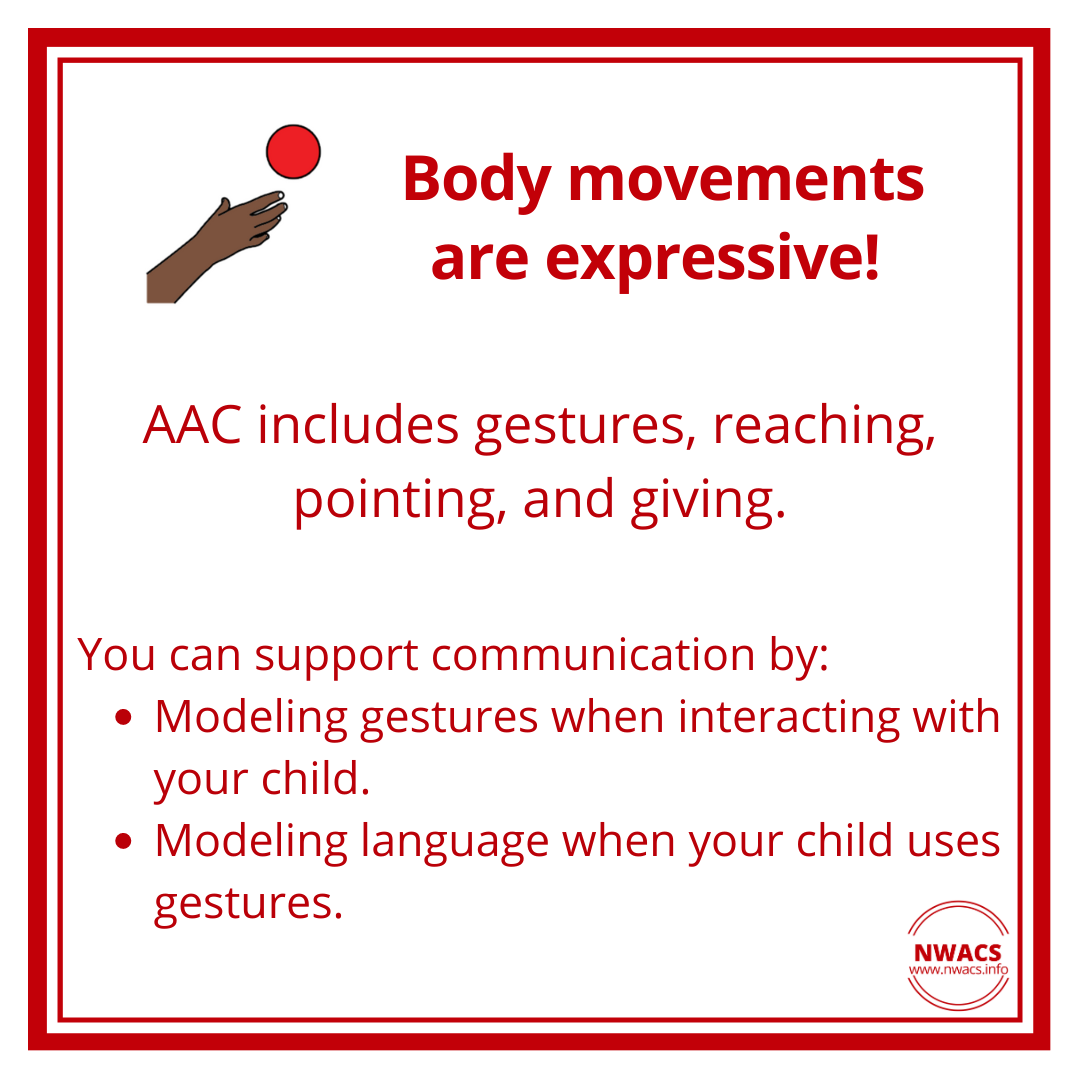
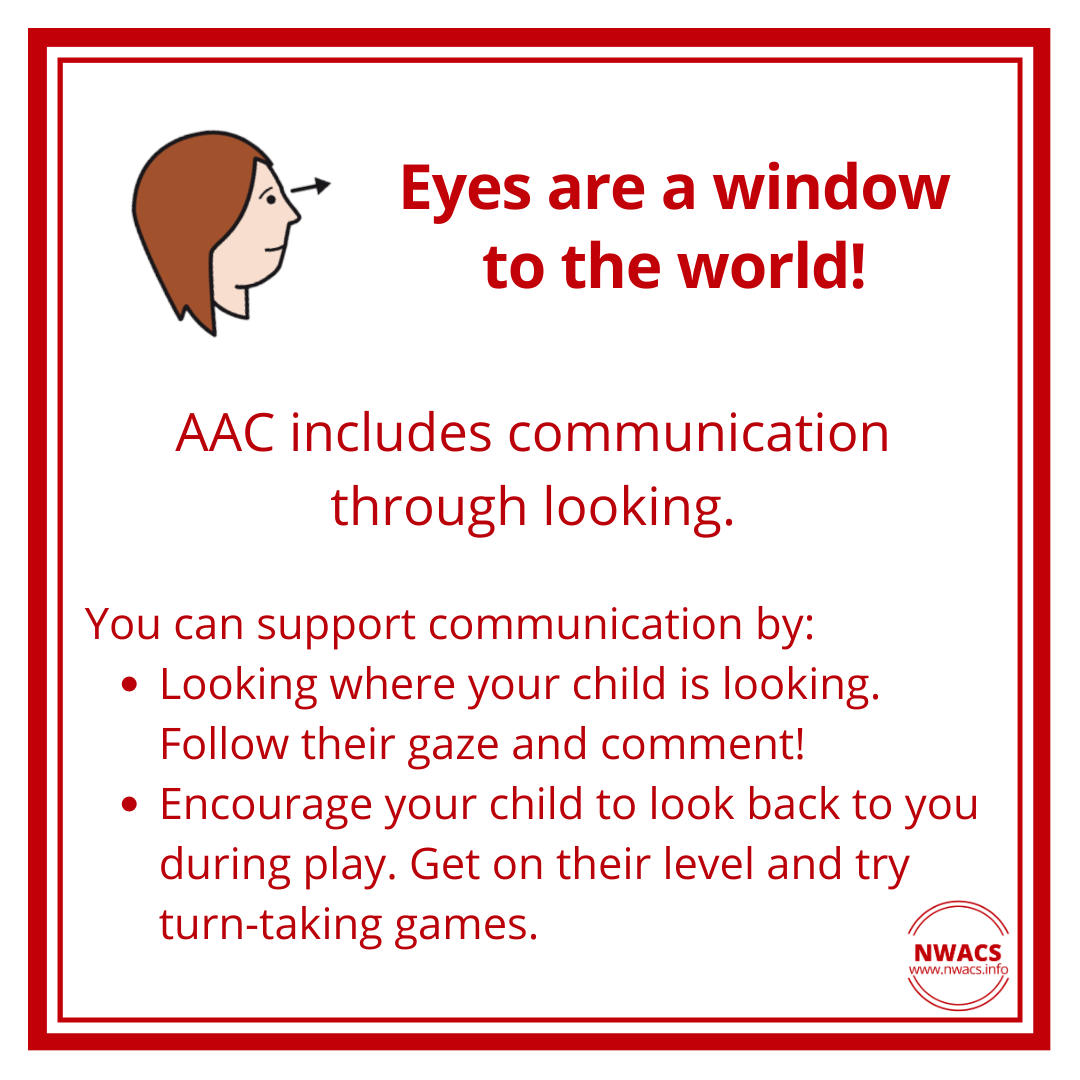
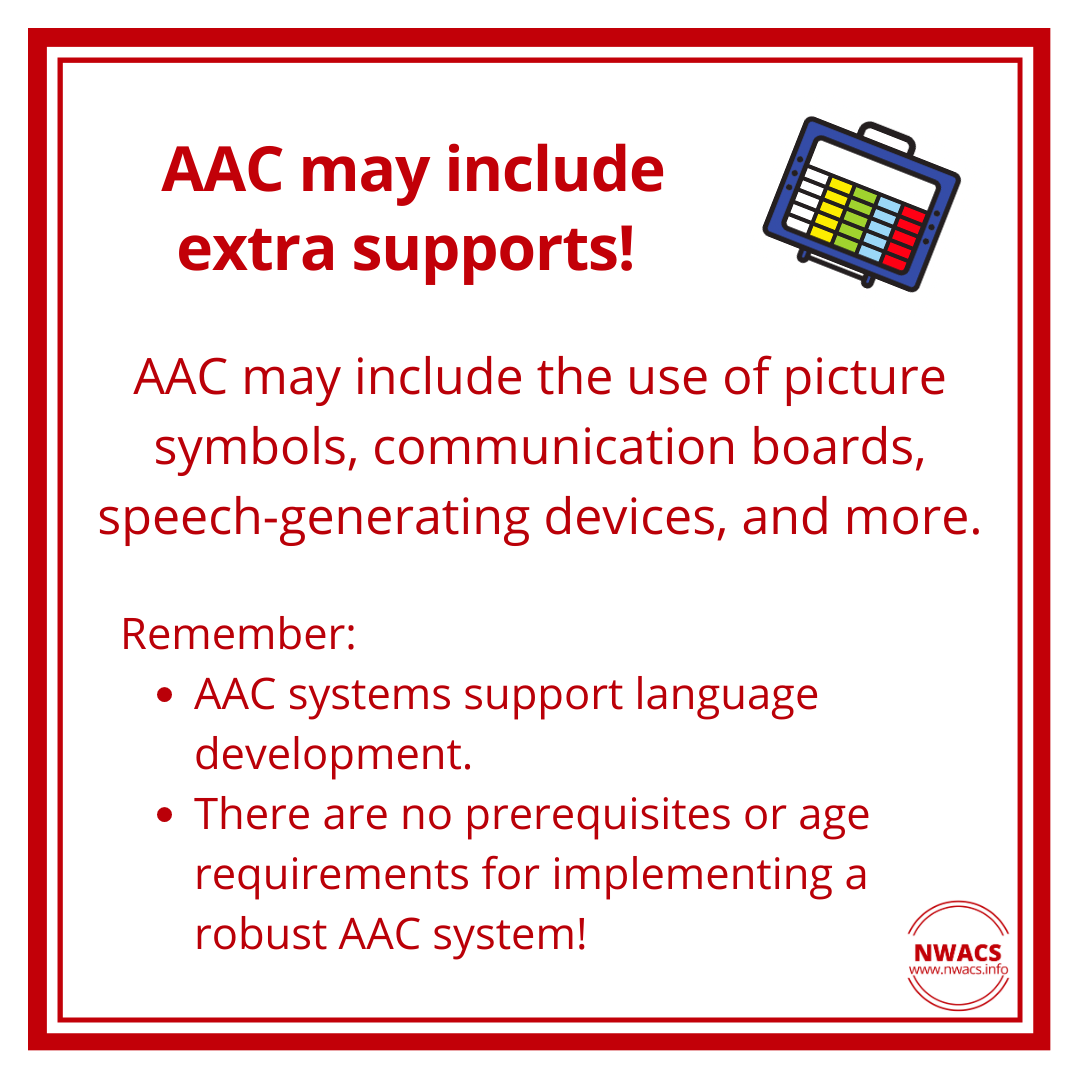
- multimodal (also see this blog post for more information about multimodal communication)
- environmental supports for communication
- able to grow with the child
- matches access and other features needed by the child
Helpful Implementation Strategies
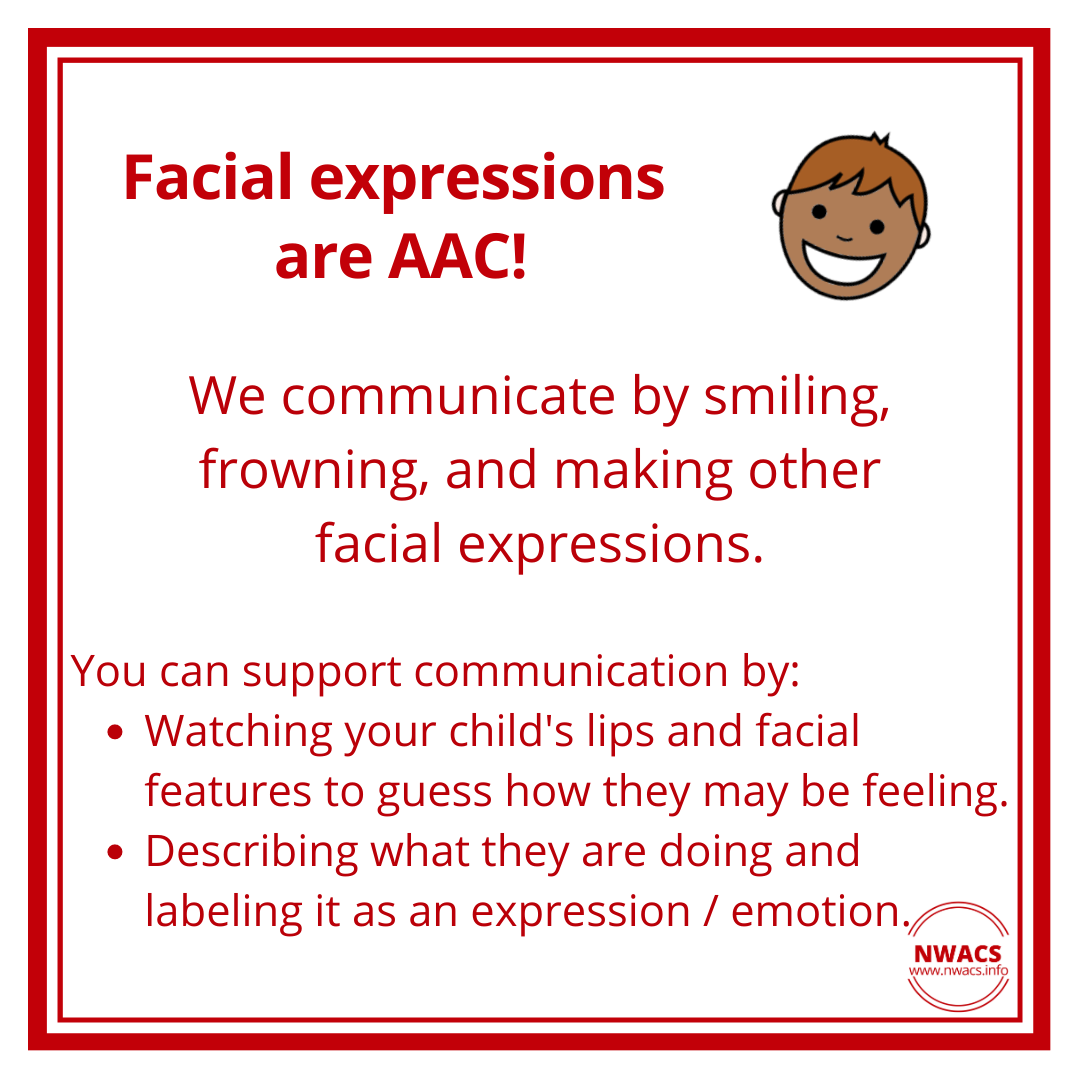
- communication partner training and support
- attribute meaning
- verbal referencing
- modeling without expectation
- create communication opportunities
- embed AAC in daily routines (motivating, repetitive, predictable)
- partner-assisted/co-constructing messages
Resources to Explore
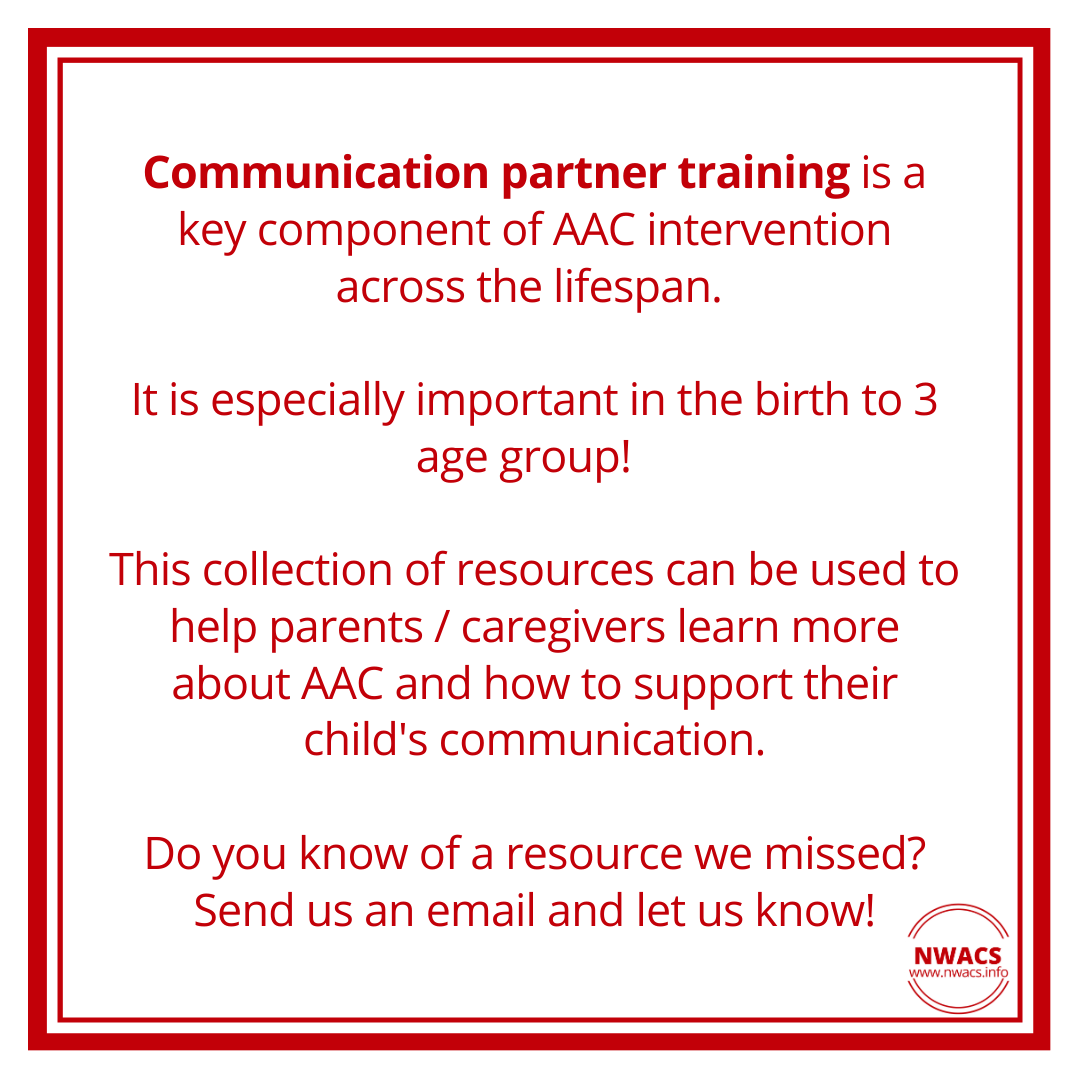
Articles, Books, and Documents
- AAC With Energy – Earlier by Beth E. Davidoff (2017) The ASHA Leader
- Augmentative and Alternative Communication: Challenges and Solutions (2021), Billy Ogletree
- Chapter 2: Earlier Is Better: Challenges to Implementing AAC During Early Intervention by Rose Sevcik, MaryAnn Romski, Casy Walters, and Gail Kaldes
- Communicating with Very Young Children Who Have Complex Communication Needs Communication Matrix Collection by Deborah Chen (2016)
- DEC (Division For Early Childhood) Conference Communication Matrix Collection by Communication Matrix Team (2017)
- Fundamentals of AAC: A Case-Based Approach to Enhancing Communication (2023), Nerissa Hall, Jenifer Juengling-Sudkamp, Michelle L. Gutmann, and Ellen R. Cohn (eds)
- Identification and Incorporation of Multimodal Play to Promote Early Communication Skills Communication Matrix Collection by Heather Reffitt (2019)
- PLAI: Promoting Learning Through Active Interaction: A Guide to Early Communication with Young Children Who Have Multiple Disabilities Communication Matrix Collection by Jennifer Hayes (2016)
- Resource Roundup: AAC in Early Intervention resource from OMazing Kids AAC Consulting on TPT (free download)
- The Importance of Merging a Normal Language Development Model with AAC Service Provision Communication Matrix Collection by Jennifer Kent-Walsh and Cathy Binger (2016)
Websites
- NWACS website
- Early Intervention for Young Children with Autism, Cerebral Palsy, Down Syndrome, and Other Disabilities website by Janice Light and Kathy Drager at Penn State
- Early intervention articles on the PrAACtical AAC website by Carole Zangari
Webinar Recordings
- AAC and Early Intervention: Getting Started webinar recording from PRC-Saltillo
- Assistive Technology / AAC in EI (Part 1 of 2): Introduction to AAC in the EI Setting webinar recording from Virginia Early Intervention Professional Development Center
- Assistive Technology / AAC in EI (Part 2 of 2): Implementation of AAC in EI webinar recording from Virginia Early Intervention Professional Development Center
- Early AACtion: Using Augmentative and Alternative Communication with the Birth to Five Population webinar recording from AbleNet U by Meghan Reitz and Cary Hastings
- How Young is Too Young webinar recording from SETC by Brenda Del Monte
- Parent-Coached Language Intervention for Toddlers and Preschoolers webinar recording from Edmonton Regional Learning Consortium (ERLC) by MaryAnn Romski and Rose Sevcik [this is part of a series of 24 webinars: Resources to Support the Complex Communication Needs (CCN) Population)
- Sparking Early Connections: High Tech AAC in Early Intervention Teletherapy webinar recording from Control Biotics by Sarah Walker and Maddie Reinlein
Other Resources
- AAC Early Starts Conference is an annual free, live, online event for supporting young children with complex communication needs
- Road Maps (Patricia Dowden, Ph.D., CCC-SLP, University of Washington; shared with permission at 2017 WSLHA Spring Workshop)
- Talking With Tech Podcast
Useful Tips
- Families/caregivers of and professionals working with young children need to be told about the option and benefits of AAC!
- Families/caregivers of and multidisciplinary professionals working with young children need training and ongoing support!
- Stay family-centered and child-centered!
- pay attention to the pace that works best for the family
- Focus on communicative intent, not how the message was communicated.
- Model communicating for a variety of communicative functions.

- Learn about prompting hierarchies, different kinds of prompts/cues, and how to fade them.
- Being proactive and starting AAC early is research-supported!
- Research indicates that various types of AAC systems can be effective with children 0-6 years across a wide variety of disabilities (including high-tech, robust systems)!
- Presume competence! Presume Potential! Believe they CAN learn!
- Find your support networks!
- Families:
- Leslie Jeanne Berns Support Group for children who have communication challenges and their families (facilitated by University of Washington Speech and Hearing Sciences clinical faculty (SLP) and graduate students; meets virtually, monthly)
- Family AAC (hosted by NWACS) – This Facebook group (administrated by NWACS) is centered in Washington State, although any parent/caregiver interested in augmentative and alternative communication (AAC) is welcome. This group is for parents and other family members of children who are non-speaking or unable to meet all of their communication needs with mouth words. While this group does center the family perspective, other AAC stakeholders are welcome in the spirit of collaboration and shared learning!
- AAC vendors and app developers have pages on various social media channels. Many also have Facebook groups that can be a good place to connect with a support network.
- also look for social media accounts and/or Facebook groups related to specific diagnoses
- and look for social media accounts of AAC users and/or parents of AAC users
- Facebook groups, such as:
- Professionals:
- NAACHO: Networking for AAC and Hangout – This Facebook group (administrated by NWACS) is for SLPs in Washington State who support people who use AAC. It is for collaboration, networking, and supporting each other in the grand adventure of augmentative and alternative communication.
- AAC vendors and app developers have pages on various social media channels. Many also have Facebook groups that can be a good place to connect with a support network.
- also look for social media accounts and/or Facebook groups related to specific diagnoses
- and look for social media accounts of AAC users
- Facebook groups, such as:
- Families:
Selected References
- Branson, D., & Demchak, M. (2009). The use of augmentative and alternative communication methods with infants and toddlers with disabilities: A research review. Augmentative and Alternative Communication. 25 (4), 274 — 286.
- Kangas, K., & Lloyd, L. (1988). Early cognitive skills as prerequisities to augmentative and alternative communicaiton use: What are we waiting for? Augmentative and Alternative Communication, 4, 211-221.
- Romski, M., & Sevcik, R. (2005). Augmentative communication and early intervention: Myths and realities. Infants and Young Children, 18(3),174-185.
- Schlosser, R., & Wendt, O. (2008). Effects of augmentative and alternative communication intervention on speech production in children with autism: A systematic review. American Journal of Speech-Language Pathology, 17, 212-230.


Share your comments or questions.